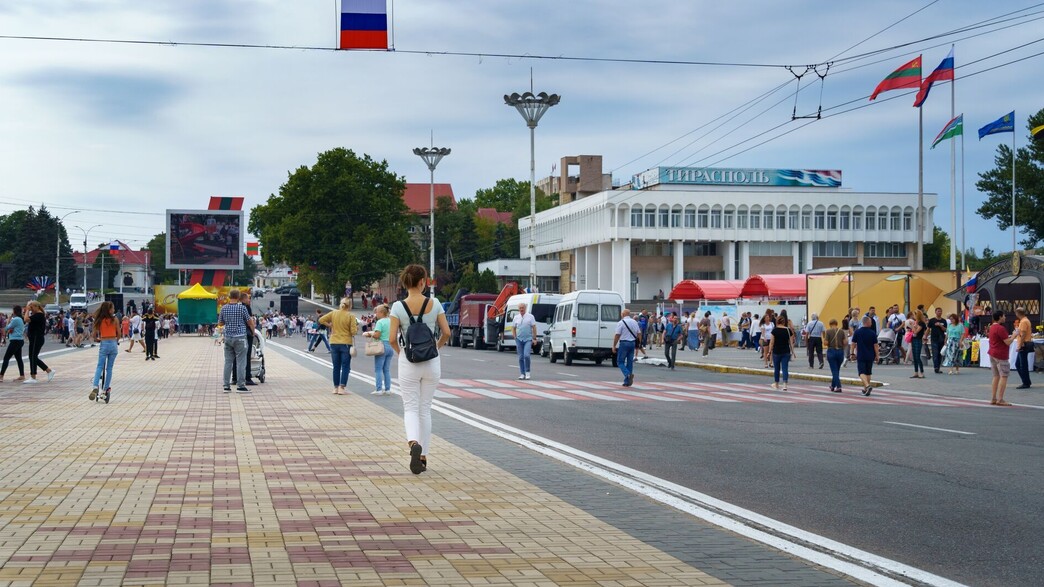
Transnistria used to be a blank spot on the map of Europe, but in recent years the narrow strip between Moldova and Ukraine has become a surprisingly viral phenomenon. Thousands of videos appear on TikTok and Instagram under the hashtag #Transnistria, in which tourists smile next to Lenin statues, flip through Putin’s postcards or dine in a “Soviet canteen” that offers an old menu from the communist era. But behind the digital enthusiasm hides one of the most mysterious and complex places in Europe, a political entity that maintains all the hallmarks of a state, but does not exist according to international law.
Soviet time capsule
Transnistria, or by its official name the Pridnestrovian Moldavian Republic (PMR), seceded from Moldova in 1990, fearing that the new country would unite with Romania after the breakup of the Soviet Union. Since then, this entity exists in a state of political limbo: it has a government, currency, police and parliament, but no country in the world recognizes its independence.
About 1,500 Russian soldiers are stationed in its territory, ostensibly as a peacekeeping force, but in practice they mark the region’s close ties to Moscow. This is how a kind of living museum of the Soviet era was created: in the streets of the de facto capital Tiraspol, statues of Lenin stand tall, communist symbols are visible everywhere, and the old signs remain exactly as they were three decades ago.
“I felt like I had entered a time machine,” said the British tiktoker Harry Tully (@exploringwithharry), whose videos about Transnistria have received hundreds of thousands of views. “Old, damp, and you can see mold on the walls, but that’s part of the experience,” he said when describing his meal in a Soviet-style canteen, where “Soviet music is playing and the smell of pickles in the air.”
Tourism figures in Transnistria are difficult to verify, the Moldovan tourism bureau refuses to publish official figures, but according to local authorities, the number of visitors has doubled in the last two years. Organized tours depart regularly from the Moldovan capital Chisinau, and Transnistria even recently published its first tourist guide in Russian and English.
There are over 5,000 videos on TikTok with the hashtag #Transnistria, showing a European city frozen in time, with Soviet architecture, old propaganda signs and clean streets. Deepak Shukla, CEO of Pearl Lemon Adventures, explains that “the world is getting tired of over-photographed destinations. People are looking for authentic places, and Transnistria feels like a parallel version of history.” According to him, “There is something strange but fascinating there. As if time stopped.”
But this popularity also raises criticism. Opponents claim that the new tourism could elevate the pro-Russian government and contribute to the spread of propaganda. “It’s not just nostalgia,” wrote a Moldovan surfer in one of the comments. “This is a detached territory that is under Russian control.”
Behind the nostalgic charm is a real danger
The German Foreign Ministry and the British Foreign Ministry currently recommend against visiting Transnistria at all, due to the proximity to the border with Ukraine and the ongoing war in the region. Visitors are required to be especially careful: do not photograph military installations, carry cash as ATMs are unreliable, and be aware that the Moldovan government cannot provide consular assistance on the territory of the separatist entity.
Despite this, there are those who believe that responsible tourism actually benefits the residents. “Most people here are not involved in politics,” says Shukla. “When travelers buy food or souvenirs, they help ordinary citizens who make a living from it.”
Despite its newfound fame on social media, Transnistria remains what French photojournalist Didier Bizet called “the forgotten republic,” a Soviet relic frozen in time. Its 375,000 inhabitants, Moldovans, Russians, Ukrainians and Bulgarians, live with a divided identity, between East and West, without a clear sense of belonging.
The local economy is almost completely controlled by a huge corporation called Sheriff, which owns a chain of supermarkets, gas stations, a football team and even media outlets. Many residents claim that the company has more power than the government itself. The war in Ukraine exacerbated Transnistria’s isolation and severely damaged the economy: gas supplies from Russia became irregular, factories were closed, and relations with Moldova, whose pro-European leader is trying to distance itself from Russian influence, became even more tense.
Shadows from the Past: The Jewish History of Transnistria
Long before Tiktok discovered the place, this area bore one of the darkest chapters of the 20th century. During the Second World War, the area between the Dniester and Southern Bug rivers, then administered by Romania under the name “Government of Transnistria”, became a scene of mass murder.
Between 280 thousand and 380 thousand Jews were murdered in this area by the army of Romania, Germany and their allies. Tens of thousands of Jews in Serbia and Bukovina were deported to Transnistria and placed in ghettos and camps such as Bogdanovka, Domenavka and Shargorod, where they died of hunger, cold and plagues.
In October 1941, the Odessa massacre occurred, in which tens of thousands of Jews were murdered following the orders of the dictator Ion Antonescu. Survivors called the entire area a “death trap”. Despite the inhumane conditions, the expelled Jewish communities established internal aid organizations that tried to provide food, medicine and education. With the help of Jewish activists in Bucharest, such as Wilhelm Filderman, aid packages were delivered that allowed some of the survivors to survive.
The Antonescu regime inconsistently required Jews to wear the yellow star during the Holocaust. It was temporarily enforced in certain places (especially those recently reconquered) in Romania in 1941 & more often demanded in Romanian-occupied Transnistria from 1942 to 1944. pic.twitter.com/JnoHAvyLof
—Dr. Grant T. Harward (@GHarward) January 17, 2024
With the liberation of the area by the Red Army in 1944, only about 55 to 60 thousand Jews remained alive. After the war, under Soviet rule, most of them left first to other cities in the Soviet Union and later to Israel and the West. Today, the Jewish community in Transnistria numbers only about 2,000 people, most of them very elderly, but the synagogues and community centers in Tirspol and Bender continue to operate and preserve the memory of the community that was lost.