A lost beluga whale in the Rhine, spotted near Leverkusen! This was a media sensation in Germany in 1966, as a black and white film in the exhibition “Nature and German History” in the German Historical Museum (DHM) shows. And because the whale develops a skin rash in front of everyone on its journey through Father Rhine’s fresh water, which is contaminated with household and industrial wastewater, the beluga becomes a warning sign for environmental destruction.
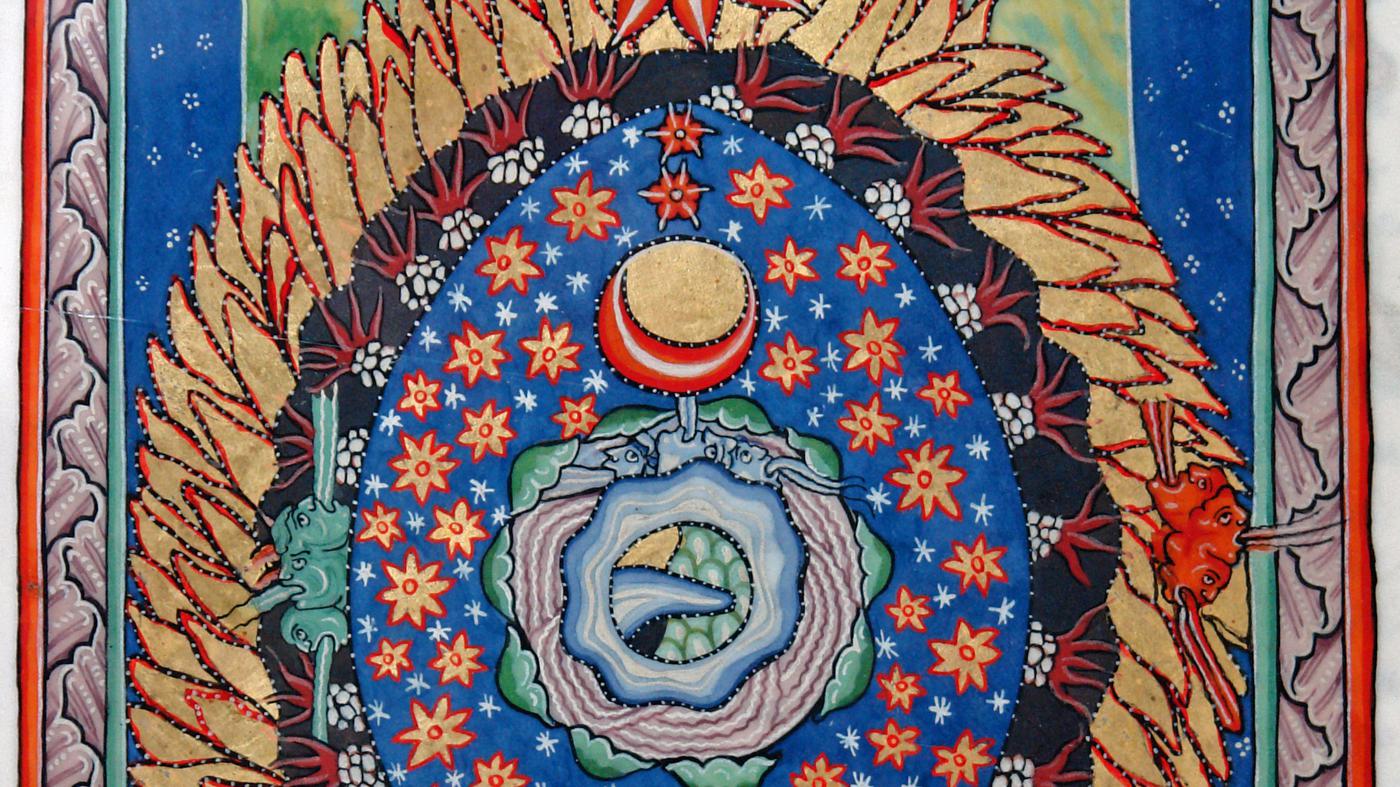
Human civilization’s overexploitation of rivers, forests and landscapes, which the scholar and visionary Hildegard von Bingen also complained about in the Middle Ages. The only difference is that the opposite term “environmental protection” only emerged in the 1970s. When the Benedictine nun Hildegard von Bingen founded the Rupertsberg monastery in the 12th century and developed her teachings about the divine “green power,” not even the term “nature,” borrowed from Latin, had yet reached German. This only happens 200 years later, as we find out in the DHM.
The show, curated by Julia Voss, covers around 800 years of German perception and instrumentalization of nature – to put it bluntly, from Bingen to Beluga – in easily consumable snippets of its huge topic, whose religious, cultural, biological and political charges should actually blow the roof of the Pei building.
What is nature, what is natural?
Last year, the DHM held a symposium on questions such as “What is nature? What is natural? And what changing ideas and concepts of nature shape German history?” prepared, as museum director Raphael Gross states at the beginning of the tour.
© Prussian Palaces and Gardens Foundation Berlin-Brankenburg, Roland Handrick
This concept has now become two dozen case histories, the so-called historical windows. In five chronologically structured rooms, they highlight events and upheavals that shape the respective concept of nature at the time. And so that the rooms, which are dressed in overly muted shades of green, also offer a few sensual stimuli, there are symbolic animals and plants.
The wolf is ravaging Europe
In the “Middle Ages” it is a white dove, which for Abbess von Bingen symbolizes the Holy Spirit. In the “early modern period” there is a specimen of an Indian peacock with a magnificent blue shimmering neck, which tells of the rise of the Fugger trading family, and a she-wolf, which represents the devastation of Europe caused by the Thirty Years’ War.
© German Historical Museum/Carl Wilhelm Ernst Putsche
In the course of this great slaughter in the 17th century and the epidemics it caused, the population fell drastically, but the wolf population grew in the devastated areas. The wild animal becomes a war profiteer. Writings from the time even show war as a monster with a wolf’s head; the animal serves as a synonym for its brutal violence.
In view of such attributions, it seems unintentionally strange that the taxidermists have decorated the she-wolf, which died in a motorway accident near Magdeburg in 2012, with branches and forest floor in their display case. True to the romanticized ideal of a nature that knows no highways.
© German Historical Museum/Waldemar Bonsels
It’s a good thing that in the Anthropocene there are not only disastrous examples of the broken relationship between humans, animals and plants, but curator Voss also provides beautiful examples of careful nature management such as the amazing “Lake Constance commons”. There, in the late Middle Ages, monasteries, counts and free imperial cities managed to keep the lake’s fish population stable for centuries with fishing regulations engraved in bold letters.
Myth of the German forest
As far as the interaction between nature and politics is concerned, the 19th century, with the strengthening of the German national movement, is only topped by National Socialism in the 20th century. Although the national movement idealized the “German forest” as the natural origin of a common identity, this did not detract from the overexploitation of nature dictated by the industrialization that began around 1830. What’s more, the two belong together. A magnificent painting of “Germania” crowned with oak leaves speaks of these nationalist charges, as does the thick tree slice of an English oak that stood in Berlin’s Tiergarten for 150 years.
© German Historical Museum
The romantic myth of the German forest, to which the DHM dedicated an exhibition in 2011, also includes the belief in green “naturalness” as understood by the reform movement. One of its representatives is the educator Friedrich Fröbel, who founded the first kindergarten in 1840. The idea of education in the countryside, which found supporters worldwide, was promptly banned by the Prussian authorities. Fröbel’s concept seems too revolutionary and atheistic to them. It takes twenty years until kindergartens become legal in Prussia.
The Nazis ideologize nature
Nobody in Germany has ideologized nature as rabidly as the National Socialists, who form the heart of the darkness of “Nature and German History”. Their concept of nature and their ideas of “German landscapes” based on exclusion resulted in the “Reich Nature Conservation Act” in 1935, which was passed in the same spirit in the same year as the “Nuremberg Laws”. In the major motorway construction project, “landscape lawyers” ensure that the road is curved and the edges are planted with “German plants” such as gorse.
© Bernd Nössler
In divided post-war Germany, both in the economic miracle West and in the socialist East, industrial animal production and landscape utilization for the purpose of energy production are going full steam ahead. What remains are acidified opencast crater landscapes and beluga whales with rashes.
An example of the environmental protection movement spurred on by this development is the anti-nuclear movement in Wyhl, Baden, where winegrowers, farmers, pastors and academics successfully defended themselves against a nuclear power plant in 1973. Hans-Dietrich Genscher from the FDP had already institutionalized a “U” department for “environmental protection” in the Ministry of the Interior in 1969.
You learn all this and more in “Nature and German History,” but in such a fragmentary way that you feel simultaneously overwhelmed by the abundance and undernourished by the sketchiness of the case histories. The exhibition deserves significantly more space and a more sensual design. A flower smelling station at Hildegard von Bingen and a touch station about the development of the silk moth seem meager when it comes to this dazzling topic.
And the folios, paintings, graphics, globes and objects on display, 250 of them, are arranged too neatly in a museum style. In view of a present that is increasingly marked by global warming, it seems like a wasted opportunity, even fainthearted, for such a prominent museum to content itself with a distant, overhead view of the changing meaning of nature. And conveniently locates it in the historical. Today’s typhoons, floods and droughts shape tomorrow’s understanding of nature.