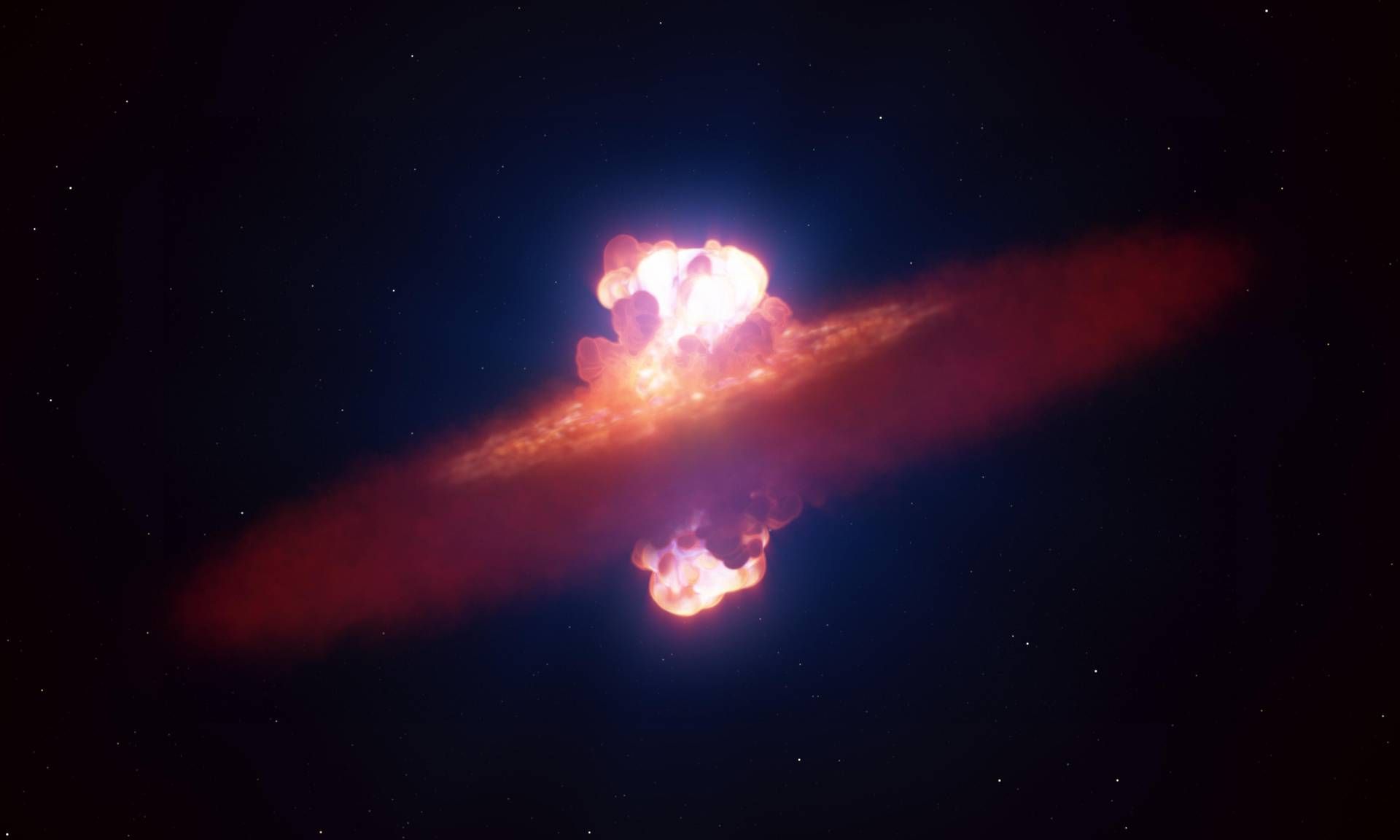
Astronomers at the European Southern Observatory (ESO) have used VLT spectropolarimetry to capture the initial, fleeting geometry of a red supergiant star’s shock breakout, rewriting theoretical models.
A new and revolutionary observation, conducted with the Very Large Telescope (VLT) of the European Southern Observatory (ESO), allowed astronomers to reveal the explosive death of a star at the precise moment the blast shock wave made its way across its surface. For the first time ever, the shape of a supernova explosion in its early phase has been revealed, an observational window that would vanish in less than a day.
The supernova SN 2024 today, located in the galaxy NGC 3621 (“only” 22 million light years away, in the direction of the constellation Hydra), was detected on the night of April 10, 2024. The international team, led by Yi Yang, assistant professor at Tsinghua University in Beijing, acted with exceptional promptness. After an accelerated approval process, the VLT in Chile was pointed towards the explosion just 26 hours after the initial detection.
The location of supernova SN 2024 today in the galaxy NGC 3621. It was taken on April 11, 2024, just 26 hours after the supernova’s initial detection. The image was obtained with the FORS2 instrument installed on ESO’s Very Large Telescope (VLT). Among other capabilities, FORS2 allows you to obtain spectra in polarized light. This technique, called spectropolarimetry, provides crucial information about the shape of the explosion even if it appears as a single point when viewed from Earth
. Credit: ESO/Y. Yang et et al.”
Spectropolarimetry: the technique that revealed hidden geometry
The occasion was exceptionally rare, since the initial phase of the breakout lasts a few hours. The progenitor of SN 2024ggi was a red supergiant, with a mass estimated between 12 and 15 times that of the Sun.
Dietrich Baade, astronomer at ESO in Germany and co-author of the study published today on Science Advancesexplained the meaning of timeliness: “The first observations from the VLT captured the phase in which matter accelerated by the explosion, near the center of the star, escaped through the stellar surface. For a few hours, the geometry of the star and its explosion could be, and were, observed together.”
To penetrate the geometry of the explosion, the team used a technique called spectropolarimetry, employing the FORS2 instrument installed on the VLT, the only facility in the Southern Hemisphere capable of such measurement.
Lifan Wang, co-author and professor at Texas A&M University, clarified the effectiveness of the method: “Spectropolarimetry provides information about the geometry of the explosion that other types of observation cannot provide because the angular scales are too small.”
Artist’s impression of a star about to explode into a supernova. Credits: ESO/L. Calçada
The “olive” shape and implications for stellar models
By analyzing light polarization data, astronomers discovered that the initial jet of ejecta was olive-shaped, strongly directed above and below the star. Although this shape flattened as the explosion expanded and interacted with surrounding material, the axis of symmetry remained unchanged.
This result provides a crucial clue about the exact mechanisms underlying the explosive death of massive starsa topic that is still hotly debated. Yi Yang summarized the importance of the discovery: “The geometry of a supernova explosion provides fundamental information about stellar evolution and the physical processes that lead to these cosmic fireworksi.” And he concluded on the meaning of the geometric finding: “These results suggest a common physical mechanism driving the explosion of many massive stars, which exhibits a well-defined axial symmetry and acts on a large scale.“, secondo Yang.
This knowledge now allows astrophysicists to rule out some of the supernova models currently in use and to refine existing ones. Ferdinando Patat, co-author and ESO astronomer, concluded by underlining the value of international collaboration: “This discovery not only reshapes our understanding of stellar explosions, but also demonstrates what can be achieved when science transcends boundaries. It’s a powerful reminder that curiosity, collaboration and quick action can unlock profound insights into the physics that shape our Universe.”