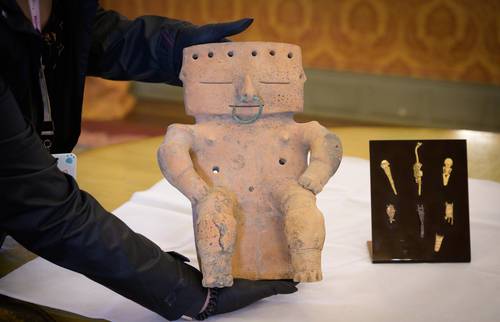
The United Nations Educational, Scientific and Cultural Organization (UNESCO), which established November 14 as the International Day Against Illicit Trafficking in Cultural Property, seeks to raise public awareness about the scope of heritage theft and its consequences, through its Virtual Museum of Stolen Cultural Objects.
The site: museum.unesco.org, which was presented at Mondiacult 2025, includes around 250 objects from 46 countries representing all the traditions of the world.
The museum offers an immersive experience in which the visitor can tour digital rooms from anywhere in the world that house three-dimensional reproductions of works and artifacts stolen from sites, temples and archaeological sites. Through these reconstructions, the project seeks to symbolically restore the memory of lost property and raise awareness about the impact of cultural looting on the communities of origin.
Among the objects on display are a Zambian ritual mask, a Palmyra pendant and a painting by the Swedish painter Anders Zorn, as well as a painting of dancers and another of the Immaculate Virgin, among other looted items.
The project, designed by Burkinabe architect Francis Kéré, winner of the 2022 Pritzker Prize, seeks to raise people’s awareness on the issue of illicit trafficking of cultural property.
The UNESCO proposal, in collaboration with Interpol, presents stories, testimonies and photographs that accompany each missing object.
One of the long-term purposes is to empty the Gallery of Stolen Cultural Property and fill the Returns and Restitution Room.
The goal is for the museum to close when all objects are returned to their communities.
The Virtual Museum of Stolen Cultural Objects proposes an urgent reflection on collective memory, international responsibility and the role of culture in the reconstruction of human ties.
The 1970 UNESCO Convention, with 143 States Parties, continues to be a reference to establish actions and guide global cooperation against the illicit trafficking of cultural property.
This agreement investigates, safeguards and protects more than 82,300 historical monuments, architectural complexes and real estate with cultural value that are susceptible to theft.