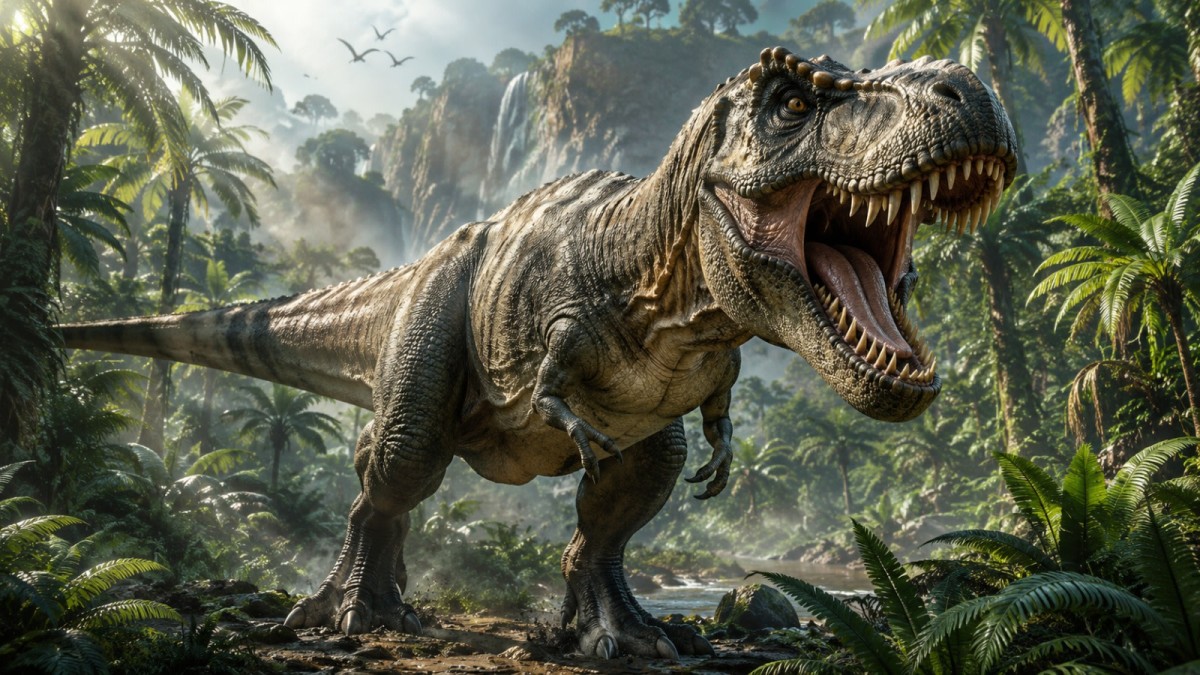
The new species described in the study is estimated to have reached a length of about 7.5 to 13 meters, that is, up to about 43 feet. This is one of the largest mosasaurs known so far. The researchers note that it was larger than the species Tylosaurus proriger to which some of the fossils were previously attributed. The differences were not limited to size. Tylosaurus rex had serrated and fine teeth, an uncommon feature among mosasaurs, and may indicate a particularly effective ability to cut or grip prey.
The fossils examined were not only larger, but also geologically younger. Most of the known Tylosaurus proriger fossils come from the Kansas area and date to about 84 million years BC. The new fossils, mostly from Texas, are younger than them by about 4 million years. In the eyes of the researchers, the difference in time, place and body structure was enough to justify the description of a new species.
One of the main fossils on which the research was based is a large skeleton displayed at the Peru Museum in Dallas. It was discovered in 1979 near an artificial reservoir near Dallas, and has now been designated as the reference specimen of the new species. In other words, this is the fossil upon which the new scientific name rests. Other famous fossils, until now considered Tylosaurus proriger are expected to be reclassified as Tylosaurus rex.
One of the intriguing findings in the study is evidence of violence between individuals of the same sex. A fossil known as the “Black Knight” is kept in the Peru Museum. He is missing the tip of his snout and suffers from a fractured lower jaw. According to the researchers, the type of injury and its intensity are particularly suitable for a confrontation with another individual of the same species. In other words, this giant carnivore not only hunted other animals, but may also have fought with its own kind, perhaps for territory, food or reproduction.
Beyond the public curiosity aroused by the name T. rex, the importance of the research is broader. The researchers note that the work reveals a familiar problem in paleontology: Old fossils, collected decades ago and defined once, can remain for years under an inaccurate label. Only a re-examination, combined with up-to-date comparison methods, sometimes makes it possible to identify new species that were hidden in plain sight in drawers and showrooms.
The study also dealt with the evolutionary tree of the mosasaurs. According to the researchers, the databases used for years to analyze the relationships between the species have changed relatively little over almost three decades. As part of the new work, a more updated data set was assembled, which should help re-examine the kinship relationships between tylosaurs and other mosasaurs. This means that the discovery not only adds a new name to the list of ancient animals, but may change the way scientists understand the evolution of ancient marine predators.
The fact that such a species has been discovered in Texas also highlights the importance of the area for understanding ancient marine ecosystems. 80 million years ago Texas was not just a warm continent, but part of a rich and complex marine environment. Within this sea, Tylosaurus rex was probably one of the top predators. He wasn’t a dinosaur, and he wasn’t a relative of the terrestrial T-Rex, but in terms of image, dimensions and primal terror, it’s hard to think of a more successful marketing name than him.
https://www.successcenter.com/pro/20250925235507
https://zumvu.com/der-hauptling/
https://bookmark-template.com/story28844679/independent-investor-reviews-experiences
https://www.sitelike.org/similar/findas.org/
https://www.startus.cc/company/falkordb
https://www.slideserve.com/falkordb
https://hedgedoc.schule.social/s/kXrZrDIXs_
https://www.wealthbadge.com/mastering-online-trading-with-metatrader-5-webtrader/
https://mapacultural.ap.gov.br/agente/775054/#info
https://www.hashtap.com/@trading/trade-stock-indices-with-cfds-and-hedge-your-portfolio-2WwOxd0Nygmk
https://hackmd.k15.synology.me/s/VV1ym8MXf
https://www.trepup.com/store/zoidii/profile
https://worldofholisticarchitecture.com/como-saber-si-una-pared-es-de-carga-antes-de-reformar/
https://dadosabertos.ufersa.edu.br/user/poddescartavelcomnicotina
https://www.accea-finance.com/how-do-you-know-which-etfs-are-the-best-to-invest-in/
https://md.coredump.ch/s/IYtK4oUs3
https://myturbotaxlogin.com/cfds-and-tax-what-every-trader-needs-to-know/
https://www.pexels.com/es-es/@falkordb-2158156184/
https://internetlifeforum.com/showthread.php?18022-Which-Website-has-the-Best-Affiliate-Process
https://the-dots.com/pages/zoidii-835013
https://dailymagazinenews.com/how-to-trade-index-cfds/
https://md.picasoft.net/s/P1QVvYeivR
https://hedgedoc.musikinformatik.net/s/tk6HJp7GS
https://md.mandragot.org/s/end0M1JCGQ
https://www.quora.com/profile/FalkorDB