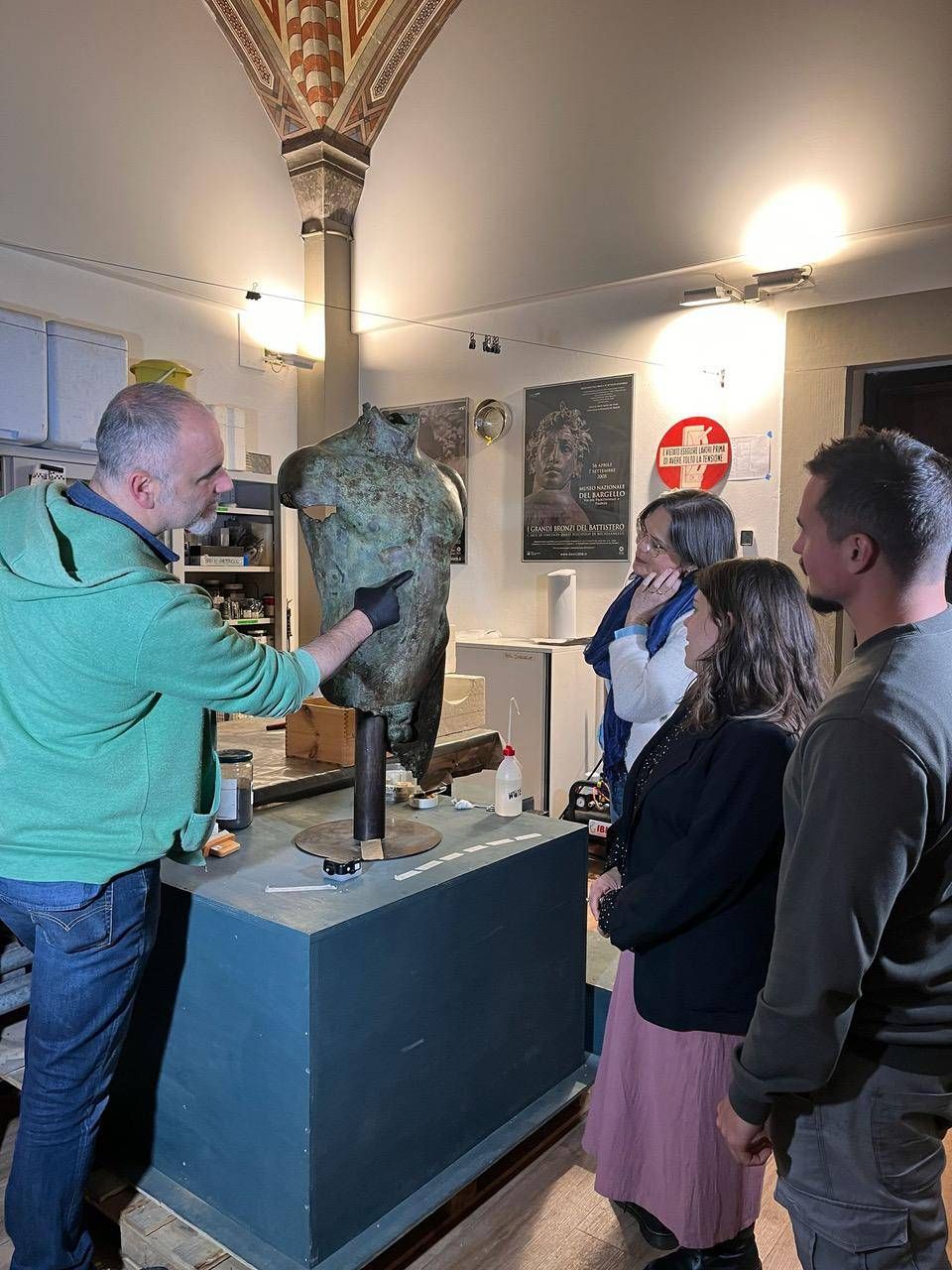
The famous “Torso di Livorno”, an extraordinary bronze sculpture belonging to the Great Bronzes of the Medici Collections, can now be visited again at the National Archaeological Museum of Florence after a long work which saw it as the protagonist of a complex restoration project, technological study and advanced scientific investigation coordinated by Italian and international specialists.
The conservative intervention, which began in 2024, was possible thanks to the support of the Friends of Florence, the professionalism of the restorer Nicola Salvioli and the foresight of Mario Iozzo, then at the helm of the Museum. The restoration, particularly complex due to the variability of the surface and the conservation criticalities of the work, was accompanied by an analytical study of the metal alloy and the manufacturing techniques.
“It was an exciting investigation – comments Daniele F. Maras, director of the National Archaeological Museum of Florence – in which the skills of different scientific and humanistic disciplines were intertwined in the name of restoration, to tell the very long history of the ancient bronze, from its creation to its stay under the waters of the sea up to its exhibition in the grand ducal collections, then in the museum. A team work between many specialists that highlights the active role of the museum as a center of research and knowledge on the archaeological heritage; but also a new and precious collaboration with the Friends of Florence, which strengthens the relationship between the collection and its most generous and passionate public”.
“With the restoration of the Torso di Livorno, Friends of Florence is pleased to renew its collaboration with the National Archaeological Museum of Florence – announces Simonetta Brandolini d’Adda, president of Friends of Florence – supporting a project that has been able to combine conservation, research and scientific analysis. An intervention that has restored legibility and stability to the work and has allowed us to delve deeper into its history, materials and executive technique. We are deeply grateful to Messrs. Lauri and Michael Corliss: thanks to their generous donation, Friends of Florence was able to support and make this important project possible, contributing to the protection and valorization of a work that today can tell the public an even richer and more complete story. Our thanks also go to all the museum staff for their precious collaboration and to Nicola Salvioli who oversaw the restoration of the work by coordinating a complex and innovative diagnostic and research process”.
Numbered among the Great Bronzes of the museum, the Torso was part of the Medici collections since the time of Cosimo I (1537-1574) and was already among the most representative works of the Gallery in the famous painting The Uffizi Tribuna (1772-1778) by Johann Zoffany. Its origin remains still shrouded in mystery. In the past, people questioned whether it was a Greek original or a Roman copy, whether it had really been found off the coast of Livorno or whether it had always belonged to the Medici galleries. What is certain, as also emerged from the analyzes of the restoration, is that the work had a long stay underwater.
Like many other bronzes from the ancient Medici collections, the Torso was also covered with thick dark surface coatings, the so-called “Lorraine patinations”, which were essential to remove in order to intervene on the corrosion of the metal alloy. Thus the variations in color of the metal surface were brought to light, furthermore the restoration made it possible to accurately map the pieces and residues of shells and marine concretions present inside the sculpture.
To investigate the numerous questions still open about the work, a vast diagnostic campaign was launched which involved the use of non-invasive and micro-invasive techniques aimed at studying the metal alloy and its alteration processes. Furthermore, already in June 2024 the Torso was subjected to advanced analyzes at the Institute Laue-Langevin (ILL) in Grenoble, France: for the first time the neutron imaging technique (used to penetrate dense materials) was applied to a bronze sculpture of monumental dimensions.
The restoration represented an important opportunity for research and scientific study, the results of which will be illustrated during a day of studies scheduled for Thursday 17 September at the Florentine museum.
In addition to the restoration, Nicola Salvioli also oversaw the design of the new exhibition support of the sculpture, conceived to guarantee greater structural stability, a more correct distribution of loads and a better aesthetic rendering of the work.
After spending the summer at the Archaeological Museum, in fact, from 25 September the bronze will be part of the large exhibition at Palazzo Strozzi in Florence entitled “Broken. The power of the fragment”, scheduled until 24 January 2027: a large exhibition that will investigate the theme of the fragment from archeology to contemporary art.
“The restoration of the Torso di Livorno represents an opportunity to valorise and return to the public a work of extraordinary significance, which will be part of the major Palazzo Strozzi exhibition ‘Broken. The power of the fragment’ (25 September 2026 – 24 January 2027) – declares Arturo Galansino, General Director of the Palazzo Strozzi Foundation – A result made possible thanks to the precious support of Friends of Florence, which supported the restoration campaign, and the collaboration with the Museum National Archaeological Institute of Florence, whose loan of the work renews and strengthens the dialogue between the city’s cultural institutions”.
http://sayara.parts/catalog/ford/focus
https://sayara.parts/catalog/audi
https://sayara.parts/catalog/audi/a4-allroad-quattro
https://sayara.parts/blog/best-engine-oil-for-hot-climate-in-dubai
https://sayara.parts/blog/how-to-prepare-your-car-for-hot-weather-a-step-by-step-guide
https://sayara.parts/catalog/lexus
http://sayara.parts/blog/3-plus-1-on-premium-idemitsu-oils
https://sayara.parts/blog/car-overheating-in-dubai-why-and-how-to-fix
https://Baltimoremarijuana.clinic
https://Baltimoremarijuana.clinic/telehealth
https://Baltimoremarijuana.clinic/about
https://ColumbiaMDmarijuana.clinic/
https://ColumbiaMDmarijuana.clinic/telehealth
https://ColumbiaMDmarijuana.clinic/about
https://germantownmarijuana.clinic/
https://germantownmarijuana.clinic/telehealth
https://germantownmarijuana.clinic/about
https://SilverSpringmarijuana.clinic
https://SilverSpringmarijuana.clinic/telehealth
https://SilverSpringmarijuana.clinic/about
https://Frederickmarijuana.clinic
https://Frederickmarijuana.clinic/telehealth
https://Frederickmarijuana.clinic/about
https://Charlottemarijuana.clinic/
https://Charlottemarijuana.clinic/telehealth