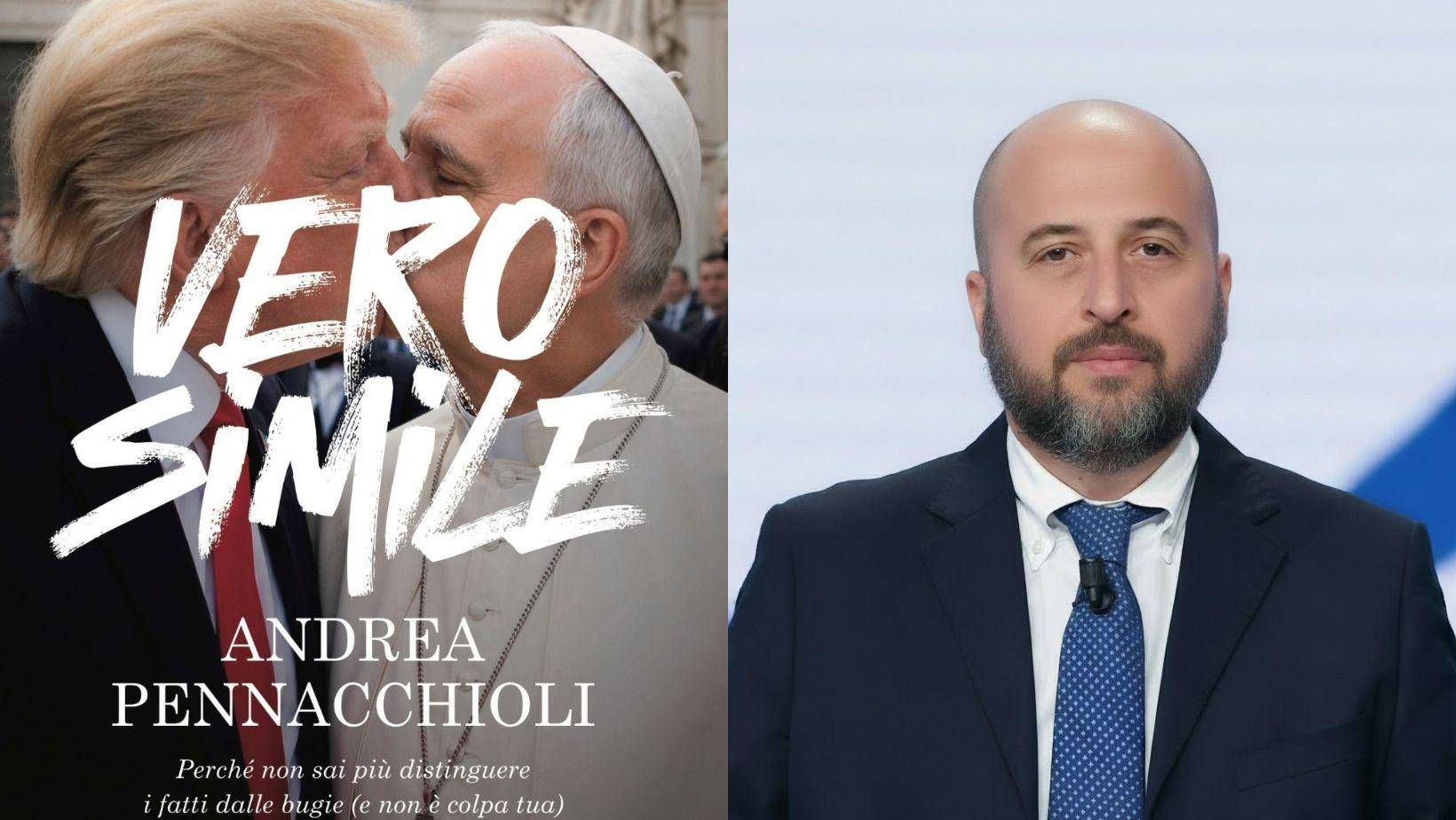
Reality has become a terrain of manipulation, spectacle and emotional consensus. The true and the plausible are confused. The boundaries of certain, confirmed and verified news are increasingly blurred. It’s from here that Andrea Pennacchioli, journalist and television author, begins his essay ‘Likely. Because you no longer know how to distinguish facts from lies (and it’s not your fault)’ on shelves from June 19th with Countries Editions. A wide-ranging reflection in which Pennacchioli, who works at TgLa7 and is among the hosts of Omnibus, the network’s historic morning talk show, actually proposes a lucid and ruthless journey into the great transformation of contemporary public debate and communication itself. An itinerary that moves from hoaxes passed off as truth to the incredible return of Donald Trump, from the power of technocrats to the weakness of politics, up to the polarization produced by social networks and artificial intelligence.
“State hoaxes – he writes in the preface Enrico Mentana, director of Tg La7 – they cannot resist, those put into circulation from below can. And not only since the web existed: for more than a hundred years, anti-Semites from all over the world have been using and exhibiting the Protocols of the Elders of Zion, created by the tsarist secret police. While the constructions for social use of fake images which would like to demonstrate, for example, that while the Ukrainian population resists and the men go on the massacre against the Russians, Zelensky’s wife goes around shops and fashion houses in Paris spending a fortune, documented by false invoices and non-existent assistants, are absolutely of today – and are real weapons of war. Many will continue to believe it – continues Mentana – and will do so for a long time. Why we have entered the era of the unsinkable because plausible fake, of bluff that resists unmaskingof the alternative facts, the ‘alternative facts’ that is the truly great Trumpian patent in political communication: I say this, you prove to me that it is not true, and I continue to say that it is true, as is done with opinions. Everyone has their own. The work by Andrea Pennacchioli that you are about to read speaks of all this and more, and which constitutes, at least for all of us of the old guard of the twentieth century, a challenge to understand and counter an intellectual and technological drift that Artificial Intelligence will make even more profound and dangerous”.
Pennacchioli then tells how reality has become a terrain of manipulation, spectacle and emotional consensus in an era in which objective facts seem to matter less and less than personal beliefs. At the center of the volume there is a crucial question for contemporary democracy: what remains of the public debate when the boundary between true and false dissolves? Pennacchioli observes the role of algorithms, digital platforms and artificial intelligence in the construction of new information bubbles, capable of distorting the perception of reality and transforming every issue, from taxes to the climate, from immigration to the cultural war, into an identity battlefield.
https://www.quora.com/How-do-I-play-crash-games/answer/Klara-Hoffmann-8
https://www.trustpilot.com/review/stake-zerkalo.com
https://github.com/1xbet-ru
https://www.quora.com/What-are-your-predictions-for-the-2026-FIFA-World-Cup/answer/Thomas-Berger-1-1
https://vk.com/@zerkalo_selector.casino-gg
https://vk.com/@zerkalo_selector.casino-promocode
https://www.rctech.net/forum/groups/chatting-d7672-navigating-boom-creator-content-where-start.html
https://www.adrex.com/en/forum/via-ferrata/how-to-actually-find-decent-exclusive-content-online-85639/
https://fpgeeks.com/forum/showthread.php/54661-Discovering-Fresh-Voices-in-Online-Content?p=469247
https://discuss.ilw.com/forum/immigration-discussion/624951-navigating-the-world-of-online-content-creators
https://www.fusioncash.net/forum.php?topic=100470.0