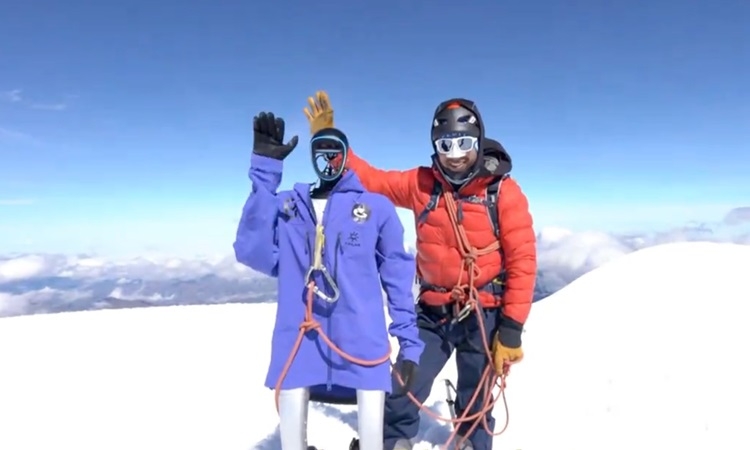
The improved Unitree G1 humanoid robot successfully climbed the Chimborazo volcano and is preparing for the journey to Mount Everest.
Theo Interesting EngineeringPemba, the improved version of the G1, over the weekend completed an expedition to the summit of the 6,200 m high Chimborazo volcano in Ecuador. This is the first leg of an ambitious exploration project with the goal of bringing a humanoid robot to Mount Everest. The 16-hour climb marks a new milestone in the effort to push humanoid robots beyond controlled environments and operate in some of the harshest places on the planet.
The Pemba project was designed by engineer Pablo Berlanga Boemare, founder of the Geologic Dome organization who worked with the World Wide Fund for Nature (WWF) in the Congo basin and Amazon rainforest. During his time in the field, Boemare noticed that traditional robotic systems often failed when deployed in natural environments. Because 97% of the Earth’s surface is inaccessible to wheeled or tracked robots, the Pemba project aims to build a highly mobile platform for conservation.
Theo Humanoids DailyBoemare notes that many protected areas rely solely on networks of fixed cameras and sensors to monitor wildlife, illegal logging, poaching and environmental change. He and his colleagues think mobile robots could provide a more flexible alternative. Instead of installing thousands of cameras in remote locations, humanoid robots equipped with cameras, sensors, satellite connections and artificial intelligence can automatically patrol large areas while collecting environmental data. In the future, robots will operate on solar energy and connect to satellite networks like Starlink.
Robot Pemba on top of Chimborazo volcano. Image: Pabloberlanngab/X
According to the project team, Pemba walks independently on terrain with slopes less than 30 degrees. In steeper and more technical areas, expedition members carry the robot. Their current goal is to gradually expand the robot’s autonomous capabilities through a reinforcement learning system trained to handle increasingly complex terrain.
The volcano’s high altitude causes electronics and batteries to experience freezing temperatures, rapid thermal changes, and reduced cooling performance. To handle this, engineers developed a custom thermal management system and ventilation unit integrated into the robot’s jacket. These modifications are based on previous testing results in the Altay region of China, where the Unitree G1 robot operated in temperatures as low as -47.4°C.
Boemare and his colleagues’ long-term goal is to send humanoid robots to the Himalayas. According to Kathmandu PostGeologic Dome and Nepal-based company Fourteen Peaks Expedition have proposed deploying a robot on Mount Everest in a study of robot performance in extreme environments. The robot will be tested at Everest Base Camp and Camp IV at an altitude of nearly 8,000 meters, collecting data on battery performance, movement, joint pressure and environmental resistance. Researchers hope the future robotic system can assist in garbage collection, glacier monitoring, search and rescue and environmental surveys on Everest.
Mountain environments provide a unique and challenging testing site as humanoid robots must deal with less-than-flat terrain, extreme temperatures, limited communications, power pressures, and unpredictable weather. All that difficulty will expose weaknesses in both the hardware and the robot’s AI system.
Launched in May 2024, G1 has a compact size, 127 cm tall and weighs 35 kg with a starting price of about 14,240 USD in the Chinese market. The robot has 23-43 joint motors depending on the configuration, with a maximum joint torque of 120 Nm.
G1 is equipped with a series of advanced sensors, 3D Lidar, RealSense depth camera and noise canceling microphone system for voice control. With a 9,000 mAh battery, the robot can operate for up to two hours and the battery can be replaced quickly. An 8-core processor controls the robot’s joint system, allowing flexible movement with a maximum walking speed of about 7.2 km/h. The robot is based on UnifoLM, an AI model developed by Unitree for robots, and supports reinforcement learning to control movement and perform tasks.
https://NorthProvidenceLandscaping.us/lawn-care/weed-control
https://NorthProvidenceLandscaping.us/lawn-care/lawn-grubs-control
https://NorthProvidenceLandscaping.us/lawn-care/lawn-leveling
https://NorthProvidenceLandscaping.us/lawn-care/hydroseeding
https://NorthProvidenceLandscaping.us/lawn-care/sod-installation
https://NorthProvidenceLandscaping.us/lawn-care/lawn-installation
https://NorthProvidenceLandscaping.us/lawn-care/lawn-edging
https://NorthProvidenceLandscaping.us/lawn-care/fertilizing-lawn
https://NorthProvidenceLandscaping.us/gardening
https://NorthProvidenceLandscaping.us/gardening/hedging
https://NorthProvidenceLandscaping.us/gardening/pruning
https://NorthProvidenceLandscaping.us/gardening/brush-removal
https://NorthProvidenceLandscaping.us/gardening/plant-removal
https://NorthProvidenceLandscaping.us/gardening/flower-bed-maintenance
https://NorthProvidenceLandscaping.us/gardening/mulching
https://NorthProvidenceLandscaping.us/gardening/weeding
https://NorthProvidenceLandscaping.us/gardening/flower-planting
https://NorthProvidenceLandscaping.us/yard-clean-up
https://NorthProvidenceLandscaping.us/yard-clean-up/leaf-removal
https://NorthProvidenceLandscaping.us/yard-clean-up/green-waste-disposal
https://NorthProvidenceLandscaping.us/yard-clean-up/gutter-cleaning
https://NorthProvidenceLandscaping.us/yard-clean-up/tree-removal
https://NorthProvidenceLandscaping.us/yard-clean-up/junk-removal
https://LittleComptonLandscaping.us/
https://LittleComptonLandscaping.us/lawn-care