Enterprises said that direct power purchase and sale (DPPA) and rooftop solar power projects still have licensing procedures and inconsistent understanding between localities.
At the conference on energy transition by Labor Newspaper held on June 9, Ms. Bui Cam Ha, CEO of Nami Energy Consulting, said that Decree 57 creates a relatively clear legal corridor for the direct power purchase and sale mechanism (DPPA) and rooftop solar power development. However, after more than a year of implementation, the number of contracts actually signed is still very limited.
“The biggest barrier today is the issue of licensing electricity activities,” Ms. Ha said, saying that the regulations are quite clear but the way they are understood and applied in different localities is still different.
Specifically, in the process of applying for an electricity operating license, many businesses are still required to supplement an investment registration certificate. Meanwhile, according to the Investment Law 2025, domestic enterprises investing in electricity production activities are not required to apply for an investment registration certificate.
“In fact, businesses are still required to apply for additional documents or work with many different agencies to complete documents. This is an administrative bottleneck that prolongs the project implementation process,” Ms. Ha said.
Another problem mentioned by Ms. Ha is the understanding of the “self-produced, self-consumed” solar power model. According to her, in essence, this is a model of businesses using electricity produced on the spot to reduce pressure on the national electricity system and increase businesses’ resilience to energy market fluctuations.
But in some localities, the concept of “self-production, self-consumption” is being understood in the direction that businesses must invest their own capital in the entire solar power system. This understanding makes third-party investment models difficult to implement. In this model, energy businesses will invest, own and operate solar power systems, while customers only buy electricity or rent energy services.
Ms. Ha said that many manufacturing businesses have a need to use solar power but do not want to become investors in an energy project. They just want to focus on main production and business activities. On the contrary, energy businesses that have the expertise and resources to invest cannot clearly deploy the model due to different understandings of the concept of self-production and self-consumption.
“As a result, both the party with the need to use clean electricity and the party with the ability to provide solutions face difficulties during project implementation,” Ms. Ha stated.
Faced with the above reality, a representative of Nami Energy Consulting said that the executive agency needs to have specific and unified instructions to create conditions for distributed solar power projects to be deployed more quickly and effectively.
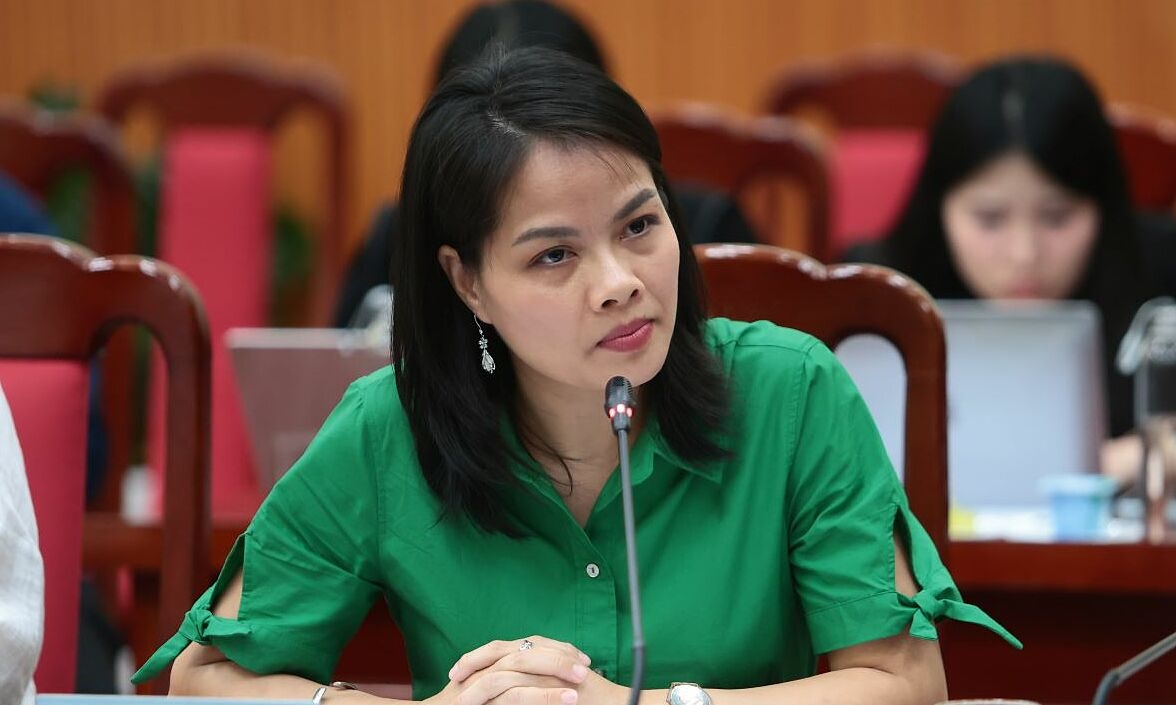
Ms. Bui Cam Ha, CEO, Nami Energy Consulting, discussed at the seminar, June 9. Image: Labor Newspaper
Sharing the same opinion, Ms. Tran Thuy Tien, Director of Market Development and External Relations of Constant Energy Company, also pointed out that when implementing projects locally, the way of understanding and applying regulations in each place is different, making the implementation process longer than expected.
She also said that manufacturing enterprises, especially large enterprises, mainly want to focus on core production and business activities instead of directly participating in management or operation of the power system. Therefore, businesses want a simpler, more transparent and convenient mechanism to access and use clean energy sources for production.
In response, Mr. Trinh Quoc Vu, Deputy Director of Electricity Department (Ministry of Industry and Trade) said that this agency has had official and unofficial discussions with a number of investors on the self-generated and self-consumed electricity mechanism and the DPPA mechanism. Accordingly, the operator understands these bottlenecks.
According to Mr. Vu, Decree 57 regulates the DPPA direct electricity trading mechanism; Decree 58 regulates the mechanism for developing renewable energy, including self-produced and self-consumed solar power. In particular, “self-production, self-consumption” is understood to mean that any unit that consumes electricity will produce electricity itself – this content has been included in the Electricity Law 2024.
To solve the problem of implementing investment cooperation models between organizations and individuals, operators allow the scope of Decree 57 to be expanded. Specifically, this Decree stipulates that the direct electricity trading mechanism is expanded, so that businesses have more options.
“Enterprises can choose to follow the self-production and self-consumption model if they invest themselves. If they cooperate in business, they can follow the model of direct electricity trading through a separate connected power grid,” he said.
In addition, Mr. Vu said that the Law on Economical and Efficient Use of Energy 2025 also provides additional investment cooperation under the ESCO (energy service company) model. This is a channel to help businesses cooperate and invest more diversely, meeting the needs of each unit.
However, the representative of the Ministry of Industry and Trade also affirmed that the management agency recognizes the problems of businesses and will adjust and resolve them in the process of revising the upcoming revised Electricity Law.
“The point of view is that social relationships and business cooperation between businesses and people should not be tied up,” he said. According to Mr. Vu, the operator plans to only regulate self-produced and self-consumed electricity, meaning consumed on-site, not transmitted to the grid, affecting the national grid. Thus, the key is “on the spot”, not necessarily intervening in business cooperation forms.
With problems with fire prevention and fighting regulations or investment registration certificates, the Ministry of Industry and Trade is also amending Decree 57 and Decree 58. Accordingly, the management agency will remove as much cumbersome administrative procedures as possible.
“In fact, currently there are many administrative procedures and many doors, leading to problems. We have noted and grasped this problem to solve it,” he added.
https://CentralFallsLandscaping.us/lawn-care/lawn-leveling
https://CentralFallsLandscaping.us/lawn-care/hydroseeding
https://CentralFallsLandscaping.us/lawn-care/sod-installation
https://CentralFallsLandscaping.us/lawn-care/lawn-installation
https://CentralFallsLandscaping.us/lawn-care/lawn-edging
https://CentralFallsLandscaping.us/lawn-care/fertilizing-lawn
https://CentralFallsLandscaping.us/gardening
https://CentralFallsLandscaping.us/gardening/hedging
https://CentralFallsLandscaping.us/gardening/pruning
https://CentralFallsLandscaping.us/gardening/brush-removal
https://CentralFallsLandscaping.us/gardening/plant-removal
https://CentralFallsLandscaping.us/gardening/flower-bed-maintenance
https://CentralFallsLandscaping.us/gardening/mulching
https://CentralFallsLandscaping.us/gardening/weeding
https://CentralFallsLandscaping.us/gardening/flower-planting
https://CentralFallsLandscaping.us/yard-clean-up
https://CentralFallsLandscaping.us/yard-clean-up/leaf-removal
https://CentralFallsLandscaping.us/yard-clean-up/green-waste-disposal
https://CentralFallsLandscaping.us/yard-clean-up/gutter-cleaning
https://CentralFallsLandscaping.us/yard-clean-up/tree-removal
https://CentralFallsLandscaping.us/yard-clean-up/junk-removal
https://FosterLandscaping.us/
https://FosterLandscaping.us/lawn-care
https://FosterLandscaping.us/lawn-care/lawn-renovation
https://FosterLandscaping.us/lawn-care/lawn-aeration