In order to reduce dependence on oil exports through the Strait of Hormuz in the future, Gulf countries aggressively spend money to build more pipelines and reserve warehouses.
For decades, the map of the Gulf’s energy exports converged on a single choke point: the Strait of Hormuz. Now, the Iran war has motivated countries to find ways to escape dependence, by pouring billions of dollars to build more pipelines, storage facilities and railways.
“The legacy of the crisis will lead to the building of infrastructure to avoid the Strait of Hormuz,” said Hamad Hussain, a commodities economist at London-based research firm Capital Economics.
Last week, the Iraqi cabinet approved a plan to boost oil exports by pipeline through the Kurdistan autonomous region to Ceyhan port (Türkiye). Accordingly, this country builds an additional pipeline connecting Basra with Haditha, 700 km long, with an investment of 1.5 billion USD.
When completed, the output of the Kurdistan-Türkiye route will increase more than three times, from 220,000 barrels to 770,000 barrels per day. At the same time, Baghdad is trying to renovate an unused pipeline, allowing it to pump oil directly to Ceyhan port without going through Kurdistan.
Expanding the pipeline network is urgent, as Iraq’s oil exports have been nearly clogged since the outbreak of hostilities in Iran. According to data released by the country in the middle of last month, oil export output through the Strait of Hormuz in April was only 10 million barrels, compared to 93 million barrels before the conflict broke out.
Iraqi oil and gas pipeline network. In particular, the dark broken lines are construction plans and the light lines are unused. Source: S&P
Similar to Iraq, the UAE is accelerating the construction of a new pipeline to bring crude oil to Fujairah – a strategic port city located outside the Strait of Hormuz. On May 15, Abu Dhabi Crown Prince Sheikh Khaled bin Mohamed bin Zayed Al Nahyan called for accelerating the progress of the project.
The project is expected to operate next year, helping the state-owned Abu Dhabi Oil Company (ADNOC) double its export capacity. “Energy security is no longer just about maintaining production. It involves routes, accessibility, storage and redundancy,” said Mr. Al Jaber, CEO of ADNOC.
The UAE simultaneously strengthened its trade network and reserves. Mr. Al Jaber said he has secured additional supply for Asian customers and is expanding oil storage to prevent future fluctuations. Meanwhile, Oman takes advantage of ports in the Gulf of Oman to market its oil storage and export capacity.
In addition, Gulf countries are also discussing accelerating a long-planned railway project. According to Capital Economics, this will be an additional method of transporting oil, but the output is smaller than pipelines or ships.
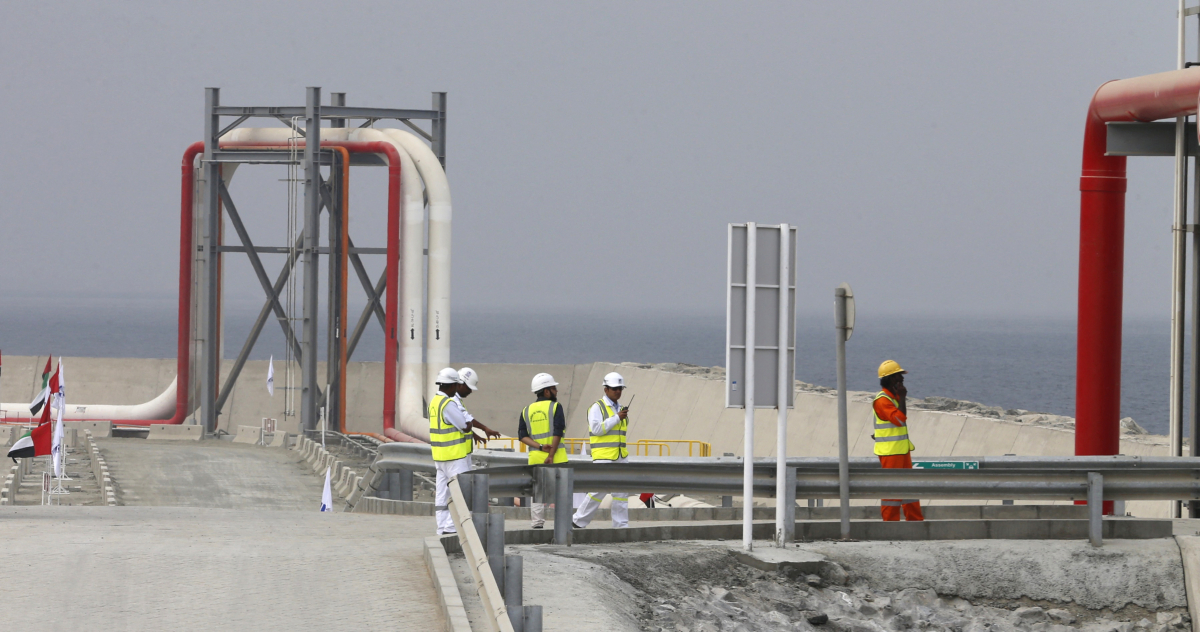
Oil transportation pipeline in Fujairah, UAE. Image: AFP
However, escaping the Strait of Hormuz will not be easy because this is the most economical export route. This ambition requires time, money and delicate cross-border diplomacy. For example, Iraq’s pipeline requires agreements with Jordan, Syria or Türkiye on security, transit and export rights.
Pipeline exports cannot completely replace the Strait of Hormuz. According to the International Energy Agency (IEA), Saudi Arabia’s East-West pipeline and the route to the UAE port of Fujairah have a total available capacity of about 3.5-5.5 million barrels per day.
Since the war, Saudi Arabia claims its pipeline is transporting up to 7 million barrels per day, but that is still much lower than the about 20 million barrels of crude oil and petroleum products that once passed through the Strait of Hormuz.
In addition, land infrastructure is not guaranteed to be safe. Saudi Arabia’s East-West pipeline was attacked by Iran in April. Similarly, the port of Fujairah (UAE) was once the target of drones.
Number of large oil tankers (over 10,000 DWT) passing through the Strait of Hormuz, calculated on a 7-day average. In particular, the blue line is the number of ships entering the Persian Gulf via Hormuz, the green line is the number of ships leaving the Persian Gulf via Hormuz. Graphics: Reuters
Shipping through the Strait of Hormuz is still significantly lower than before the conflict. According to Lloyd’s List data, ship traffic passing through this maritime route has dropped to its lowest level since late February.
Ships stuck in the Persian Gulf are still in a dilemma. They may be attacked by Iranian military forces, if they are not approved by Tehran to pass through the designated corridor at Hormuz. On the contrary, cooperating with this country risks leading to the risk of US sanctions being imposed.
This situation shows that despite spending a lot of resources, Gulf countries have realized the importance of investing in alternative oil transportation routes. Because it will neutralize the possibility of the Strait of Hormuz being turned into a weapon in the future.
Mr. Robin Mills, CEO of Dubai-based consulting company Qamar Energy, said that once there is a bypass route, the threat will gradually decrease. “At some point, Iran’s blockade of the Strait gradually becomes meaningless because it no longer causes any significant disruption,” he commented.
Ms. Cinzia Bianco, an expert at the European Council on Foreign Relations (ECFR) research organization, said that the Gulf region’s determination for long-term investments to reduce dependence on the Strait of Hormuz is increasingly stronger.
“When Saudi Arabia and the UAE first poured money into the Hormuz bypass pipeline, many people thought they were extremely expensive and not really necessary projects. But reality now shows that these investments are very worthwhile,” she said.
https://www.willowproduction.org/forums/topic/ultimamente-cercavo-qualcosa/
https://www.inwomenshealth.com/group/my-site-group/discussion/368ed053-5f96-4d89-bcfa-a6153ea5d34f
https://www.drjohnlieurance.com/group/brain-force-summit-group/discussion/5b6f49cd-891c-4d95-abdc-5d925db094c2
https://www.eplaydigital.com/group/fan-freak/discussion/c4c1db94-db18-4b9e-96de-9aa6cfa79def
https://international.projectwet.org/discussion/ero-convinto-che-avrei-chiuso-dopo-dieci-minuti
https://www.chrissailerkicking.com/group/young-ninja-group-ages-3-5/discussion/9c878b9e-55ca-4b1b-8cf2-aacecca398f3
https://pbase.com/tbes50203/esperienze_reali_con_i_prelievi_e_il_live
https://dnfinance.freeflarum.com/d/5709-glorion-platform-it
https://www.ioviaggioresponsabile.it/group/vietnam-oltre-la-guerra/discussion/7acfbdc5-5ba9-4f6b-bce0-1691d8446d93
https://www.manofwar.us/group/general-discussion/discussion/132d7bb9-dcde-41a6-a336-41b19a80ab35
https://www.idahobasecamp.org/group/sun-valley-single-fly-anglers/discussion/4e03fca4-9de1-492c-9e08-072ce4cfe16f
https://www.hardemanhealth.org/group/hardeman-county-comm-group/discussion/0975d220-0d98-408d-9ff9-6ee0ae6db593
https://campus.extension.org/tag/index.php?tc=1&tag=5k
https://brian.carnell.com/discussion/topic/novita-assoluta-o-solito-portale/
https://www.sandonatomurano.it/group/questions-and-answers/discussion/c13438ad-5a18-4064-8013-7315c53f3f96
https://www.labsgallery.it/group/gruppo-labs-gallery/discussion/ff4c0ed4-6d59-4ead-a1fd-ea4f58f2c908
https://www.arcidiocesiurbino.info/group/gruppo-arcidiocesi/discussion/3ecaab83-8964-4cf0-b259-e5ccda4b8994
https://www.clubdellemamme.com/group/la-salute-dei-nostri-bambini/discussion/71a78a22-5b26-4fc2-8f63-85c1979990a7
https://www.improg.it/group/guide-to-sleep/discussion/22bed800-1bd4-4626-ade0-70a0690b5954
https://www.fitday.com/fitness/forums/off-topic/53570-nuova-piattaforma-glorion.html
https://www.ewebdiscussion.com/threads/glorion-e-il-supporto-clienti-in-italia.397021/
https://www.keepandshare.com/discuss4/41267/glorion-platform
https://www.jointcorners.com/forums/thread/11312/
https://www.papercall.io/speakers/137628/speaker_talks/438426-sezione-live-di-glorion
https://www.molecularcloud.org/p/app-mobile-glorion-o-versione-browser-cosa-preferite