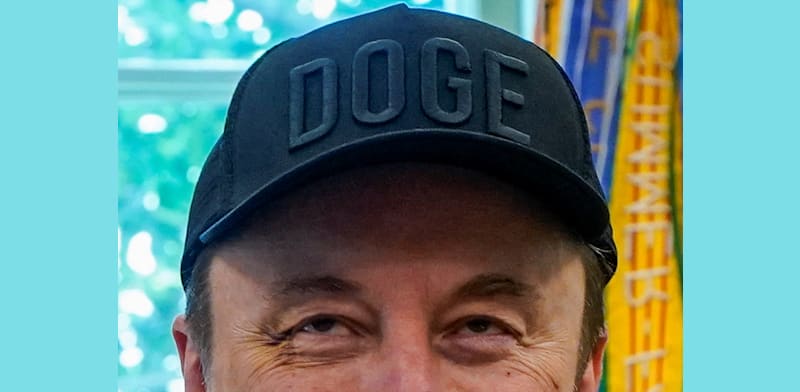
What started as an innocent internet joke soon became a real government initiative. When it was suggested online to call US President Donald Trump’s cutbacks the “Department of Government Efficiency”, DOGE, Elon Musk embraced the idea enthusiastically, sharing memes in which he stood behind a booth with the stamp of the imaginary agency and joked that he would volunteer to head it. Soon, the satire turned into a radical move that tried to reshape the federal apparatus on a scale never seen before in American history. the modern.
And so, on the day he returned to the White House, Trump signed a presidential order and established the Department of Government Efficiency as an agency within the government. By virtue of its position, DOGE was granted broad access to human resource systems, contracts, budgets and most government operations. Musk was appointed a “special government employee”, insisting that it is possible to save “up to a trillion dollars” from waste without harming essential services.
Many analysts expressed doubts from day one, but the administration fully embraced the rhetoric. Some critics warned that reducing the agencies responsible for collecting taxes or administering benefits could lead to higher expenses in the long run than the immediate savings.
The initial results were dramatic. DOGE declared savings of more than 200 billion dollars in a few months; Tens of thousands of contracts and grants were canceled; Hundreds of thousands of federal workers have retired, resigned or been fired as part of an aggressive restructuring. DOGE’s dedicated website states that this is only “about 30% of the total savings” planned.
Chaos without purpose in the White House
Outside the administration, the picture was more complex. Independent estimates stated that the real savings is only about 175 billion dollars, very far from Musk’s vision. Some of the “huge cuts” turned out to be inflated or based on miscalculation. A Senate investigation revealed that the implementation itself, mired in “operational chaos”, caused a waste of tens of billions, a decrease in productivity and high costs of payments to workers.
At the same time, a different kind of criticism was taking shape: one that painted DOGE not only as a professional failure, but as an essentially performative move. Even conservatives who supported for years the reduction of the government claimed that the fact that the agency was established by a temporary presidential decree, without legislation and without long-term budgetary backing, doomed it to be a body designed to run fast, make noise and make headlines – without stable and significant reform.
Accordingly, many reports in the American media described how the organization led by Musk sometimes had an atmosphere of “execution for the sake of execution.” At the same time, critics from outside the administration, especially those politically opposed to Trump or Musk, tended to amplify any failure. Thus the entire discussion became polarized, far from the complex reality that is usually in the middle.
However, within the machinery of the federal government the impact was well felt. Employees received notices urging them to retire early or risk being fired. A wave of layoffs began, and entire offices were emptied overnight.
Tesla is sinking, relations are deteriorating
As early as February, protests broke out at Tesla branches in the US and Europe. The protesters accused Musk of destroying public service and deepening inequality. In some locations, the protests degenerated into vandalizing vehicles and attacking government agencies, and federal investigators were called to the scene. Tesla itself reported a sharp drop in profits, and many commentators linked the crisis directly to the political involvement of Musk and the conflicts that broke out in its wake.
For a moment, it seemed that Trump and Musk were working shoulder to shoulder. The president publicly praised Musk and dismissed the allegations against DOGE as “deep state opposition.” Then came the big confrontation: “The Big and Beautiful Law” – Trump’s flagship proposal in the area of taxes and spending. Musk warned that the law would increase the deficit and deplete the savings effort. Trump was furious. In a short time, the relationship deteriorated until Musk left his position at the end of May. The parties parted politely, but the mutual attacks were not long in coming, including teasing and personal tweets from both directions.
Musk’s departure did not mark the end of DOGE. Internal budget documents indicated that the administration plans to expand the agency, double its budget and hire dozens of additional employees in the coming year.
The losers: the children of the third world
At the same time as the horizontal cuts in the government ministries – even though this was not an official part of DOGE’s role – a deep shock also took place in the international development agency USAID. The freezing of foreign aid at the beginning of the term led to the shutdown of many offices, the sending of field workers on administrative leave and the termination of significant programs. Aid groups have warned of long-term consequences, including halting HIV treatment and childhood vaccinations in countries that depend on US funding. Development experts warned that a sudden stop to this type of funding could carry a heavy human cost: Boston University estimated, based on forecasting models, that more than 300,000 possible deaths in Third World countries, including over 200,000 children, could be a direct result of USAID cuts.
The administration rejected the predictions. According to him, many of the USAID programs were wasteful or duplicative, and the US continues to fund “life-saving aid” and “vital programs”. Senior officials in the White House presented the move not as abandonment, but as modernization, streamlining and structural change designed to direct resources to places where they serve the American interest in the best way. Towards the end of the summer, the administration informed Congress of its intention to integrate USAID into the State Department.
These days, DOGE continues to operate without Musk – but his spirit is still present. Many of the changes made seem irreversible. Canceled contracts are not expected to return, and the government system is still dealing with the consequences of the past year. However, a new administration will be able to re-establish everything, for the simple reason that almost everything is done under presidential or administrative orders and without legislation.
For your attention: The Globes system strives for a diverse, relevant and respectful discourse in accordance with the code of ethics that appears in the trust report according to which we operate. Expressions of violence, racism, incitement or any other inappropriate discourse are filtered out automatically and will not be published on the site.