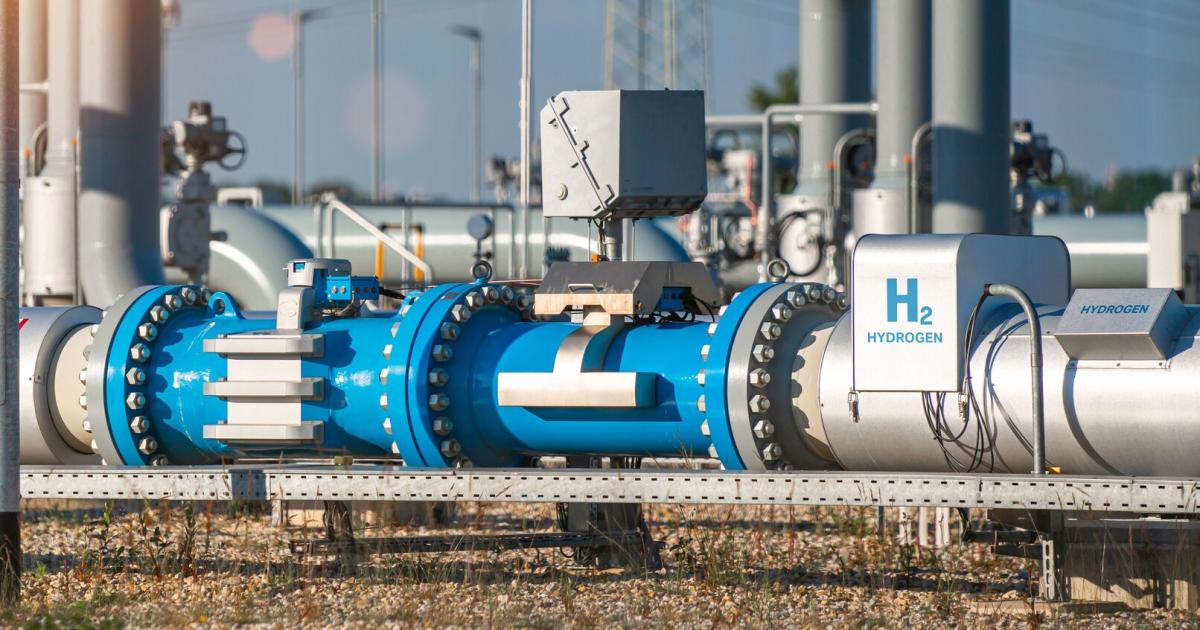
Hydrogen should play an important role in the energy system of the future and Austria wants to be at the forefront when it comes to building infrastructure for the gas that can be produced in a climate-neutral manner. The conditions for becoming a European hydrogen hub in the long term are not bad. The country has an efficient gas transmission network and voluminous underground storage facilities. The Ministry of Economic Affairs has now commissioned one Study published, which breaks down how much hydrogen in the future in Austria need will be how much you save should be able to wo that would be possible and how much that will cost approximately.
7.7 terawatt hours of storage capacity required by 2040
The current hydrogen demand in the country is approximately 4 terawatt hours. According to calculations in the Austrian Network Infrastructure Plan (ÖNIP), the need will increase to 48 TWh by 2040 increase. The majority of it is needed in the energy sector. The gas is also needed in industry as an energy source and chemical and is intended to replace fossil natural gas. The Memory requirements should be up by 2040 7,7 TWh climb. The majority of this capacity will be used to convert surpluses from renewable electricity production during the year and take them into the winter. For comparison: the current natural gas storage capacity is 97 TWh.
Technical challenges must first be solved
Due to the declining demand for natural gas reserves, many are expected to deposits free. These are particularly suitable for hydrogen in porous rock deep underground. They are mainly found in Lower Austria, Upper Austria and Salzburg. However, there are different requirements depending on the gas. The energy density of hydrogen is significantly lower than that of natural gas (methane), and the same amount of energy is required in hydrogen 3 to 4 times more space. In addition, the gas is much more volatile, which is why it reinforced seals and there must be regular exchange. There are also other technical challenges such as turbo compressors that are not yet available on the market. But they are solvablesays the study.
High costs and low income are to be expected
The costs for hydrogen storage are currently very difficult to estimate because there is hardly any reliable statistical data available. In Austria there is no system in commercial operation yet. The project that has progressed the furthest is “Underground Sun Storage” the RAG. One of the world’s first geological hydrogen storage facilities is being built in Rubensdorf near Lake Attersee. Roughly estimated Storage costs 4.5 to 5 times higher be like natural gas. The assumption is that the price of hydrogen will fall from the current 210 euros per MWh to 80 euros. For comparison: Natural gas currently costs around 35 euros per MWh wholesale. Even in a scenario with low construction costs, the Total costs higher than the expected revenue. Especially at the beginning, income will be rather low.
In addition to funding, a legal framework is also needed
So when it comes to financing government support be necessary. Various funding models are possible, from guaranteed minimum revenues and bonuses to state investment guarantees. The study authors from Energy Agency, Montanuniversität Leoben, Austrian Institute of Technology and NHP Rechtsanwälte make no recommendation on this. They just advise one sustainable regulatory legal framework to create and one Project implementation as quickly as possible to enable.
The federal government wants to make rapid progress
The federal government wants to push the topic of hydrogen with full force. In October it was announced that four national lighthouse projects with a total of 275 million euros be promoted. Afterwards there was a trilateral meeting with Germany and Italy Building a European southern corridor. In the future, green hydrogen will be imported from North Africa.
“Hydrogen is alongside solar, wind and hydropower the missing piece of the puzzle in our energy supply of the future,” says Economics Minister Wolfgang Hattmannsdorfer. “For industry, wherever electricity reaches its limits, hydrogen is the key to the transformation towards climate-friendly production and secure supply.” With sufficient supply, industrial companies should be retained in Austria and Europe.