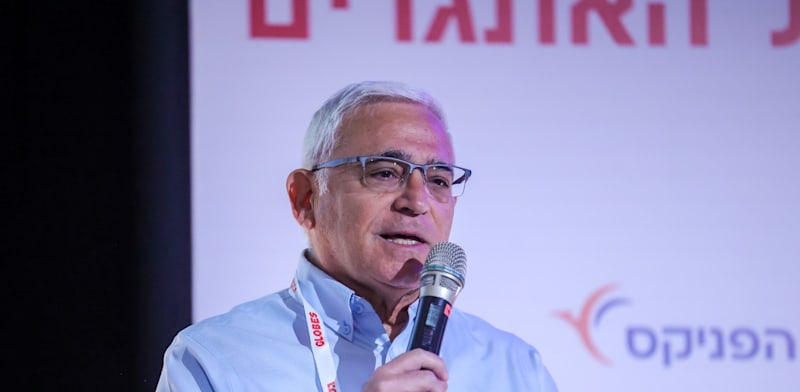
In his lecture at the 32nd Globes Israel Business Conference, Hanan Steinhart, co-director of the Gidor Fund and columnist for Globes, presented a stark picture of the state of the American economy. According to him, “The elephant in the room has been in the room for a long time, so everyone has gotten used to it, it is actually the debt of the US government and the debt of the American economy in general.” Steinhart explained that the total debt grew at a rapid pace, and even emphasized: “The debt has increased by two trillion dollars in the last few months alone, and the interest on the debt ‘eats’ from tax revenues.” According to him, the interest rate on the American debt is significantly higher than the rate of economic growth: “The interest rate on the entire American debt is three and a half times the increase in GDP per year.” According to his description, a situation in which the debt service is financed through additional debt is similar to the dynamics of “vertigo of death – a business that cannot pay the interest except from a constant increase in debt.”
Steinhart returned to the audience to the points he previously raised in the articles he published in Globes. After the “crypto crisis” of 2018, as he called it, he advised readers to hold crypto as part of a portfolio. “We wrote and recommended entering crypto in every portfolio. “In 2019,” he claimed, “he warned that gold will become a major trade of the decade. And in 2021 he wrote that US government bonds are, “a very dangerous asset”, and recommended avoiding them. In his criticism of the Bank of Israel’s reserve policy, Steinhart said: “The Bank of Israel had 32 tons of gold in reserves, and it sold them for $42 per ounce.” According to him, if the Bank had maintained the historical ratio between gold and reserves instead of purchasing American bonds, “it could have financed from its reserves not just one war, but a war.”
The bond market is the operating system of the global economy
Steinhart presented three possible ways to deal with the crisis: government insolvency, deep cuts or a significant devaluation of the currency. “The first option, insolvency, is unlikely because you are both printing the money and the bottleneck.” According to him, the cuts also do not provide a solution: “We saw – from too many cuts, the deficit was two trillion dollars and already next year it is expected to be three trillion dollars.” Therefore, according to his words, the only option left is to lower the value of the debt in real terms through inflation: “If the United States produces inflation for three years, the debt ratio will improve dramatically.” He also referred to the possibility of a change in economic policy in the event of another term of office for Donald Trump.
According to him, “the first option, the Trump option: simply ignore the cooling and increase the amount of money.” Steinhart described a scenario in which the Federal Reserve will control the long-term yield curve by buying bonds, or choose a course of “revolution of gold reserves.” According to him, proposals within the Trump term such as $2,000 checks or 50-year mortgages are designed to increase the money supply. He added that the Federal Reserve’s response is not self-evident: “Jerome Powell told Trump, if there is low inflation, it will keep the issue of interest.”
Steinhart warned that damage to the American bond market would affect not only Wall Street, but the entire global economy. “The American bond market is not only a market of debtors and creditors, it is the operating system of the global economy.” According to him, “Half of the capital of the world’s banks is invested in American bonds,” and the global repo market, based on them, “turns over four trillion dollars a day.” If the market cracks, he warns, “we will reach a situation where the entire economy The world will go wrong to the level of liquidity of money in ATMs.”
“The US currently has the worst employment figures ever”
In the context of the labor market and technological effects, Steinhart claimed that US employment data indicated deep stress, with “the worst employment data ever.” According to Steinhart, the next few years will be characterized by unusual volatility in the markets: “There will be a correction in the short term because there are many parallel pressures that are difficult to sort out at the same time.” He warned that leverage could become especially dangerous in such a period: “Dollar bonds, life-threatening, especially long-term bonds.”
As for the crypto market, he noted that the risk is high in it as well. “In a market that is very volatile you can lose money even when there were huge opportunities.” According to him, the example of Ethereum illustrates this: “Etherium has fallen by 12% since the beginning of the year,” Steinhart concluded with a warning to investors: “It will not be the same story as in the long years of free money printing and celebration that we all enjoyed. Those who have open eyes to know how to take advantage of the volatility, will benefit. Those who don’t, may lose.”
***Full disclosure: The conference is in collaboration with Bank Hapoalim and the Fenix Group. Sponsored by: Bezeq, El Al, Tnuva, Electra, Aramis, Haifa Group, Hamilton Line Israel, Doral, Shikhun and Binui, Black Rock, Bezan, Pagaia, KPMG, Nespresso, Egged, Zikar, ICL and the Medical Association; and with the participation of: Israel Ports Company, Mekorot, Ashdod Port Company and the Innovation Authority.
For your attention: The Globes system strives for a diverse, relevant and respectful discourse in accordance with the code of ethics that appears in the trust report according to which we operate. Expressions of violence, racism, incitement or any other inappropriate discourse are filtered out automatically and will not be published on the site.