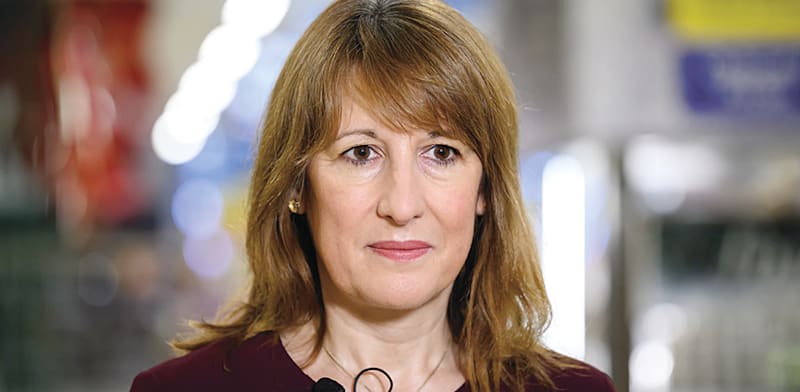
The pressure on British Chancellor of the Exchequer Rachel Reeves these days is enormous. Not only the public is waiting to see the new budget that she will present to the parliament on Wednesday, and how it will affect the ability of ordinary families to “close the month”.
Not only the media is lurking for every nuance of her words, and will especially check closely if she sheds tears in public, as happened in the past. In practice, an entire British government bond market will decide whether the measures she announces will represent an increase or decrease in the risk of the kingdom’s debt default, with Britain’s immediate economic future at stake. “A £2.7 trillion monster is waiting for the news,” wrote a British newspaper this week.
● In Britain they are considering: imposing a new tax on every tourist who enters London
● Defense stocks fell, Europe is in trouble: the US is pushing for a forced peace agreement in Ukraine
Reeves has to meet huge expectations: she has to find sources of income, or cut government spending in an attempt to cover a budget hole of between 20 and 30 billion pounds, without raising income tax directly. The idea of going back on the Labor party’s election promise and doing so was leaked to the media, was not well received, and according to most estimates was shelved in recent weeks.
Reeves must deliver election promises regarding larger pensions, increasing child allowances, investing in infrastructure and increasing the defense budget, in a situation where the British economy is faltering. It should take measures against inflation, which will allow the central bank to lower the high interest rate (4%) and resume growth.
Labour’s promise to do so was at the heart of last year’s landslide election victory. Now, the pressure is on Reeves to deliver the goods.
The surge in returns has already brought down a prime minister
Over her speech hovers the threat of British 10-year and 30-year bond yields. A jump in these yields has already brought down one prime minister, and trading in “gilts” – as British government bonds are called – is the center of enormous interest and huge volumes, even compared to other governments. Part of this is due to the fact that close to a third of them are held outside the kingdom, by foreign investors.
Due to the great interest, “Deutsche Bank” announced, for example, that on Wednesday it will launch a special AI tool that will analyze in real time every word of Reeves. He is calibrated to sense changes in tone, and especially differences in wording compared to her previous speeches.
Any negative hint, any word that differs from what has been broadcast so far regarding the financial future of Great Britain – the reduction of the national debt (which has reached 95% of GDP), the reduction of the deficit (about 5.1%) or an increase in state revenues – will be translated into buy and sell orders.
Already now the British interest payments on the kingdom’s debt reach 106 billion pounds, and burden the annual budgets.
This is why in Britain the current budget for 2026 is called the “bond budget”. The yield on them will be the main indicator that will be looked at on Wednesday to see if Reeves, led by British Prime Minister Keir Starmer, has succeeded in convincing the markets that Britain will show fiscal restraint and commitment to its own rules, and reduce the deficit, or if panic and anxiety about the future will take over and become a self-fulfilling prophecy.
Every move by Reeves, even in the last few weeks, resulted in immediate changes in yield. It now stands at 4.5% for 10-year bonds, not far from the records recorded at the beginning of the year, and at a historical “peak” if you look at the last decade.
Britain has the highest yields for 30 years
The yield on the 30-year bonds is also of interest to investors. In this area, the United Kingdom even leads above countries like France (in a poorer financial situation), mainly due to the uncertainty arising from its economic independence since it withdrew from the European Union and lost access to the common market. A combination of great dependence on free international trade (which is shrinking), tariffs on the American market and trade restrictions with the European Union, alongside relatively high inflation and energy and security problems, make the UK a less safe destination for long-term investment. At 5.36%, the UK has the highest 30-year bond yields among the G7.
How is Reeves expected to try and change the image? With the help of a series of new measures, the effectiveness of which is hypothetical at this point. Among the measures that have been leaked in advance is a new tax on the 100,000 most expensive homes in Britain, which could reach £4,500 per home. There will also be a travel tax on electric vehicles and an existing exemption for withdrawing money from small cash deposits will be abolished. On top of that, as most governments do in an attempt to balance the books, a “war on tax evasion” will be promised which should generate billions in revenue. Tax relief for working families, which was planned for the coming years, will be frozen (with consequences only from the following budgets), and pensions will also increase more moderately than they were supposed to in the past.
Raising taxes has probably fallen out of favor
The collection of these steps is known in the UK as the “simmerbread method”, after the Danish open sandwich, in which different layers of ingredients are piled on top of each other. The second option, a tax increase that would close the hole in one step, has apparently been dropped from the episode, unless there are any last-minute surprises.
Not only the financial market threatens Reeves, but also the political situation in the United Kingdom. The ruling Labor Party has collapsed in the polls over the past year, and now receives only 18% of the people’s support, compared to 34%.
The one benefiting from the collapse is Nigel Farage’s “Reform” party. The British politician, who is considered the driving force behind Britain’s withdrawal from the European Union, is threatening to change the political system in Britain with a new party. Regarding the budget, he himself admitted that “cuts will be necessary” if he comes to power, but promised a pro-business approach. Among his promises – to save billions by cutting the welfare budget, deporting immigrants and not accepting asylum applications.
Therefore, this Wednesday at 14:30 (Israel time) there will be many eyes on the speech of Reeves’ life. Her personal political fate may also depend on the market’s reaction to the measures that will be announced, as past cases have proven.
In the last day before the speech, Reeves asked her party to “demonstrate unity” and not criticize her actions after the speech. She promised to continue being the finance minister for the next elections as well. This week the debt market will express its opinion on this promise.
For your attention: The Globes system strives for a diverse, relevant and respectful discourse in accordance with the code of ethics that appears in the trust report according to which we operate. Expressions of violence, racism, incitement or any other inappropriate discourse are filtered out automatically and will not be published on the site.