In the second half of the nineteenth century the word ‘capital‘, after the publication of Karl Marx’s book that changed the world and gave rise to the birth of communism e l’idea di class struggle as a political instrument. Then it became clear to everyone that thecapitalit was the engine of the economy, the ultimate goal of trade and the main cause of allsocial inequalitiesin the Western world.
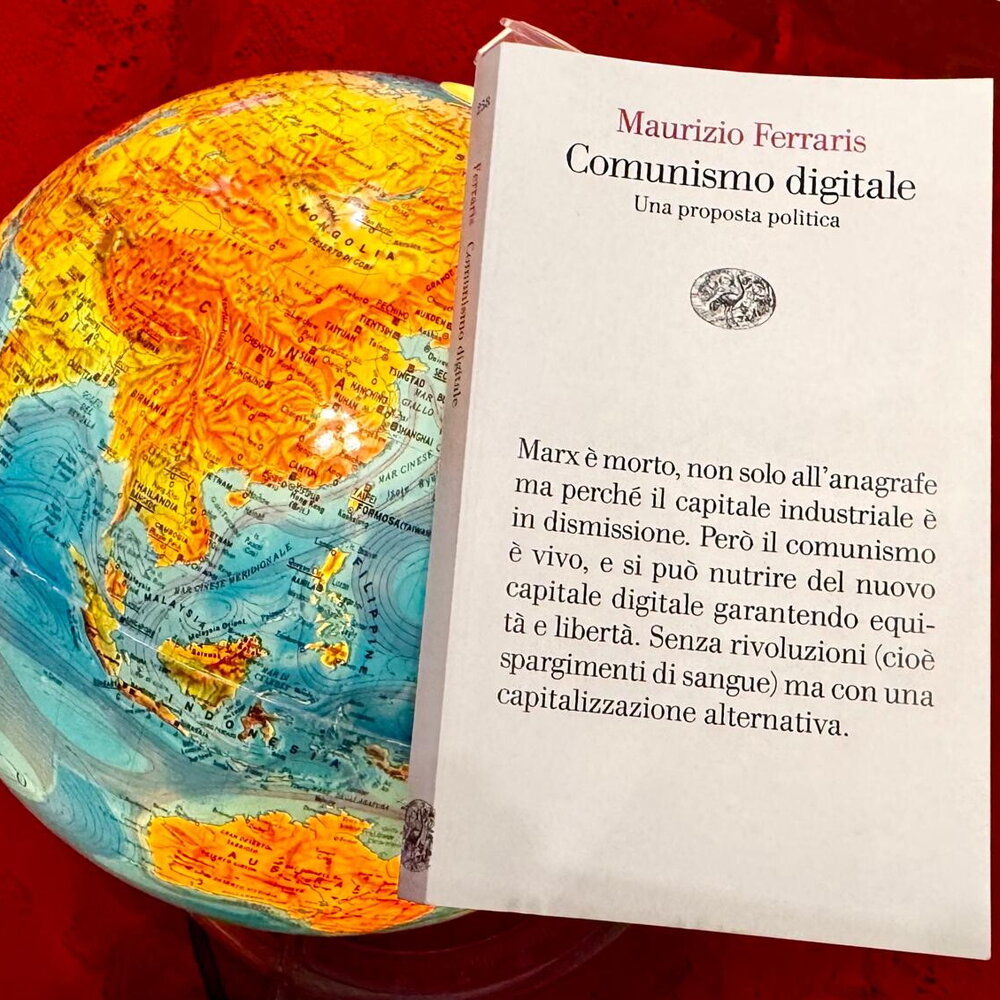
After 150 years the capital in its classic form, the industrial one, is being decommissioned. As is theMarx’s communismthat fed on that capital. Yet thecommunism is aliveand finds new life in a newdigital capitalwhich can guaranteeequity and freedomwithout revolutions with bloodshed. And it can implement that wonderful idea whereby thewealth is distributed to each according to his needswhich has failed to find a political correspondence in reality except in deformed, dictatorial and inhuman forms. Starting from this assumption the philosopherMaurizio Ferrarishas developed in recent years at ‘Scienza nuova’ (the institute of advanced studies for cooperation between humanism and technology which unites the University and Polytechnic of Turin) a project which he called, borrowing it from the word Welfare, ‘Webfare. From social state in reality to social state on the web. A project which he now talks about in a booklet published by Einaudi, ‘Digital communism. A political proposal‘ (Vele series, pages 144; 13 euros).
The ‘documentary’ revolution and the value of data
In the third millennium with the advent ofInternet and AI today (documentary revolution‘), claims the philosopher, every document, from the photo to the like, has been transformed into amerce. A socioeconomic transformation that in some ways achieves thecommunismbut without eliminating exploitation. For this reason today lTrue wealth no longer consists of money or financial securitiesbut in much informationally richer documents, idata.
Unconscious work and the concentration of value
Ferraris explains that all of humanity producesvalue on the web. Unlike classical capitalismHowever, the work is not tiring, but it is alsounaware(for example, just go on social media and, in this way, producedata) e gratis. Le American liberal platformsconcentrate the value in a few hands – writes the author – while thoseChinese totalitariansthey redistribute it, but at the price of atotal control over citizens.
Digital Communism and ‘Documedia Capital
Il digital communismthat Ferraris proposes consists instead ofhumanitarian actions che usino i data per produrre value for those who need itwithout compromising itsfreedom. The data collected today bydigital platformsi.e. what the author defines as ‘document capital‘, they can also be valued as aalternative capitalthat is, capable of responding to the Marxist precept”to each according to his needs“, enhancing its fundamental traits, that is, the fact of being new, rich, renewable and fair. And this, he underlines, is the truenoveltythat the ‘document capital‘ brought into our world, that is, precisely, “basing thehuman dignity over needand not on merit. Because, it is useless to remember – explains the philosopher – to ask from each according to his owncapacityit’s not that difficult (and that’s what liberalism has done up to now) and the history of oppression as we’ve known it up to now.”
The Webfare Project: Redistributing the Value of AI
To clearly clarify what the idea behind the project is, Ferraris relies on in the epilogue of the bookTania Cerquitelliprofessor in the Department of Automatics and Computer Science ofPolytechnic of Turinwhich he asks to explain what theWebfare. “Dear Tania – writes Ferraris – as Yogi Berra (player ofbaseballand great American aphorist whose birth centenary marks the centenary, ed.) in theory there is no difference between theory and practice, in practice there is – and theWebfareis no exception”. And the teacher explains that “the objective of the project isredistribute the value generated by AI-based services a favore di citizens, communities and institutionspromoting acircular social impact. In this approach, idataprocessed by algorithms are no longer just resources to be exploited, but they becomecommon goodsto be reused in a responsible, sustainable way to produceshared value“.
Alternative platforms for a new communism
In other words, it’s about creatingplatformsthat using idataproducts by all users can create them for thembetter living conditions: review the parameters for which a bank grants a mortgage, for which an insurance grants the possibility of taking out a policy, for which a hospital establishes the priority of interventions, etc. “The newvalue productionand its capitalization throughalternative platforms– writes Ferraris – lay the foundations of acommunism as a position, politics and non-ethicscapable of implementing theWebfarestarting from a network ofalternative and complementary platformsto existing ones”.