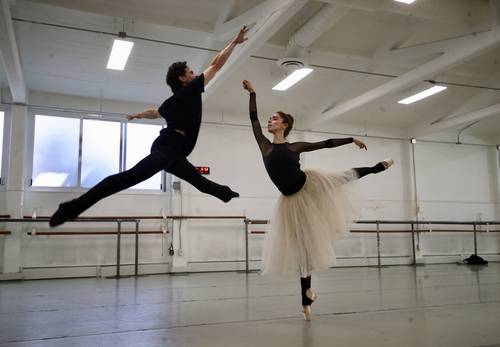
Ana Elisa Mena, as Giselle, dances alongside dancer Alejandro Hidalgo, in the role of the Count of Silesia, in the new version of that ballet, directed by the outstanding Cuban-Russian dancer and educator Svetlana Ballester. His expressiveness on stage is a reflection of discipline, style, technique and dedication. In addition to his movements, the way his arms and hands move smoothly and precisely mesmerize any viewer.
This classic work of romanticism is presented until November 23 in the main hall of the Palace of Fine Arts, with the National Dance Company (CND), under the artistic direction of Erick Rodríguez.
In the assembly of the choreography with the members of the CND, Sve-tlana Ballester, former principal dancer of the National Ballet of Cuba, gave instructions, corrected poses, suggested “loose arms,” “long legs,” and even danced with each of the characters.
In interview with The Daythe Cuban-Russian educator, creator of the new version of Gisellecomments that his work is based on a deep understanding of the work and its evolution over time.
The classical ballet will feature the participation of the Fine Arts Theater Orchestra, under the baton of Yhovani Duarte, chief conductor of the Symphony Orchestra of the Gran Teatro de La Habana.
“Giselle It is a ballet that I know very well,” says Ballester, who worked for many years in the National Ballet of Cuba directed by Alicia Alonso. “However, I think it is important to update the work so that it remains relevant for today’s audiences. Life changes and ballet must also transform to maintain its essence and style,” he added.
For the teacher, her version respects the time, style and history, that is, it maintains the essence of classical ballet. “We want the work to be fresh and current, but without losing its air and style. We have worked on new choreography, pantomimes and movements to give more dynamism and energy to the piece.”
Ballester highlights the importance of the corps de ballet in the work. “There is no successful staging without them. I made them see that they are also protagonists and that their participation is essential for the success of the play.”
Giselle is based on the legend of the Willis, spirits of betrayed brides who die before getting married and force men to dance to death. It is divided into two acts: the first takes place in the real world, during a joyful grape harvest; the second, in a forest enchanting with supernatural elements.
It is the most representative work of 19th century romantic ballet, which prioritizes emotion, narrative and the ethereal over classical formality. It is characterized by the “white ballet”, the long tutu and pointe shoes, used for the first time to create a floating effect.
The love story between the protagonists is a universal theme that transcends time. “We see that first love, the disappointment, the deception, the repentance, the forgiveness, the love beyond death. That will always be there, because it is inherent to the human condition and it is something that the public can feel and with which they can identify.”
Svetlana considers herself a demanding teacher because she seeks to ensure that the members of the company reach their maximum potential and, with it, excellence. “I always give the dancer the tools to make him better. It is not about telling him that he is wrong, but rather giving him the necessary tools so that he can improve. Sincerity and demand are fundamental in this process.”
In the opinion of the former dancer, excellence in dance is only achieved with demand and dedication. “When we see a ballet show or any other discipline, we know that behind it there is dedication and great demand.”
Passion, emotion and dedication
Regarding ballet, which is an art that requires technique and expression, Ballester indicated: “We are artists who use our technique and our body to express. We cannot simply move without meaning, like robots. Dance requires passion, emotion and dedication, but I also want the dancer to feel free to express and connect with the audience.” The combination of technique and expression is what makes dance such a powerful and moving art.
In the functions of the new version of Giselle Ana Elisa Mena (November 9), Mayuko Nihei (on the 6th, 11th and 18th), Yoali Souza (on the 13th and 16th) and Valeria Mariaud (on the 20th and 23rd) will participate in the main role of the young peasant girl. In the role of Albrecht, the Count of Silesia, Alejandro Hidalgo (November 9), Alejandro Mendoza (on the 13th and 16th), Argenis Montalvo (on the 6th, 11th and 18th) and Roberto Rodríguez (on the 20th and 23rd) participate.
Myrtha, the queen of the Wilis, will be played by Greta Elizondo (November 6 and 18), Corinne Jarvis (on the 13th and 16th), Ana Paula Montero (on the 20th and 23rd) and Elisa Ramos (November 9).
The season of Giselle It will be at the Palace of Fine Arts (Juárez Avenue and Eje Central Lázaro Cárdenas) until November 23, Tuesdays and Thursdays at 8 p.m., and on Sundays at 5 p.m.