Faced with the illegal circulation and the recovery of documentary heritage, the general director of the General Archive of the Nation (AGN), Carlos Enrique Ruiz Abreu, maintains that “the illicit trafficking of historical documents is not a minor crime, but rather a wound against our collective memory”, to which the institution has responded with concrete actions.
On the occasion of the International Day Against Illicit Trafficking in Cultural Property, which is commemorated today, the AGN organized a forum this week to make visible the historical value of documentary heritage and reinforce national and international strategies to combat its looting.
In interview with The Day, The director of Preservation of Documentary Heritage of the AGN, Mariana Berenice Gayosso Martínez, highlighted that in the recent four years specific actions have been implemented to prevent illicit trafficking of documentary heritage. These actions have been carried out in collaboration with the Legal Affairs Directorate to combat this problem.
He reported that the issue of prevention has been redefined from the perspectives of security and protection of documents. “As part of these prevention actions, we updated and redesigned the control mechanisms of the historical collection; the traceability of the documentary loan has also been more closely monitored for all personnel who carry out any specialized process.”
In order to protect the collection protected by the AGN, in 2023 the documentary heritage preservation department created the mechanism of curators, who collaborated in controlling access to deposits and improving document security protocols.
Currently, the AGN is working on the creation of the National Network of Guardians of Documentary Heritage, whose purpose is to develop actions for the construction of inter-institutional links that collaborate in continuous monitoring and that allow the identification and protection of heritage at risk.
Gayosso Martínez explained that they have monitored the catalogs of auction houses and Internet pages dedicated to the sale, and have recently identified four suspicious documents located in the United States and Hungary, which have characteristics of the country’s documentary heritage. “It is relevant to determine their belonging or if they were from a Mexican archive; in that case it will be necessary to manage their recovery.”
The preservation director indicated that in recent years the archive has hired “professionals, such as archivists and historians, in order to identify and recognize, make a summary as a record and descriptive and control instruments of the historical collection.”
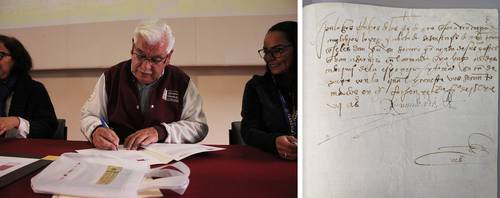
▲ Proclamation of Huejotzingo, signed by Fray Juan de Alameda in Huejotzingo, on June 24, 1554.Photo courtesy of AGN
Marlene Victoria López Torres, deputy director for the Protection and Restitution of Documentary Heritage, told this newspaper that recently “many issues of theft of ecclesiastical archives were identified, and she recognized that “there is a vulnerability of the collection due to its characteristics,” because they can easily be taken, coupled with the practices that some libraries or archives continue of not having a safekeeping room separate from the consultation area.
“In some archives, consultation is allowed within the storage area and that is a bad archival practice that affects the security of the documents.” He added that the theft from the historical collection is carried out by people inside the archive who are in collusion with crime and know the value of the documents in the market for collectors, a situation that was reported The Day in its edition of December 12, 2022.
In the commemorative forum of the International Day Against Illicit Trafficking in Cultural Property, an agreement was signed between the AGN and the General and Historical Archive of the State of Tlaxcala, with the purpose of strengthening the National and International Network of Guardians of Documentary Heritage. This strengthens the inter-institutional commitment to protect the country’s documentary memory against illicit trafficking.
This year, the AGN recovered the document Issue of payment for sixty pesos of gold dated February 20, 1527, which contains an autograph signature of Hernán Cortés, which was returned on August 13 thanks to the efforts of the government, the FBI and its Joint Task Force against Major Robbery, and the New York Police Department.
The archive also delivered the Proclamation of Huejotzingo, signed by Fray Juan de Alameda in Huejotzingo, on June 24, 1554, to the municipality of that Puebla entity. This document was recovered on May 21 by the AGN and the Ministry of Foreign Affairs (SRE).
Furthermore, on November 5, the AGN received the document entitled Villa de Santa Fe, New Mexico, of the SRE, which was repatriated from New Mexico, United States, to remain in the custody of the Mexican institution.
The original cartographic piece from the 18th century was delivered on September 23 by the FBI to the SRE through the Mexican consulate in Albuquerque.