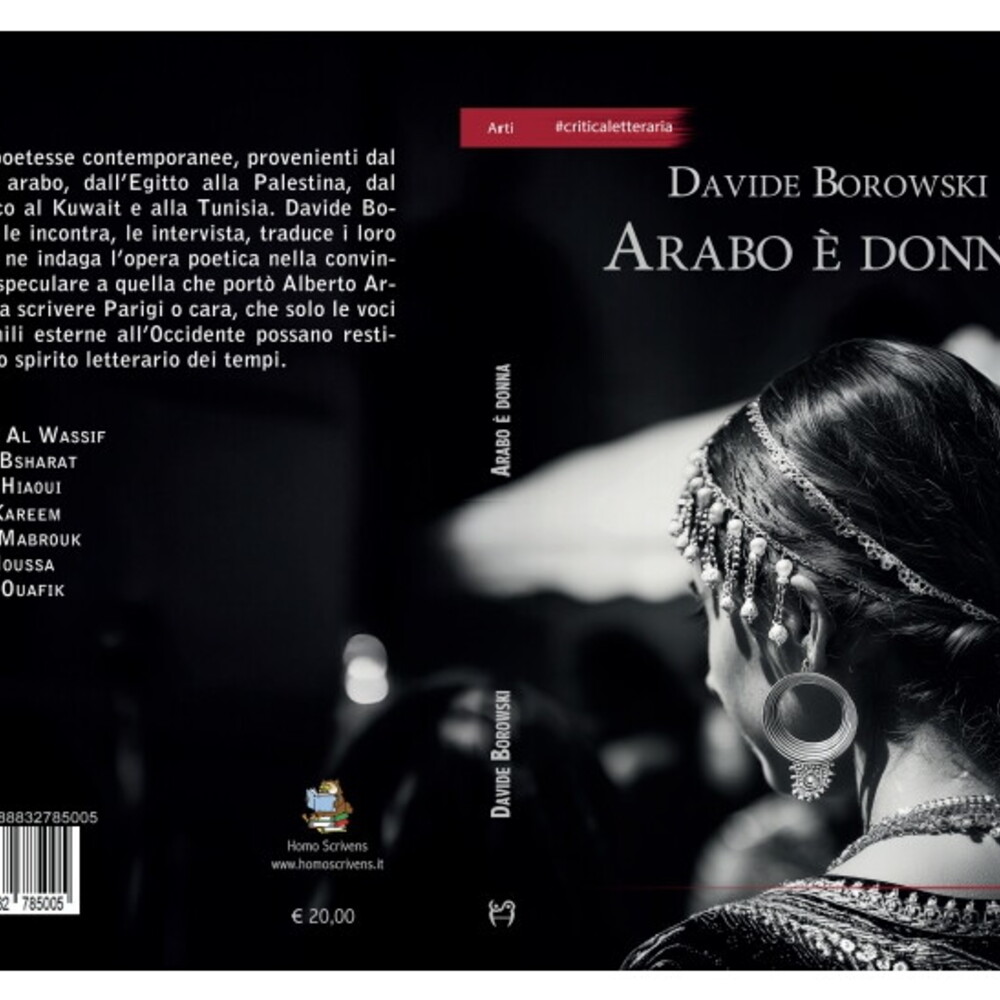
What does an ‘ugly and bad’ representative of the Spoken Word have to do with a book which, right from the title, seems to embody the sum of political correctness? Let’s talk about ‘Arab is female. Seven poets told using the oral history method‘, just published by Homo Scrivens. The author, Davide Borowskiis a performing poet who is quickly distinguishing himself in national poetry slams (performance poetry competitions in which slammers recite their lyrics live and are judged by the audience in the room). It is enough to listen to some of his works on the ‘Banda poetica’ podcast to realize that he is anything but a good guy: urban setting, street themes, often strong words, no concession, apparently, to romanticism. Perhaps the answer to the initial question is to be found in the fact that, after having traveled the world working in finance and cooperation, Borowski discovered himself as a poet just three years ago, during a long stay in a London hospital following heart surgery. Since then a new path has begun, culminating in 2025 with the inclusion among the finalists of the poetry section of the De André Prize.
The book
Three hundred dense, and often surprisingly lyrical, pages that cross the cultural universe of the contemporary Arab world taking on a purely feminine perspective. The essay is based on the belief that only the voices of women outside the West can truly convey the complexity and spirit of our time.
The seven poetesses
The core of the research is made up of the journey – or rather, the journeys – undertaken by the author to personally meet the authors and establish a direct dialogue with them. It’s about seven poets from different areas of the Middle Eastespecially Mediterranean, but in some cases – like that of the stateless Kuwaiti Mona Kareem, tracked down in the United States – forced into exile in other places because of their activism. Specifically, Borowski traces the human and artistic portraits of Amirah Al Wassif and Nadra Mabrouk (Egypt), Ahlam Bsharat (Palestine), Dalila Hiaoui and Mouna Ouafik (Morocco), Mona Kareem (Kuwait) and Imèn Moussa (Tunisia).
Oral history and thirdness
The programmatic choice is not to structure the text as an academic critic’s anthology, instead favoring the method of oral history. Ample space is given to biographical fragments, stories and confessions about everyday life that restore intact the sociopolitical background in which each author’s verses were born. Avoiding judging, altering or filtering, Borowski positions himself as a ‘neutral third’ who eschews both the attitude of the academic who pigeonholes poetry into Eurocentric patterns and the trap role of Western savior who attempts to speak in the place of Middle Eastern women. A step back that serves to leave room only for the voices of the authors and for the personal opinion that the reader can form on them.
49 translated poems
As a corollary to the story of the meetings and interviews, the essay contains 49 poems (exactly seven for each author), selected and translated by the author to show how the poetic word can transform itself into a tool of expression, resistance and redefinition of female identity in the Middle East and North Africa.
https://betwin360.eu.com/
https://betwin360it.it/
https://big-lucky.eu.com/
https://bigboostcasino.eu.com/
https://biglucky-no.org/
https://biglucky.eu.com/
https://billybets-casino.co.no/
https://billybets-no.org/
https://billybets7.com/
https://billybetscasino.co.no/
https://bison-casino.co.no/
https://bisoncasino.co.no/
https://bitstarz.co.no/
https://bizzo-casino.co.no/
https://bizzocasino.co.no/
https://bizzocasinos.eu/
https://blitz-casino.co.no/
https://blitz.co.no/
https://blitzbe.net/
https://blitzbe.org/
https://blitzcasino-be.org/
https://blitzcasino.co.no/
https://bluebet-au.com/
https://bluebet-aus.com/
https://bluebet-casino.com/