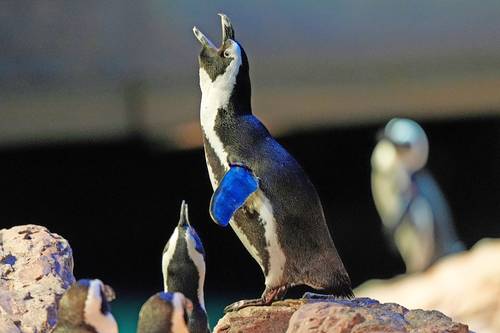
Boston. When Lambert As he began to lose his vision and walk more slowly, it became clear that he needed to be moved to a place where he could age safely and still be with his friends.
However, it could not be transferred to any nursing home, as it is a critically endangered African penguin. For this reason, the New England Aquarium in Boston, where Lambert33, was born and has lived his entire life, decided in February to open a geriatric island for himself and his six other elderly penguins.
“Honestly, it started as a joke. It was like, ‘What if we give them a nursing home?'” said Eric Fox, the aquarium’s associate curator of penguins. “But the more we looked at their wellness data and understood the ailments they suffer from as well as their physical limitations, the more we realized we had discovered something important.”
The rocky island near the aquarium entrance is separated from the rest of the colony of 38 birds, ensuring that the older penguins do not have to compete for territory with their often aggressive younger companions. These penguins, with their characteristic black and white plumage, measure about 60 centimeters tall and weigh about the same as a large domestic cat.
The facility has a flatter topography and a carpeted path down to the water, allowing Lambert and the other penguins move more easily around the island. The aquarium has built a platform in front of the island, making it easier for the penguins to get out of the water.
As a result, Mia Luzietti, the aquarium’s head penguin trainer, mentioned that she has seen Lambert more active since moving to the new island: he swims with his partner more and leaves the island more frequently.
Longevity in captivity
The concept arose from a larger concern affecting zoos and aquariums around the world: what to do when their animals survive much longer than their peers in the wild. In the case of these African penguins, some are over 30 years old and one lived to be 40. This is twice as long as they would live in the wild in South Africa and Namibia, due to threats such as pollution and food shortages caused by overfishing.
“It is critical that, as we learned how long these animals can live in an optimal environment, we have evolved accordingly,” Luzietti said. “So, learning on an individual level how we can give our animals the best conditions to thrive is what really led us to create our geriatric island, a place where our oldest penguins enjoy a more comfortable and peaceful life while they spend their final days here,” he added. Caring for elderly penguins goes far beyond a safer enclosure.
Older birds receive more checkups than younger ones, and veterinarians offer them treatment for ailments that might be familiar to older humans, such as supplements and anti-inflammatories for arthritis and joint pain, and eye drops for glaucoma. Additionally, more cameras have been installed on the island so that staff can better monitor it. “We are paying more attention to some of these older birds,” Luzietti said. “It’s important that we pay attention to those details: how their hips move, how they walk, how they behave, if they squint. The slightest daily change can hide a big secret.”
Recently, Luzietti was in the senior animal enclosure taking care of Lambertwho seemed content to be standing on top of the island with his companion Dyer IIIgrooming each other and occasionally emitting a loud bellow similar to the braying of a donkey. His left eye had been removed due to an infection and he suffers from glaucoma in his right. He also suffers from chronic inflammation. Luzietti took him down from his perch and soon he was sitting on her lap, preparing for his daily dose of eye drops.
When a crowd gathered around the enclosure to watch the birds, including Terri Blessman, a 69-year-old tourist from Canton, Illinois, who was pushed in a wheelchair by her friend Lou Ann Delost when she learned of the bird’s age. Lambert and the care she receives, Blessman expressed that she felt identified. “It’s wonderful,” Blessman said. “All seniors need additional care as we age.”