Astronomy|So far, only post-supernova dust and gas nebulae have been verified.
The summary is made by artificial intelligence and checked by a human.
Astronomers have for the first time observed the initial stages of the birth of a supernova. Until now, only gas and dust clouds left by supernovae have been observed.
The observation was made with ESO’s VLT telescope equipment in Chile in April 2024. The large star SN 2024ggi exploded as a supernova in a distant galaxy.
Astronomers gained new information about the death of massive stars and the birth of supernovae, researchers say.
Astronomers have for the first time observed the explosion of a large star, i.e. a supernova, shortly after the explosion.
Information about the birth of supernova SN 2024ggi was obtained IT:n that is, the European Southern Observatory with the VLT telescope. It is located in the Atacama desert in Chile.
The explosion was expected. A supernova explosion could therefore be observed quickly right after the explosion because the community of astronomers acted quickly.
Supernova The explosion of SN 2024ggi was first observed by a Chinese telescope on the night local time of April 10, 2024.
Reader Yi Yang About 12 hours after the observation, Tsinghua University in Beijing sent a request to ESO.
He proposed that its large VLT telescope be aimed at the supernova.
The VLT captured data from the explosion on April 11, 2024, just 26 hours after the initial observation.
SUpernova SN 2024ggi is located in a galaxy cataloged as NGC 3621.
As seen from Earth, the galaxy is in the direction of the constellation of the Water Serpent, about 22 million light-years away, says ESO bulletin.
“The VLT detected a phase where an explosion near the star’s center caused the star’s material to plunge through the star’s surface,” says Dietrich Baadean ESO astronomer.
This stage could no longer be observed a day later.
A scientific article about this appeared Science Advances in the journal. Yang is the lead author of the study, Baade is the co-author.
Supernova is created when a star more than eight times the size of the Sun runs out of fuel.
Then the core of the massive star collapses. The mass shells surrounding the core fall on top of the core and bounce off it. The blow spreads outwards.
An immense amount of energy is then released onto the surface of the star. A supernova is born, which brightens.
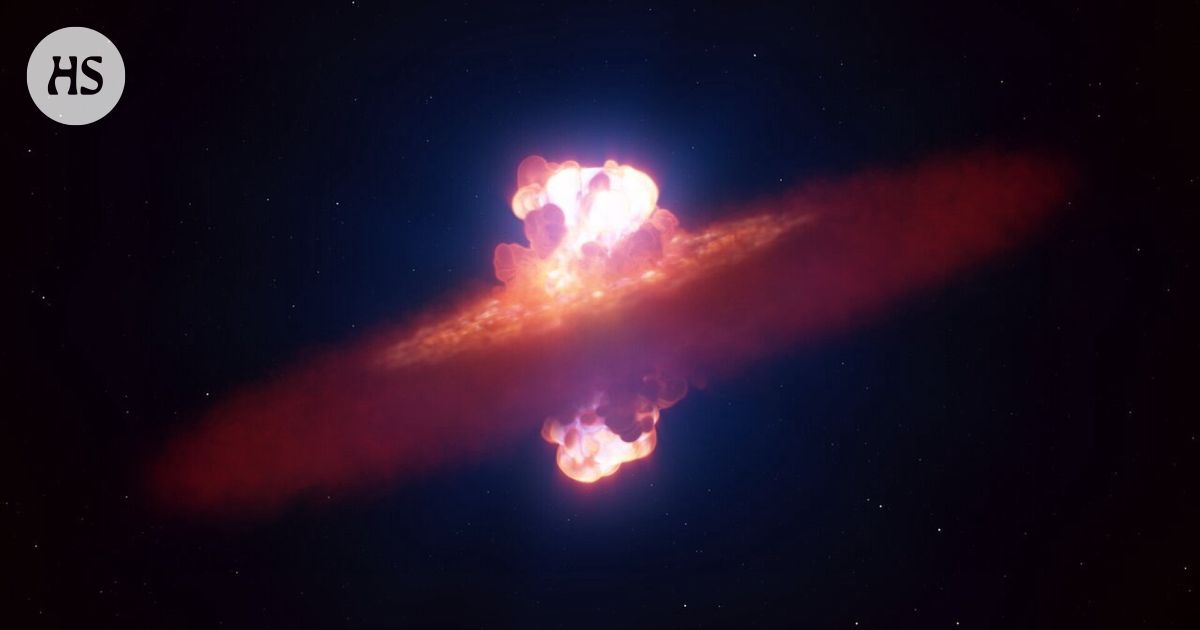
The explosion of the parent star of Supernova SN 2024ggi was a good example of this. It was originally a red supergiant with a mass 12–15 times the mass of the Sun.
“The geometry of the supernova explosion provides fundamental information about the evolution of stars,” says Yang.
The explosion had the shape of an olive. The geometry was studied at the VLT with a spectrographwho studied closely polarization of light.
Correction 13.11. 12:04 p.m.: Changed the word order of the first sentence. The original sentence talked about the explosion of a big star, or a supernova. It was the explosion of a big star, i.e. a supernova.