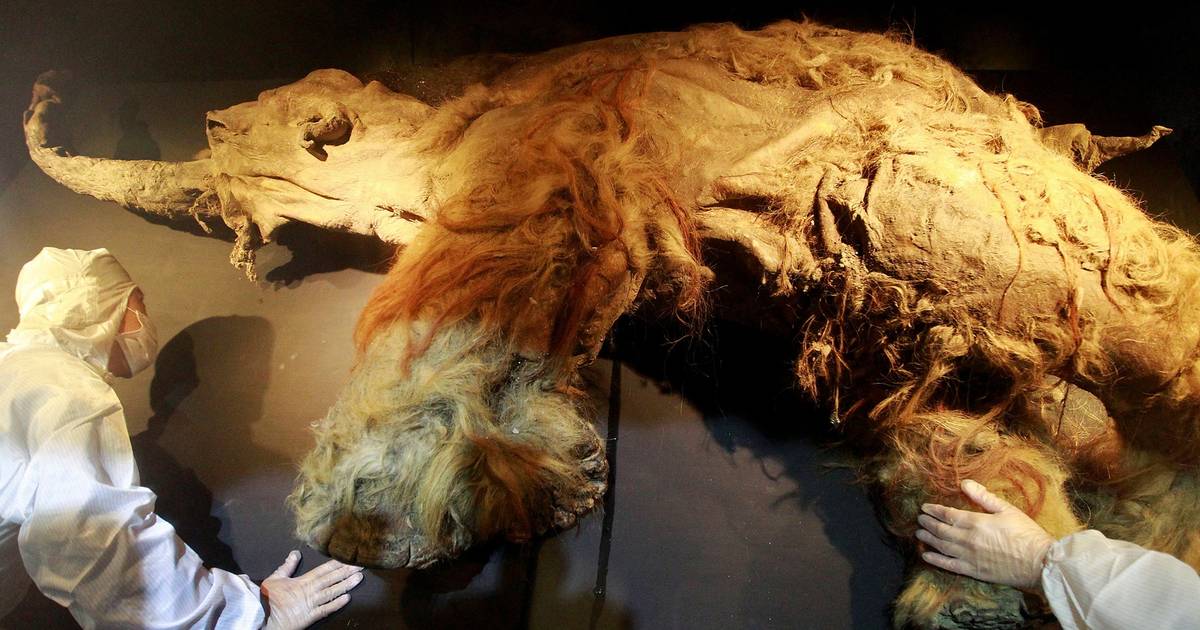
Scientists have managed to recover and sequence the oldest RNA molecules ever found, extracted from the remarkably preserved tissue of a woolly mammoth that died almost 40,000 years ago. The discovery, published in the prestigious journal Cell, not only pushes the boundaries of what we considered possible in paleogenetics, but also it also offers a unique window into the last, stressful moments of this Ice Age giant’s life.
A mummified young mammoth, named “Yuka”, was found in 2010 on the bank of a river in the Siberian permafrost. The eternal ice covered his body in incredible detail, from the reddish fur and trunk to the intact brain. But the greatest treasure was hidden at the molecular level.
More than DNA: What does ancient RNA say?
While ancient DNA can reveal to us the genetic code of an extinct species, a kind of “recipe book” for the creation of an organism, RNA (ribonucleic acid) reveals which “recipes” were active at the time of death. RNA are loud molecules that transmit instructions from DNA to cellular mechanisms, telling them which proteins to produce.
“With RNA, we can get direct evidence of which genes are ‘turned on’, offering us insight into the last moments of the life of the mammoth that walked the Earth during the last ice age,” explained Emilio Mármol-Sánchez, lead author of the study.
This is achieved all the more because RNA is considered an extremely fragile molecule that, unlike the more resistant DNA, breaks down within minutes or hours after death. The fact that its fragments have survived tens of thousands of years in the permafrost is a miracle and opens up a completely new field of research.
Yuki’s last moments
By analyzing RNA from Yuki’s muscle tissue, the team was able to identify genes that were active just before his death. They found high levels of RNA molecules associated with muscle contraction and metabolic regulation under stress. These molecular fingerprints confirm the theory that Yuki’s death was traumatic.
Deep scratches were found on his body, indicating an attack by predators, probably cave lions. “We could say that Yuka’s life right before his death was quite stressful, which left a mark on the molecular landscape of his muscles,” says Mármol-Sánchez. Although it is impossible to reconstruct the events with certainty, genetic evidence suggests that the young mammoth may have been running away from predators or struggling to get out of the mud it fell into.
During the research, scientists came to another surprise. Although the first analyzes based on anatomical features suggested that Yuka was female, the genetic material explained the second story. The presence of RNA from the Y chromosome, later confirmed by DNA analysis, undoubtedly showed that Yuka was a man.
The future of paleogenetics and the dream of “revival”
Although the title may suggest that we are on the verge of a mammoth revival, scientists are cautious. Love Dalén, one of the study’s authors, points out that these specific RNA fragments have little direct value to the “de-extinction” efforts led by companies like Colossal Biosciences, because the genes for muscle development are basically the same in mammoths and modern elephants.
However, this will turn out to be a key turning point. It proves that it is possible to study gene activity in long extinct species. “In the future, we should be able to use this approach to investigate how gene expression differs between extinct and living species,” said Beth Shapiro, an evolutionary biologist and principal scientist at Colossal.
In addition, the possibility of finding ancient RNA opens the door to studying the evolution of RNA viruses, such as the flu virus or the coronavirus. Studying pathogens preserved in Ice Age remains could help us better understand how viruses evolve and what risks they pose to modern ecosystems.
Yuka, a young mammoth frozen in time, gave us more than a fascinating glimpse into the past. His cells kept a biological archive that allows scientists to dream about discoveries that until recently belonged exclusively to the domain of science fiction.