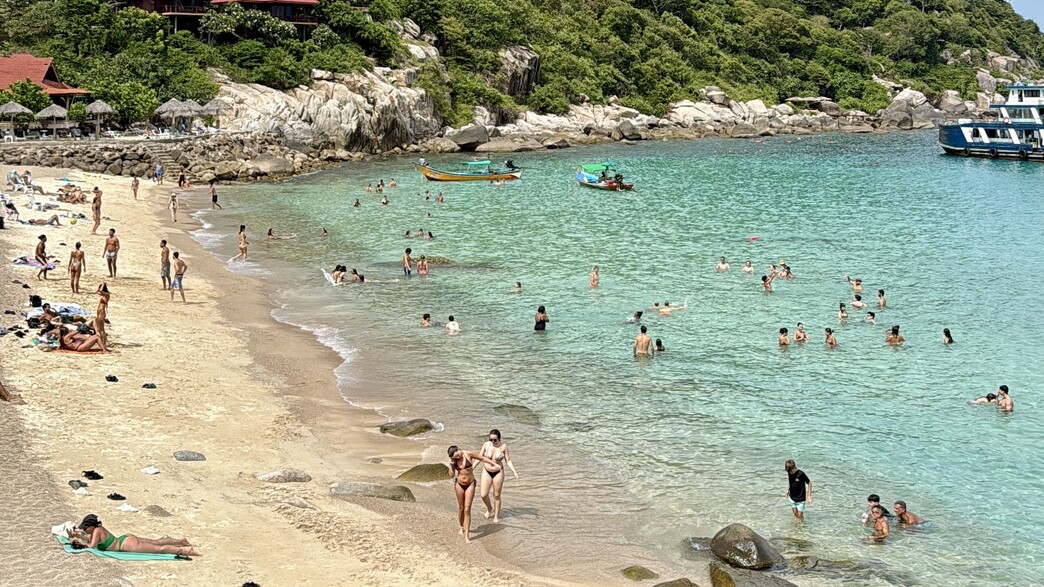
Against the background of the multitude of stories of the mess of the Israelis in Thailand in recent months, last September I went on a month-long trip with friends in Thailand. You know, like everyone else, to clear your head and escape a bit from the harsh Israeli routine. We took off optimistically for a 24-hour journey by air, sea and land that included 3 flights, a ferry, and taxis – only to find ourselves at the newly established Trumpeldor beach on land in the island nation.
We started our trip at a successful retreat complex in Copenhagen. When I booked the hotel, I fantasized how I would connect with people from all over the world around yoga classes, mindfulness and workshops. I quickly discovered that after all this arduous journey it turns out that I have not left Israel for a moment. The guests are Israelis, the place is run by Israelis, the guides are Israelis, and when I found out that shakshuka is served for breakfast and Mediterranean food is served for dinner – I realized that I couldn’t escape from it anymore. Alright, Thailand-Israel 2025 Here we come.
The highlight was in the “Zen” class I signed up for. We sat in a circle at the beginning of the lesson, and the teacher politely asked in English everyone who entered to close the door after them. After a few minutes, when Hebrew could be heard from every corner, he suddenly asked in Hebrew: “Doesn’t anyone here speak Hebrew?”. The room fell silent. In a surprised tone, he admitted that this is the first time this has happened to him, but how fun that now he can teach the entire lesson in Hebrew.
I thought that when I leave this Israeli complex, I will discover a different and more international Copenhagen. A thought that was quickly proven wrong. The movement around the island is accompanied by sirens, motorcycles that burst onto the road from all sides, and on them Israelis who drive without helmets at record speed. When sitting in restaurants and cafes, it is very easy to recognize us, when in every noisy group there is at least one Israeli with bandaged arms and legs, as a testimony to the wild driving for which he paid a physical price. It’s funny how in the crowded and busy streets you occasionally see second-hand vehicles offered for sale, which don’t even pretend to appeal to an English-speaking audience when the signs emblazoned on them are written only in Hebrew.
Our takeover of this small island is so complete that when you accidentally bump into someone while briskly walking down the street there is no need to politely say “sorry” and smile, because you can simply say in clear Hebrew: “Siliha”. People automatically address each other here in Hebrew, because the chance of running into a tourist from another part of the world tends to almost zero. And so, very quickly you get used to the clear understanding that everyone is Israeli like you. one by one.
The Thais began to adapt to the situation, and every pass by the “Banana Roti” stand is accompanied by chants of “My life” in Hebrew. Some of them also learned a more complex vocabulary that includes the random string of words, which you probably don’t learn in the first or tenth lesson of a Hebrew studio, “concentrated milk”. With so many Israelis in Thailand, the feeling is that without us this place will remain completely empty. And perhaps this island really has become economically dependent on us in a certain sense.
But over time it was evident that the Thais, known for their kindness and warm welcome, began to lose patience with us. Any attempt to haggle like a good Israeli in a store over the price of a product or a taxi ride is met with a complete refusal on their part, and sometimes with rolling of the eyes and downright anger. I have often sat in a restaurant and seen Israelis raise their voices at the Thai hostess when they complain about a long waiting time, or Israelis who try to force their way into a restaurant with a bare bathing suit, despite the requirement to cover up when entering restaurants and places of entertainment. And yes, more than once I have seen Thais put Israelis in their place with a firm voice and ask them to leave the place immediately.
“Suddenly I realized that there is an advantage to the Israeli takeover of the island”
This sense of ownership of the island brings out from some Israelis less pleasant sides that we sometimes discover about ourselves. In one of the hotels where I stayed, a group of Israelis brought a portable speaker and did not stop playing Mizrahi songs in the pool at full volume. Against the nose and anger of all the other guests in the hotel – they will force their music on all of us, every day and all day. Of course, not all Israelis behave this way, but a few cases are probably enough to leave a strong impression. And yet, I have experienced such wild behavior not only on the part of Israelis, and so, for example, the drunken British tourists at parties do not necessarily present a more polite and respectful appearance than us.
But after you free yourself from this inexplicable need to hear English and meet people from the world around you, and devote yourself to the full Israeli experience in Thailand – something opens up. Suddenly, the parties on Saturday evening at “Zen Beach”, a beach bar with a complete Israeli atmosphere, become a liberating and pleasant experience. From young people after the army, through spiritualists who went on a journey of discovery in the East to young hi-techists with children – it is impossible to ignore the fact that there is a connecting thread that connects us all in Thailand. Maybe it’s the stunning beaches, the cheap prices, the delicious Pad Thai, and the foot massage, but maybe on a slightly deeper note – it’s also the shared need for freedom, disconnection, and a little joy on difficult days.
And why are we even looking to mix abroad with people from all over the world at a time when everyone hates us so much? Why be afraid to speak Hebrew abroad when you can travel in a place with a full protection and security network of Israelis that will protect you in any situation? I suddenly realized that there is an advantage to the Israeli takeover of the island. The knowledge that you can behave freely, in an Israeli manner, not be afraid to speak Hebrew for a moment and not be afraid to answer people that you are from Israel – is amazing. I realized that this is perhaps the only place in the world where you can feel so safe even in times of war and global hatred. After all, there is no one left to hate us, when everyone here is Israeli.
A moment of such an outburst of pride met me in Kotao, an island not far from Kopenhagen, when we went to a drag show one evening. When the moderator asked where in the world everyone was from, more than half of the audience shouted “Israel!” Loud and applause took over the hall. It was so liberating – being able to shout loudly that you are from Israel in a foreign place in the world without fear. In one of the segments of the show, someone from the audience celebrating her birthday was put on stage so that everyone could sing “happy birthday” to her, but when she said her name was Noa, the whole audience started screaming in Hebrew. It is interesting how surprised the tourists from England and Germany who visited the show that evening, and the islands in general, were.
Whether you see this phenomenon as a cultural invasion or simply as the establishment of a supportive community during a war, there is no doubt that Copenhagen has today become a small representation of Israel. A place where our most beautiful sides such as solidarity, energy and creativity, live together with noise, arguments and impatience. What’s more, with the new guidelines recently issued by the Thai authorities for the behavior of Israeli tourists in the country, this situation is no longer a laughing matter. Our behavior, which may seem normal to some of us but is seen as disrespectful to the Thais, can very quickly damage the little Israeli paradise that was created there, the families and children who moved their lives there, and the delicate fabric of life that was created there in cooperation with the locals. So let’s not ruin it, shall we?