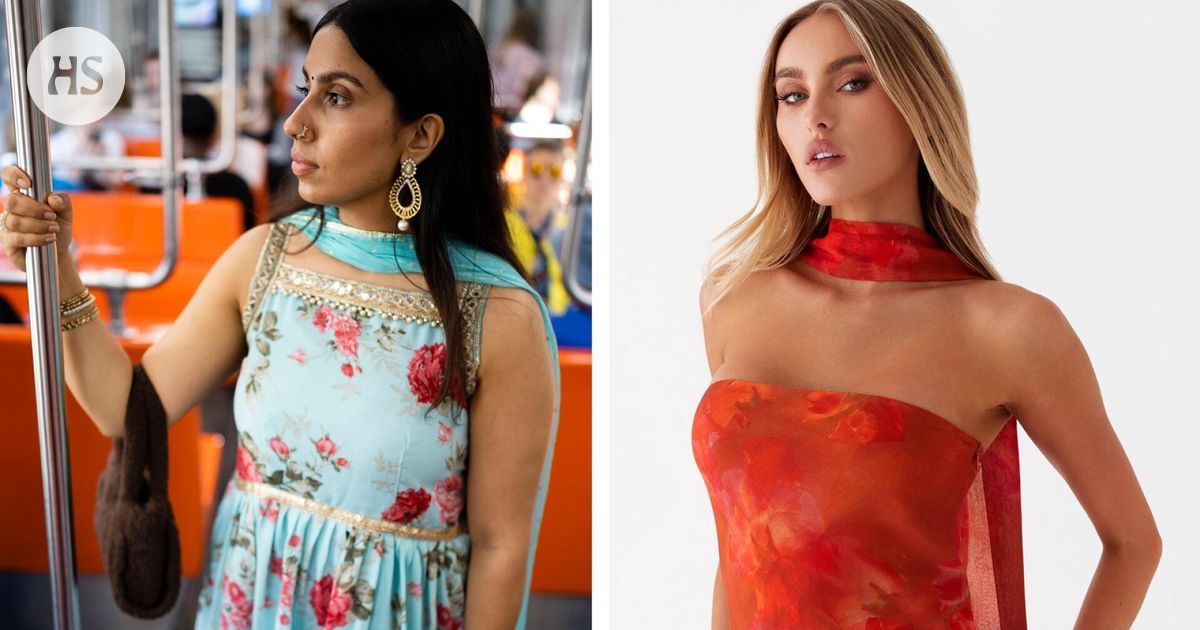
Fashion|The cultural ownership of clothing brands is not enough in the West, says Elisa Malik, influencer of social media.
Fresh The dress trend has sparked debate about cultural ownership in fashion media.
During the spring, dresses and tops have been featured in the clothing stores with the same color scarf. The garments are often translucent chiffon.
According to advertisements, the scarf of the dress or top must be placed over the neck and allowed to hang freely behind the back. Such combinations are currently sold, for example, by international clothing stores Reformation, Oh Polly and Peppermayo. Similar outfits with fashion influencers have been seen in Swedish Matilda Djerfin both the Finnish Sofia on the screen and Metti Forssell Above at the castle party.
The scarf that suits the dress or Topi has got your own term on social media Scandinavian scarf. The name has caused resentment, as a similar combination is familiar to traditional South Asian outfits, especially Indian party clothing.
The subject has been reported worldwide, among other things In the Australian Elle magazine and In Indian Indulge Express Media.
The British clothing store Oh Polly sells the dress in the picture as Imogene Scarf-Detail Strapless Gown.
In South Asia The scarf used for I live is called dupatta. However, it is a bit unclear why this style is now called Scandinavian.
The phenomenon may be a kind of a broken phone phone. It is reported that no clothing brand sells scarves under the name Scandinavian Scarf, and fashion influencers have not used the term at least in public, but it has already been breezing in somme.
The source of the term seems to be made by South Aseners Tictat videowhere they present their traditional outfits and call them sarcastically Scandinavian or European.
The videos are statements on the Tiktok video, which had a turbulent video last year, where an American woman described translucent, wrapping a scarf over the dress as Scandinavian or European. The video was removed shortly after public criticism.
Amused or annoyed by the video, South Asians were responsible for their own videos, which reminded them of the origin of the style. The videos also featured pictures of old Bollywood movies showing similar outfits.
In many In the videos, the authors emphasize that there is nothing wrong with the use of a scarf in Western fashion. They just hope that its origin is not mistaken for Scandinavian, and that Western brands will not fund with this misunderstanding.
Some people hope that the scarf will be called directly dating and that Western clothing brands would describe the clothes or outfits sold with scarves as South Asians.
This is how the Nepalese-Finnish social media influencer also thinks Elisa Malik; Malik also highlights the clothes called “Ibiza”, which are often inspired by the early 2000s bollywood movies.
Clothing brands are engaged in cultural ownership, Malik, real name Elisa Aryalsays. It’s a big problem in the West, but it is not talked about enough.
“When you fail to tell about the origin of the garment, it may be easier to brand it. Otherwise, people might consider whether the clothing from another culture is accepted,” Malik says.
Western clothing companies are likely to be largely Caucasian, Malik points out. Ignorance can be partially explained by it.
“On the other hand, if you have studied a fashion designer, you should be aware of more than European traditions.”
Future In Malik, the summer raises concern that, for example, he encounters a Caucasian influencer at a work event with a “Ibiza” outfit and a “Scandinavian scarf” around his neck. Then he would be interested in knowing where the clothes were ordered and how much the person knows the history of his or her clothing style.
“I wouldn’t approach with the attitude that a person has acted wrong, but of sheer curiosity. Maybe after our conversation, he could also share his knowledge with others.”
South Asian clothing style began to be clearly reflected in Malik’s choices about a year ago when he began to wear more boldly in Nepalese clothes. This week, Malik’s parents brought to him and his sister the outfits of Nepal, which Malik describes as stunning. The clothes were inspired by the Bollywood movie K3G – Days of Joy, Days of Sorrow (2001).
“My dream is to open a clothing store in Helsinki to sell South Asian clothing with a Western nuance. This is how anyone could use them,” Malik says.
Phenomenon has also confused Scandinavian. In the comments on Tiktok videos, many of those who call themselves Scandinavians are wondering what Scandinavian scarf has started.
“The Scandinavian scarf is wool and aunt/grandmother/mother knit. It’s cold here”, one commentator writes.