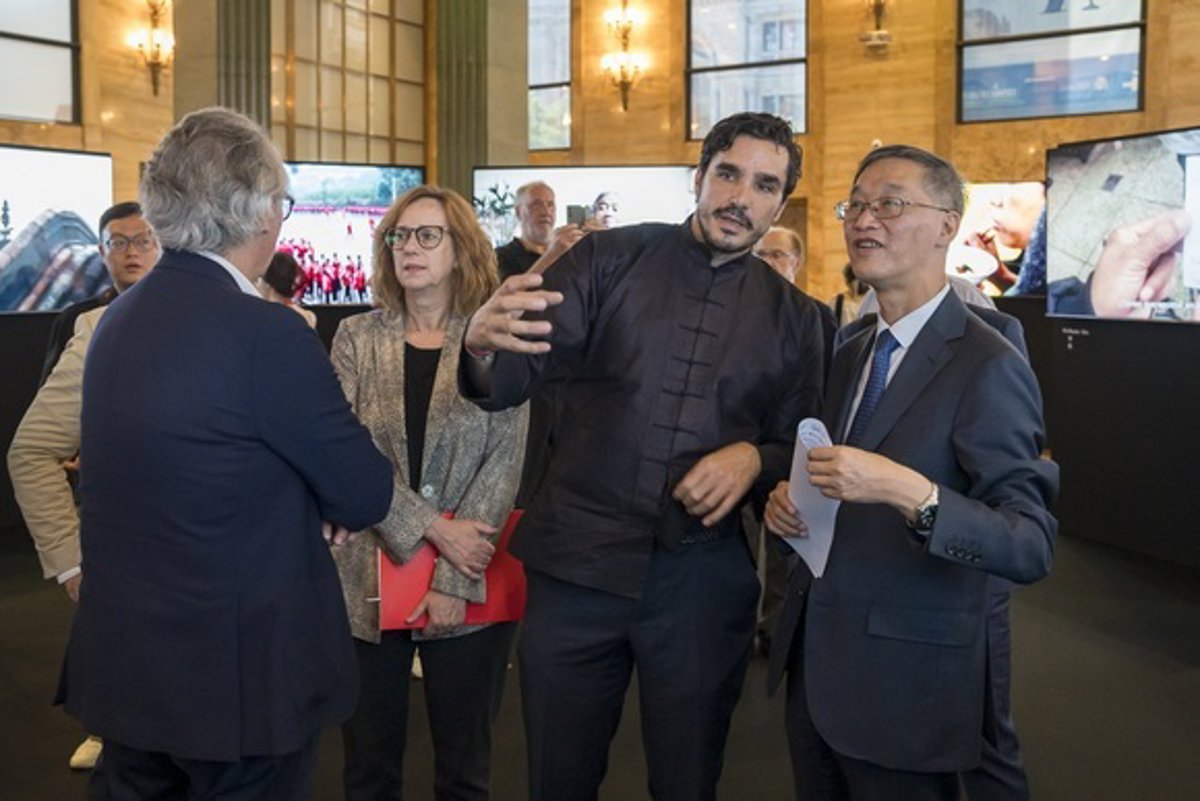
Cervantes Institute has opened this Wednesday at its headquarters, and within the framework of PhotoEspaña 2025the audiovisual exhibition ‘China 354’that explores, through the works of the filmmaker Luis Cuenca Castro, the relationship between natural cycles and contemporary life in China according to the old Chinese solar calendar, which divides the year into 24 stations.
Through 24 high definition screens that replicate the movement of the sun, the artist has created a series of 354 short filmswhich lasts a Chinese lunar year, filmed one per day and synthesized in a minute, in each of the 30 Chinese provinces, capturing fragments of everyday life: a real -time film experience, registering what he saw and letting the present events mark the development of the filming.
During the inauguration, the general secretary of Cervantes, Carmen Noguero, said that this exhibition is “a bridge between countries and, above all, between times.” “Looking is a way of being and stopping is sometimes a way of understanding “, He has added Noguero.
For his part, the artist, who has been living in China for more than 10 years, has confessed that the exhibition is a “A love letter to a country and its people, a constant observation exercise, filming the ephemeral and the eternal“. Through these” Time Capsules “, Cuenca says he reflected on the daily life of Chinese society.
Finally, the Chinese ambassador to Spain, Yao Jing, has assured that this exhibition will promote mutual knowledge between the two peoples. “I hope it serves to open a new window to the Spanish people, that of a real China, full of humanity,” he said.
“Spain has made many efforts to promote Spanish language and culture in my country and I want cultural exchanges between China and Spain to continue deepening“Jing said. The exhibition, which is curated by Jenny Chou and Larry Levene, will be open in the main lobby of the headquarters of the Cervantes Institute in Madrid until next August 31.