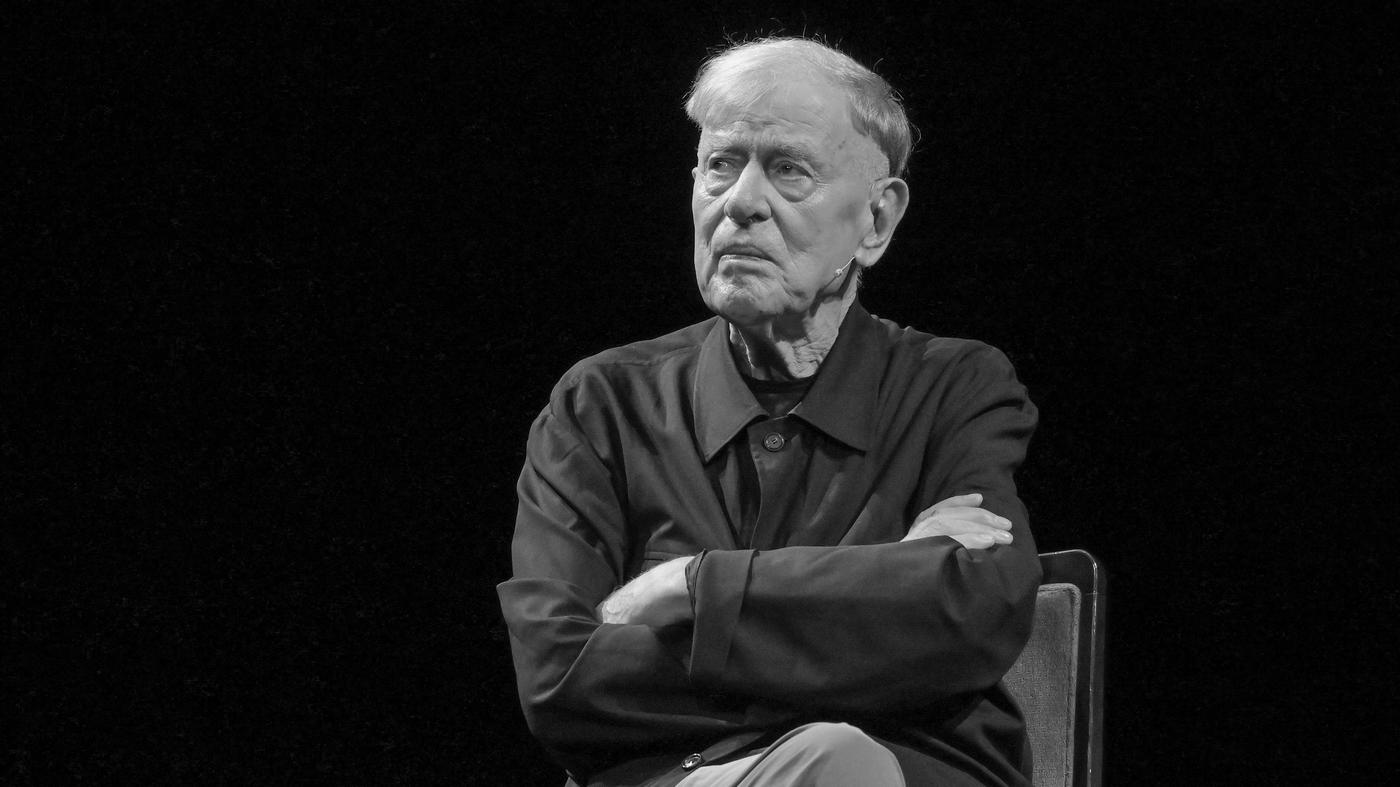
Visit to Peymann, in the Slevogtweg in Köpenick, Easter 2022. In the door of an old, listed villa, he stands, in black and leads me through the garden to the adjacent forest, with market jaws and chirping birds. We step off the whole property: Easter bells, a fox that raged, a small theater stage that has collapsed in the last storm. The sun breaks through the gray clouds.
“Striped from the ice are electricity and streams/through spring Holding, invigorating look …”, the man should now say how Faust on the Easter walk. Goethe. And he is really like Faust, I think this Claus Peymann, the old Bremer. And I’m Wagner, the student …
Peymann escape over the wild boars, who overcome his fence and eat the flower bulbs. There is no poodle like Goethe, but the Mephisto may be in one of these wild boars, I think. We eat roasted bread with homemade jam from the garden. “It’s the best jam that you get in Berlin! I have always done the best productions and now I’m doing the best jam!”
Faust or Mephisto
That’s right, I think. In contrast to Faust, Peymann never needed a Mephisto to become megalomaniac and want the impossible, because the Mephisto has probably always been in him. Faust and Mephisto together. I also saw great and megalomaniac Peymann productions: Bernhard’s “Heldenplatz” with Marianne Hoppe, “Richard III” with Gert Voss, “The Hermannschlacht” by Kleist, unfortunately only on television. “The jam is also extraordinary, Mr. Peymann,” I say and eat a bread with the jam after the other.
“Oh, the jam! I want to stage again, I’m 84 and the contemporary theater I see is toothless, opportunistic!” Yes, I think he comes from a time when provoking still helped. And theater scandals seemed to improve the world, Peymann was really like Mephisto, who always wants evil and always creates good.
A house full of books
Books all over the house, books everywhere: Thomas Bernhard, Walter Benjamin, Hans Henny Jahnn, Ionesco, Shakespeare, Kleist, Brecht. It looks like Goethe in the “Faust”. Writings everywhere, including newspapers – he reads the Tagesspiegel. Two obituaries on Herbert Achternbusch and football player Jürgen Grabowski are open on the secretary. I see a handke manuscript on the sofa. “Handke calls me every week and insulted me, I invented him, as I also invented Bernhard!”
With a jerk he pushes the jam he invented aside and leads me into the correspondence room. Countless black folders with letters from Bernhard, Handke, Jelinek, Turrini, Brasch – I wouldn’t be surprised if there are letters from Goethe.
“A letter from Rinke is also somewhere here!” Says Peymann, “Between Reinshagen and Rühmkorf. I rejected a piece of them, almost like Botho Strauß in the best moments!” “Really?”, I blush and look at him incredulously. “But they lacked the visions, everyone is missing the visions! But now that they ate from my jam, that will change, now I would stage them! But where? Where?!”
“Bremen?” I say softly. “Bremen … Bremen! Then everything started! Grew up in Kirchbachstrasse, high school in Hermann-Böse-Straße, flown from the school, then high school on Waller Ring! Bremen invented me! The Kirchbachstraße and the 68 movement invented me!
“But in Bremen they only do projects, they don’t like plays there,” I say. “Then first bring a glass from this jam to Bremen to the theater! You will see what happens then: My jam theatrically!”
King with a cardboard crown
The last time I saw Peymann on his 85th birthday, he was sitting in his garden in Köpenick on a small, wooden open -air stage. He had given his guests the instruction to bring a photo from their childhood. He let all photos hang on a clothesline and called a jury that had to determine the carriers of the “fleeting price”.
He sweared like the theater maker Bruscon with Bernhard; Like Prince Homburg of Kleist, he dreamed – and he was often as bad as Richard III. By Shakespeare.
Moritz Rinke, playwright
And so at some point Peymanns Gärtner with his children’s photo stood next to the famous actress Ilse Ritter (“Ritter, Dene, Voss”, Thomas Bernhard!), And the theater director had fleet prices presented in the form of glasses of his jam from the blackberries of his garden. Perhaps it was his last director’s instructions. And a girl put a paper crown on him.
His eternal theater dramaturge Hermann Beil, who held the birthday speech, then spoke about the madness and megalomania of his eternal theater director. To be insane without being insane, that is art, said Beil.
© AFP/Tobias Steinmaurer
Maybe Peymann was always the best theater himself. You never really knew whether he might not think himself in one piece or in a staging. He sweared like the theater maker Bruscon with Bernhard; Like Prince Homburg of Kleist, he dreamed – and he was often as bad as Richard III. By Shakespeare.
Maybe there was really a lively, real theater figure with a paper crown on the garden stage in Köpenick, I thought. Perhaps you would have to be in quotation signs like a title: “Peymann” – a play between invention and life.
At some point, Peymann said at his birthday party that he could be opened here in the garden, one day when he was dead. He also wanted to die here – in summer, naturally on the open -air stage in front of the blackberry bushes. And so it happened. He died this summer on July 16. A few days ago, Claus Peymann was laid out in Vienna at the Burgtheater’s festival. This Friday he will be buried in Berlin, on the Dorotheenstadt cemetery. On October 25th, the Berlin Ensemble, which it has led so long, will be commemorated in a matinée.