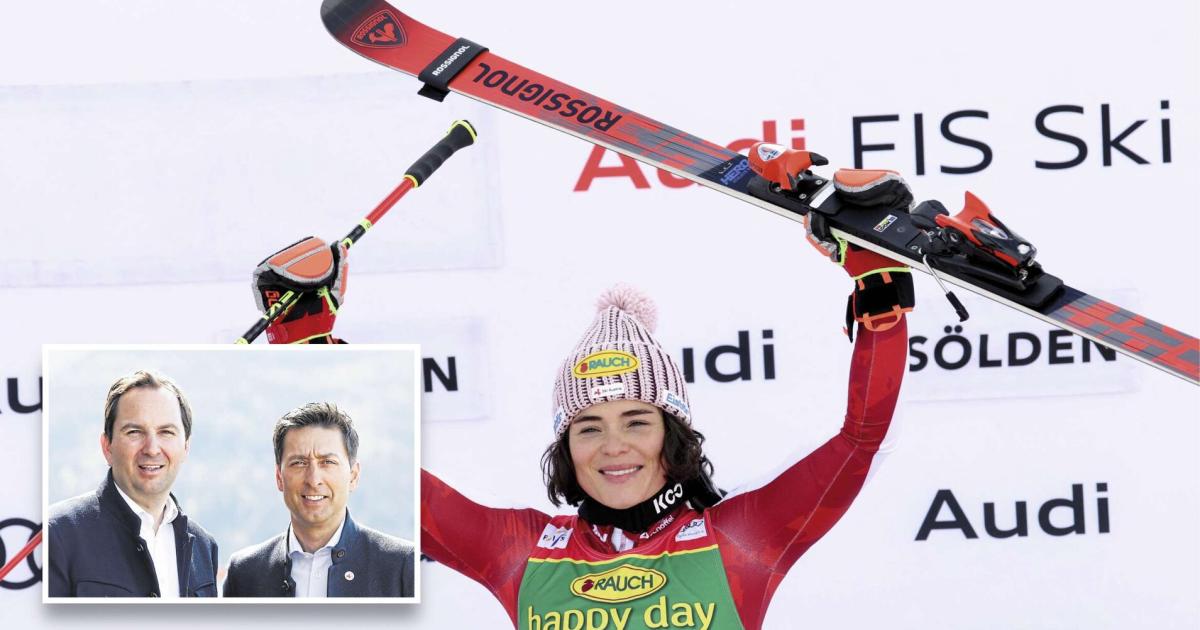
Has been in power for a year and a half Austrian Ski Association one Dual leadership: Christian Scherer acts as managing director and CEO, Mario Stecher is also managing director and sports director.
The KURIER met the duo for a double interview before the start of the World Cup in Sölden.
KURIER: What’s the situation with the ÖSV right now?
Engraver: I feel a sense of optimism again. That hasn’t always been the case in recent years. Such successful events as the home World Championships in Saalbach, the sold-out Bergisel ski jump or our home World Cups show the importance that winter sports have for us.
Scherer: Our membership numbers are increasing, the TV ratings are also going up, we are an interesting partner. Just this week we presented two new sponsors, Bybit and Intersport, and extended the contract with the WWP Group until 2034.
Open/close copyright notice
© APA/EXPA/JOHANN GRODER / EXPA/JOHANN GRODER
ÖSV President Roswitha Stadlober flanked by Mario Stecher (left) and Christian Scherer
Was the image worse three or four years ago?
Scherer: After over 30 years of very, very good leadership from Peter Schröcksnadel and his team, the association needed a certain amount of time to find itself. They certainly weren’t easy times: with the succession dispute, with issues like post-Covid, the energy crisis or the messy situation with FIS President Johan Eliasch. There was some unrest.
I like to compare the ÖSV with a large steamer: you can’t maneuver it too quickly, otherwise it will tip over. And a steamer simply needs a certain amount of time to take a new direction and pick up speed again. There is also a certain willingness to change in the ski association. The structures were certainly good, but in such a fast-moving time, adjustments were and are necessary.
Then there is less money for sport
The challenges are not without: keyword wage spiral, inflation, etc…
Engraver: If the wage spiral rises disproportionately to income, then at some point there will simply be less money left for sport. This is a huge challenge that particularly affects Austria. With all the political measures that were taken – or unfortunately not.
What is still possible and what is absolutely not possible?
Might it be easier for a smaller association with fewer athletes and fewer divisions?
Engraver: You will definitely have to start making priority lists at some point. What else is possible? What no longer works? What can we no longer afford in this form? For example, we are currently discussing the inclusion of freeriding. We really don’t want to stand in anyone’s way, but as long as there are no clear rules for this sport from the FIS, we have to consider integrating it into the ski association. The cake isn’t getting any bigger. If wage costs rise and new areas are added, things will become difficult at some point.
Does an association like the ÖSV really have to claim to be successful in all areas?
Engraver: We are of course discussing this and want to have a clear commitment from the Presidential Conference and thus from the state ski associations: What else do we need? Where do we want to develop in the future?
Scherer: It’s also about the structure behind it. It won’t do us any good if we as the ÖSV continue to promote all of our disciplines to the same extent as before, but the regional associations are not in a position to financially support these disciplines. Then the shuttle service won’t work and you’ll waste money pointlessly. These are important strategic decisions that we will have to make in the near future. As a state, we all know that federalism eats up a lot of resources, so we don’t have to complain, we just have to do better within our sphere of influence and make the overall structure more efficient.
Engraver: We do not want to and cannot take anything away from the functioning divisions so that we can finance other divisions. This hits us on the head. That is the area of tension.
Scherer: It’s no secret that we primarily generate income from alpine skiing and ski jumping, which we then use to finance the other divisions.
Open/close copyright notice
© APA/GEORG HOCHMUTH / GEORG HOCHMUTH
Does the ski association have to save money in top-class sport?
Engraver: At the moment things are still going absolutely well. Apart from Switzerland, there is probably no other association that can offer athletes such opportunities. But if you take it a step further, you really have to merge or delete things. Then you have to make the large apparatus more efficient.
Scherer: We are currently trying to keep things going as they are and mitigate all negative factors. Be it the wage-price spiral, but also cuts in sports funding. What do we do? We are trying to compensate for this with additional commercial income. We’re still doing quite well, but it requires a lot of effort. It would be important if one felt a vision in Austrian sport and could also orientate oneself towards it.
In your opinion, what is the general state of Austria as a sporting nation?
Scherer: Unfortunately, the status of sport is still not where it should be. Unfortunately, topics such as health care or relieving the burden on the health system are neglected. Sport could play an important role for society, especially in these areas.
The sport deserves more attention
Engraver: If there is no clear commitment from politicians to sport itself, and therefore also to top-class sport, it will be difficult to continue to be at the top. Sport must be independent of party politics. Unfortunately, we are far behind compared to other nations.
Scherer: The sport deserves more attention. More so than ever when I think about the fact that children already have a lack of exercise. I generally lack a positive mood in Austria. This also applies to winter tourism, which is actually one of the most crisis-resistant sectors. You could learn a lot from sport and winter tourism, where you can find a lot of idealism and a great willingness to make courageous decisions. Winter tourism faces the challenges and successfully adapts to changing circumstances. They can’t dismantle their hotels and mountain railways and go abroad because the non-wage labor costs are lower there. With its many World Cup events, the ÖSV also wants to contribute to a positive atmosphere in Austria – we also see this as our socio-political mission.
What has to happen for you to talk about a successful winter?
Engraver: The Austrian Ski Association stands for success. It’s in our DNA. When I think about the Olympics: Of course we don’t just want to and should compete for medals, we also want to win them. At the last games there were always 13 or 14 medals, and things should go in that direction again. What is much more important to me personally is that we are able to fight for the top places in every division. The public’s focus may be on the Olympics, but for us the whole winter counts. Then we come to Christian, external representation and advertising – the task is to present a positive image as an entire ski association for years to come. This is much more important than a single major event.