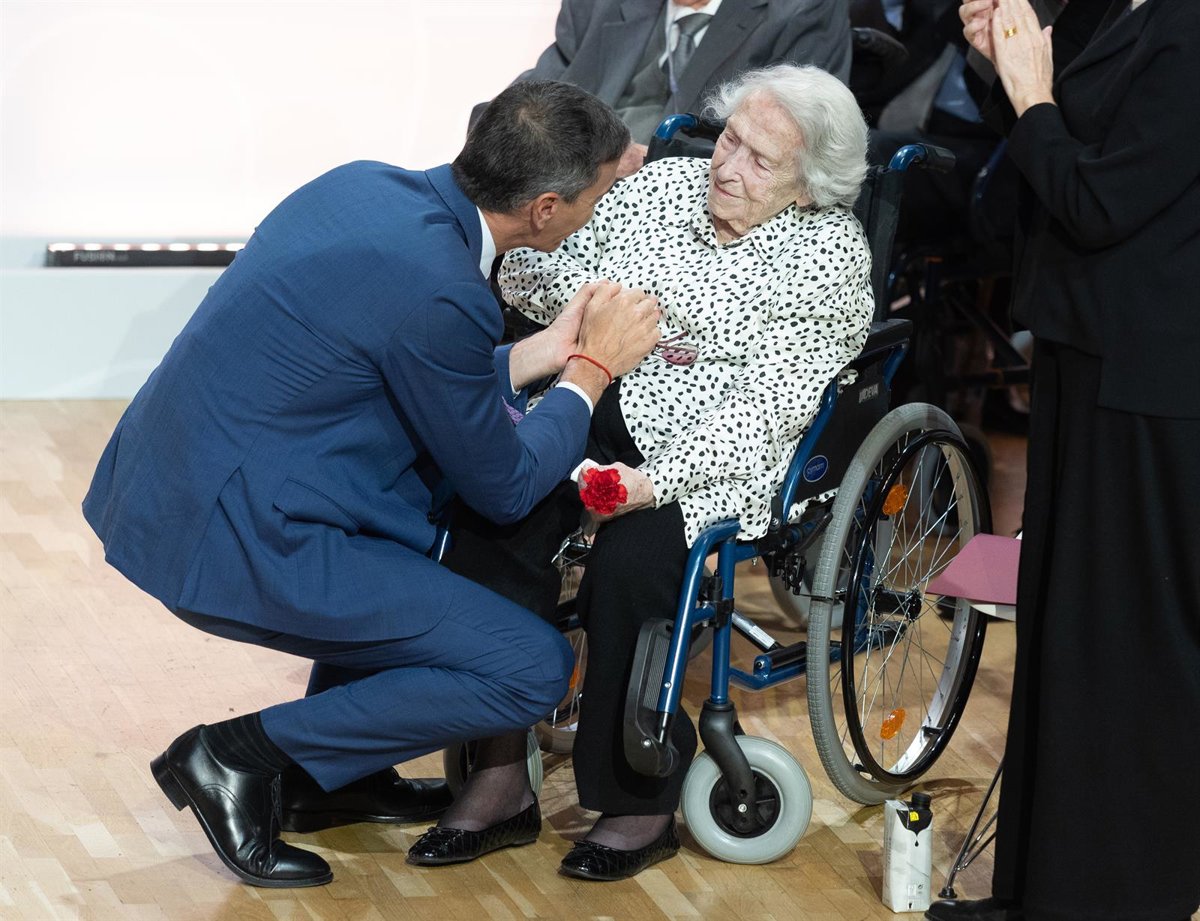
The Government has paid tribute and officially declared victims of the Civil War and the Franco dictatorship, the poet Federico García Lorca, the filmmaker Luis Buñuel and the philologist María Moliner and the painter Maruja Mallo as well as several militants, socialists, communists and victims of stolen babies, under the Democratic Memory Law.
The President of the Government, Pedro Sánchez and the minister of the branch, Ángel Víctor Torres, have delivered the diplomas of recognition to relatives of 18 victims in total, in an event for the day of remembrance and tribute to the victims of the military coup, the War and the Dictatorship, at the National Auditorium in Madrid.
Moliner (1900-1981) Librarian, archivist, philologist and lexicographer, in the decade 1929-1939 she took an active part in national library policy, collaborating with the Institución Libre de Enseñanza in projects such as the Pedagogical Missions and actively participated in creating the small library service during the Republic.
His “Dictionary of Spanish Use” constitutes “a milestone in the history of the Spanish language” and is part of the so-called “internal exile” of people who did not support Francoism, but remained in Spain after the war.
Buñuel (1900-1983) was a surrealist film director, critical of “religion, the bourgeoisie and social conventions,” according to the gloss prepared by the Government. During the War he supported the Republic and, after Franco’s victory, he went into exile first in France and then in Mexico, where he carried out much of his most recognized work. He died in 1983 in Mexico City.
Lorca (1898-1936), poet, playwright and key figure of the Generation of ’27, republican, “friend of left-wing intellectuals and homosexual, which made him a target for the rebels,” the Executive indicates that it considers him the “poet and universal martyr of the Spanish war.”
He was arrested by Falangists in Granada and extrajudicially murdered on August 18, 1936 in one of the places in the Víznar-Alfacar ravine.
María Luisa Ramos, (Avilés 1927) exiled to France and deported in 1940 in “Convoy 927” to the Mauthausen camp, which she herself received recognition.
The list of honorees is completed by Vicente Rojo Lluch (1894-1966), a Spanish soldier loyal to the Republic who was Chief of the Central General Staff of the Popular Army during the war. At the end of the war he was exiled in France, Argentina and Bolivia. In 1957 he returned to Spain where he was tried for “aid to the rebellion” and lost his military job.
Antonio Menchen Baartolomé (1902-1939) Railway worker. Member of the UGT and affiliated with the Manzanares Socialist Group. He was third deputy mayor of the Manzanares city council and private secretary of the Civil Governor. “Savagely tortured, he was sentenced to death in a War Council, and was shot on June 15 at the age of 37,” according to the Government.
Margot Moles Piña (1910-1987) was a pioneer athlete in women’s sports in Spain. After the establishment of the Franco regime, her husband was shot and she was forced to abandon her position as a teacher and her sports career.
Manuel Mina Picazo (1908-1942), husband of Margot Moles, was a Spanish skier and soldier, who fought in defense of the Republic during the war. Once the war was over, he was summarily tried by a military court, sentenced to death and shot in Madrid on January 17, 1942, on the walls of the Almudena cemetery.
Dieo José Paulino Ventaja Milan (1880 -1936) Spanish religious who held the position of bishop of the diocese of Almería between 1935 and 1936. He was murdered at the beginning of the war, along with the bishop of Guadix, Manuel Medina Olmos, a victim of religious persecution. He was beatified in Rome by John Paul II in 1993.
Joaquin Moreno Tormos, CNT-FAI activist. He was murdered during Franco’s regime on October 31, 1939 in the Eastern Cemetery.
Josefina Samper Rojas (1927-2018), was a communist militant and worker activist, wife of Marcelino Camacho, general secretary of the Workers’ Commissions.
Melchor Rodríguez García (1893-1972) Spanish trade unionist and anarchist, councilor, prison delegate and briefly mayor of Madrid at the end of the Spanish War. He was known as The Red Angel for his humanitarian work to prevent murders of right-wing prisoners in the Republican rear from his position as prison delegate, highlighting his management in stopping the continuity of the nighttime murders in Paracuellos del Jarama.
Ana Belén Pintado Lucas Torres, (1973) at the age of 44 discovered that she was a stolen baby and managed to find her biological mother, who for almost five decades believed that her daughter had died at birth. In December 2022, Pintado filed a complaint against the Santa Cristina maternity hospital for crimes of detention and illegal abduction.
Pilar Villoria García, biological mother of Ana Belén Pintado whose baby was taken from her at birth at the Santa Cristina Maternity Hospital in Madrid, making her believe that she had died.
Manuel Ciges Aparicio (1873-1936) journalist, writer and politician, assigned to the so-called Generation of ’98. He had held the position of civil governor in several provinces after the triumph of the popular front and at the time of the outbreak of the War he was in charge of the civil government of Ávila. He was extrajudicially executed and buried in the Ávila cemetery.
Ana María González, “Maruja Mallo” (1902-1995), Galician surrealist painter, linked to the Generation of ’27 and the avant-garde movement in Spain. With the outbreak of the War and the advance of Francoism, he went into exile in Argentina, where he continued to develop his work.
Cristino Gómez González, “Cristino Mallo” (1905-1989), brother of Maruja Mallo, sculptor, national architecture prize. During the war (1936-1939) he became involved in the Republican side, participating in the Alliance of Anti-Fascist Intellectuals. After the war, while his sister went into exile, he remained in Spain in what has been called internal exile, including a stay in prison.
The twelve seamstresses of the Viznar pit. Twelve women, belonging to the seamstress union murdered in the Víznar Ravine.