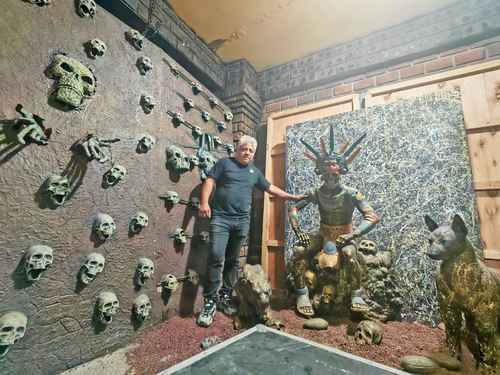
The Plaza of the Three Cultures – an emblematic site where the pre-Hispanic, colonial and contemporary lives of Mexico converge – is the scene of a double historical claim.
500 years after the assassination of Cuauhtémoc at the hands of Hernán Cortés –accomplished according to some sources on February 28–, the artist Cristóbal Ochoa installed a mega-offering there that not only honors the memory of the last Mexica tlatoani, but also seeks to vindicate the lordship of Tlatelolco, the twin city of Tenochtitlan that “for centuries has lived in the shadow” of its older sister.
This monumental artistic installation is presented from today until November 9 on the occasion of the celebration of the Day of the Dead, thanks to the efforts of that creator and his team from Taller 8A, with the support of the Tlatelolca Citizen Council and the Ministry of Culture of Mexico City.
An automotive engineer by training, the painter, sculptor and engraver born in the Guerrero neighborhood 50 years ago conceived this great offering – which transforms that capital space into the entrance to the Mexica underworld – as “an act of historical justice” and an educational journey that delves into the deepest roots of our pre-Hispanic worldview.
“I wanted to do a historical work. At first, I thought about the last battle of Cuauhtémoc; but due to lack of time it was not possible. Then, I came up with a ball game between the gods in Mictlán (the underworld in the Mexica worldview). The idea is to tell the story of how (in ancient Mexico) we lived with death and what it meant to transcend that place,” explains Ochoa in an interview.
The central narrative of this piece, developed with the advice of historian Miguel Mares, a specialist in Tlatelolco, recreates the trip from Cuauhtémoc to Mictlán, through pictorial and sculptural elements.
The premise is that, by not having an honorable death, the tlatoani could not ascend to the solar paradise and was destined for the underworld. There, in an act of epic recognition, eagle and jaguar warriors hold a ritual ball game in their honor.
“The idea of the game is that there will be a forgiveness so that he can be elevated,” he points out. “We are vindicating the last tlatoani, because they capture him and, although he asks Cortés to give him a dignified death, he does not do so, and therefore he goes to Mictlán.”
The heart of the installation – in addition to a ball court 20 meters long by 10 meters wide – is the recreation of a pyramid seven meters high and seven meters wide, inspired by the original structure of Tlatelolco. At its foot lies a tzompantli (wall of skulls), while at its peak an empty throne awaits Cuauhtémoc, guarded by his grandparents.
living offering
This structure is more than a symbolic monument: it is also a living offering, since inhabitants of the neighborhoods of Tlatelolco, Guerrero and Tepito – which in ancient times were part of that manor – intervened in the niches of the pyramid with photographs and candles to honor their deceased loved ones.
“What better than this work being located in the Plaza de las Tres Culturas, a place as important as the Zócalo,” reflects Ochoa. “In pre-Hispanic times there were two lordships that were always in battle. Yes, Tenochtitlan won, but Tlatelolco was a large and important lordship.”
The tour of the offering is a sensory immersion in the nine levels of Mictlán. Visitors will be able to walk along sawdust mats and among monumental paintings measuring three by two meters created by artists from Taller 8A and a group of graduates from the Faculty of Art and Design of the National Autonomous University of Mexico (UNAM).
On the first level, you will be greeted by a disturbing pack of skeletal xoloescuintles guarding the underworld river. In the ball game, meanwhile, about a dozen impressive skeletons of eagle and jaguar warriors, 3.50 meters high, seem frozen in the heat of the ritual match.
“It is not a common offering for the dead. It is a work made by artists that has a complete narrative and an educational sense, unlike other proposals, where the elements are isolated and even incorporate and mix issues from other cultures, such as Halloween. Here it is a vindication of our history,” underlines Ochoa.
The installation – which opens today at 5 p.m. – includes two pairs of giant wings, so that people can take photos with them; two giant screens on which films for children will be projected – including Coco y Aztlán– and short films related to Mictlán for adult audiences, as well as floral arrangements. From today until October 2, there will be a tlalmanalli (celebration of pre-Hispanic origin) in which shamans will burn copal and say prayers.
For Cristóbal Ochoa, this may be the beginning of a tradition in Tlatelolco in terms of setting up these great offerings.
“I am proud and honored that they have allowed me to present an exhibition of such magnitude in this important place. I was born and raised here, I am from Guerrero,” says the artist, who also carries out community work in the area at the head of Taller 8A, a project that he has headed for almost 30 years and in the course of which he has collaborated with important creators, such as Ángela Gurría (1929-2023), Gabriel Macotela, Roger von Gunten, Alejandro Santiago and Demián Flores, among others.