The Director of the Department of Health of Hung Yen province revoked the operating license for Emergency Transportation Center 115 due to the discovery of many violations during its operation.
The decision to revoke was announced at the end of October, based on the working minutes on October 17 of the interdisciplinary inspection team of the Department of Health and Hung Yen Provincial Police. The inspection team recorded many violations during the operation of this center.
Specifically, the Center operates at the wrong licensed location, does not have a sign, and does not report to the competent authority when changing practitioners or emergency transport vehicles.
This center was granted an operating license by the Hung Yen Department of Health No. 000042/YT-GPHD on April 25, 2013, address 86 Dien Bien, Pho Hien ward, Hung Yen city, the person in charge of expertise is doctor Tran Thi Duyen.
According to the decision of the Department of Health, from the date the license was revoked, Emergency Transportation Center 115 Hung Yen is not allowed to operate in any form. Currently, this Center has no response.
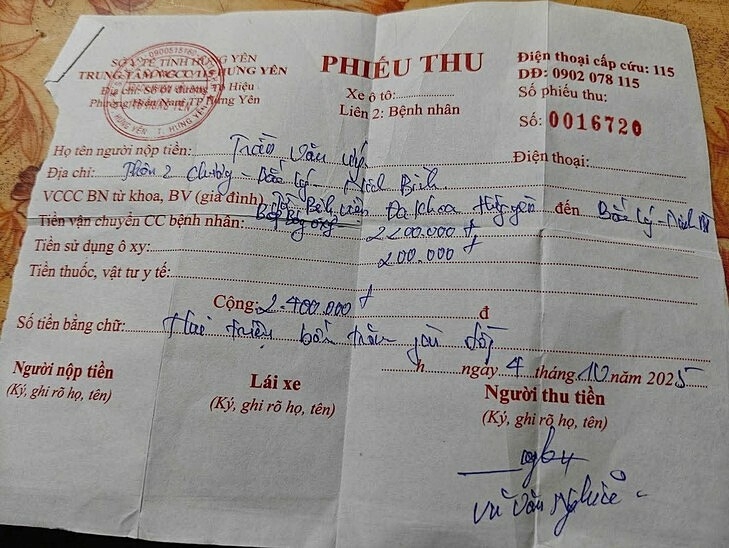
Receipt of 2.4 million VND for a distance of 12km. Photo provided by the patient’s family
The interdisciplinary team inspected the operations of this Center after a family in Ninh Binh reported having to pay 2.4 million VND to rent an ambulance to take their dying relative home, even though the distance was only about 12 km, in mid-October.
The family said that their mother was being treated at Hung Yen Provincial General Hospital and her illness became worse, so they asked to take her home to take care of her. The son asked the hospital to contact ambulance 115 to take his mother home, about 12 km from the hospital.
When we got home, the driver announced that the total transportation cost was 2.4 million VND. Thinking that the fee was too expensive, the family reported to the 115 Hung Yen Emergency Transportation Center. The center representative explained that this cost included many expenses such as the doctor’s labor to squeeze the balloon, the driver’s labor, gasoline, vehicle depreciation, oxygen and other expenses.
In fact, the cost of emergency out-of-hospital transportation is currently “different for each place” because there is no unified price framework applicable nationwide. Each locality develops its own price list decided by the Provincial and City People’s Committees, leading to differences. The price depends on the facilities, human resources and the list of medical techniques used during the transportation process.
In Hanoi, the price of out-of-hospital emergency services applies according to the Decision of the City People’s Committee from 2017. For example, a distance of less than 5 km costs 500,000-600,000 VND, while a distance of 51-100 km costs 1-1.6 million VND. However, this price was based on base salary and market factors nearly 8 years ago, so it is no longer appropriate. The city is seeking opinions to issue a new price list.
Similarly, in Ho Chi Minh City, public and private establishments can decide on prices for technical services such as transporting patients but must declare prices with the Department of Health. The facility publicizes and lists prices so that people and patients can know, thereby agreeing, choosing services as well as commenting on prices when using. But in reality, many units did not make their prices public, leading to a situation of “cutting corners” when transporting, causing public anger.
Faced with this inadequacy, Mr. Ha Anh Duc, Director of the Department of Medical Examination and Treatment Management, said that the Ministry of Health is developing an out-of-hospital emergency project. The project will provide a unified and reasonable transportation price framework to apply nationwide, to ensure the rights of patients.