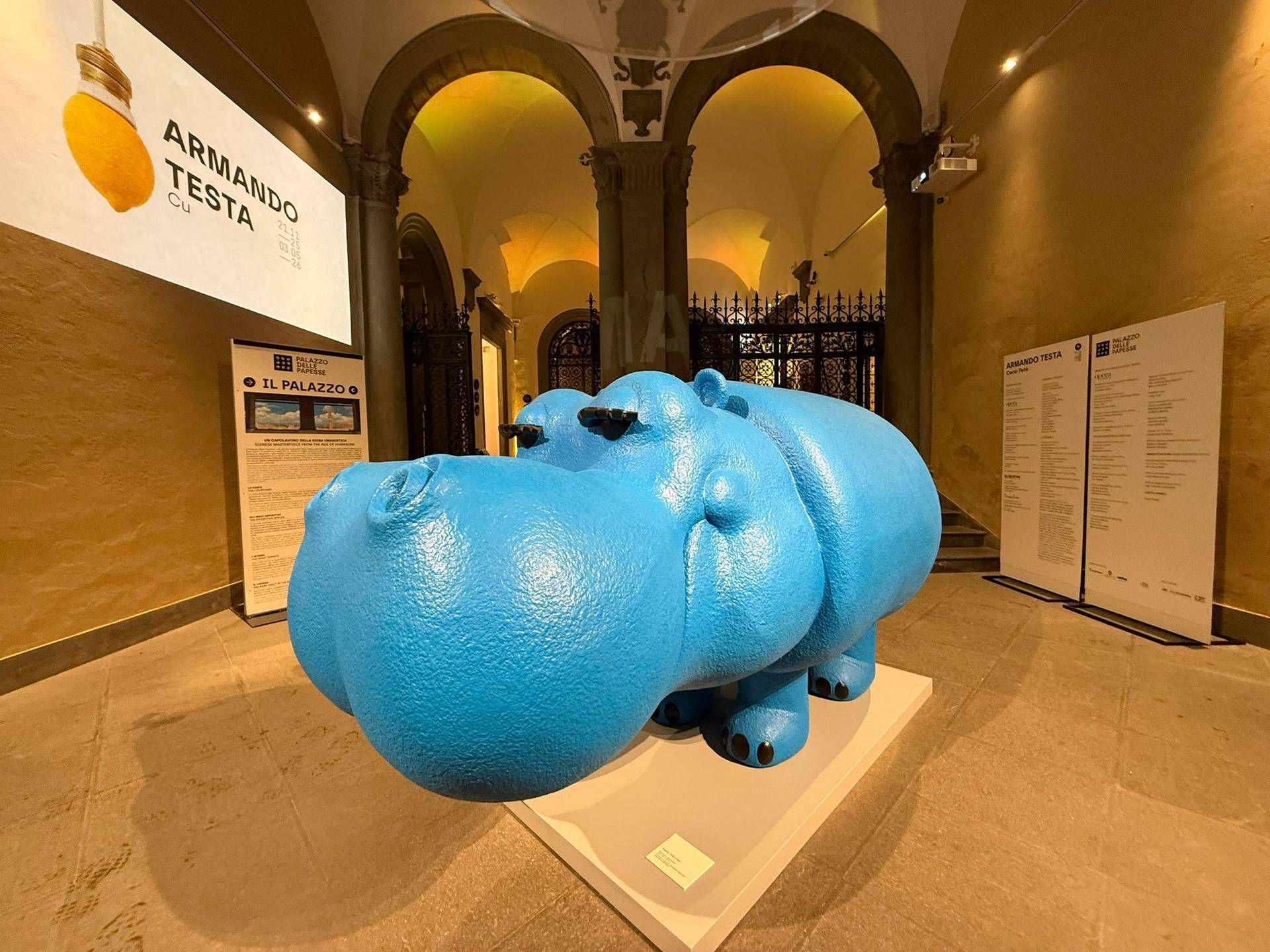
Amando Testa (1917-1992) was not ‘just’ an advertiser, he was a genius of Italian communication: from 21 November to 3 May 2026 Palazzo delle Papesse in Siena is transformed into an immersive journey into the imagination of the artist who reinvented European advertising. The retrospective “Cucù-Tetè”, curated by Valentino Catricalà and Gemma De Angelis Testa, aims precisely to undermine this reductive reading. With over two hundred works including posters, paintings, installations, sculptures, photographs and audiovisual materials, the exhibition systematically reconstructs for the first time the path of the Turin visionary who transformed the visual imagination of the second half of the twentieth century. “What other character can be compared to him? Are we sure that he is just a great and brilliant advertiser?”, asks Catricalà: a question that opens a monumental and multi-sensory exhibition journey.
The exhibition offers a comprehensive portrait of who was not only the most famous Italian advertiser, but also an artist, graphic designer and inventor of radically new visual languages. Particular attention is paid to the audiovisual aspect: in some key rooms, cathode ray tube televisions reproduce carousels and vintage films, restoring the multi-sensorial strength of an innovative and immersive language. The exhibition highlights how Testa’s communicative intuitions were often born from a creative process that started from art to transform into a universal language, capable of speaking to everyone. Testa has reinvented visual communication, transforming seeing into a highly engaging experience. It is no coincidence that Gillo Dorfles called it a “global visualizer”.
The conceptual heart of the itinerary is the “niche” located on the second floor, entirely covered with over 400 drawings: an uninterrupted flow of shapes that visually conveys Testa’s creative process, his inexhaustible imaginative vein. Another key installation is set up in the vault space, where the famous Lemon Lamp (1968) is exhibited in a completely dark environment, illuminated by a single spot: here the work becomes the metaphor of brilliant intuition.
The itinerary opens on the first floor with a “visual comfort zone”, which collects some of the most iconic works: from the famous Punt e Mes poster (1960), with its pictorial declinations, to the fluorescent posters of Gotto (1952) and Il brindisi dei due re (1949) created for Carpano, up to the campaigns for Borsalino and the posters for the 1960 Rome Olympics.
This is followed by sections dedicated to the relationship between art, industry and technology, with rare posters and preparatory drawings (Profilo Italia, 1990; Grafica 3, 1976; Esso Hydroforming, 1955; Il mondo delle torri, 1990), which demonstrate how Testa’s graphic and advertising activity was transversal and capable of translating the industrial and technological transformations of his time into images. To close this nucleus, the cover created for the musical group PIL in 1991, inspired by one of his works from 1974, is also on display.
The retrospective then dedicates ample space to painting, Testa’s first language and a place of absolute freedom, independent of the client, in which references to American abstractionism and naturalistic echoes emerge. Some previously unpublished posters are also on display for the first time, reflecting the artistic depth of his visual language.
The exhibition continues with the narrative universe of Caballero and Carmencita, presented together with original audiovisual materials on cathode ray tube.
On the second floor the visitor is welcomed by another installation, dedicated to Planet Papalla, here reconstructed to scale to immerse the public in one of the visionary worlds that contributed to defining Testa’s communicative genius. Following, the room dedicated to Pirelli’s “elephant charge” (1954), one of his first works, an icon of power and magnetism, as Germano Celant already observed. The retrospective also includes a room dedicated to the body, explored through different media – from advertising to photography, up to sculpture and painting – and according to multiple declinations: from the reference to the sacred body, evoked by the reclining head of the cross, to the advertising body, never shown in full to preserve that element of mystery that calls the viewer to the imagination; up to the pictorial body, reduced to a part for the whole: the finger. This obsession, linked to Testa’s beginnings in typography, introduces the subsequent focus on numbers and letters, without forgetting the two rooms dedicated to animals and visual experiments on food.
The visit ends with the documentary Povero ma moderni (2009) by Pappi Corsicato, awarded at the 66th Venice Film Festival (Orizzonti section – Special Prize F. Pasinetti).
To accompany the exhibition, a volume published by Sillabe collects for the first time the texts of some of the major scholars who have written on Testa – from Gillo Dorfles to Germano Celant, through Jeffrey Deitch and Vincenzo De Bellis – together with testimonies from contemporary artists such as Michelangelo Pistoletto, Paola Pivi, Grazia Toderi and Haim Steinbach, to name just a few.
“After the major exhibitions dedicated to Julio Le Parc and Hugo Pratt – explains Beppe Costa, president and CEO of Opera Laboratori – the retrospective on Armando Testa continues the path of valorisation of the Palazzo delle Papesse as an exhibition center open to contamination between languages, between art and communication. Testa is a symbol of Italian creativity, and welcoming his art in Siena means not only paying homage to a master, but reaffirming the value of culture as a driver of innovation and participation”.
To enrich the visit to the historic building, on the ground floor, there will be a bookshop with dedicated merchandising and products and a bistro accessible, as are all the other rooms, even for those with mobility difficulties. Also present to support the Palazzo’s cultural project were: Estra, Terre Cablate, the Consorzio del Vino Brunello di Montalcino and Lavazza, while media partners of the event will be QN – La Nazione and Canale 3 Toscana. Palazzo delle Papesse will offer educational activities, inclusive visits and workshops through the “Papesse Lab” project, with the aim of bringing the public closer to art and broadening the viewer’s gaze, whatever their age, investigating the folds of reality. To participate in all the events and exhibitions of 2026, Opera Laboratori is promoting a card, the “curious card”, which can be purchased online or at the Palace ticket office, which will allow unlimited access within one year of activation and discounts on products on sale in the bookshop, on drinks in the cafeteria and on educational workshops. At the end of the year, card holders will be able to renew it, thus continuing the experience with unlimited access to exhibitions, events and initiatives: an opportunity to stay connected with the cultural activity of Palazzo delle Papesse.