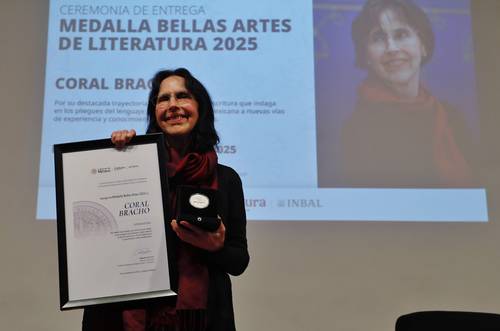
The poet Coral Bracho said that in the current “vulnerable” era we need the sensitivity and perspective of art and culture to value and protect nature and human beings expelled from their territories due to war, misery or discrimination.
Together with science, culture and art, they can open new ways of “seeing the world and other human beings to be able to little by little dismantle the inconceivable violence that surrounds us,” the translator also pointed out yesterday during the reception ceremony of the 2025 Fine Arts Medal for Literature.
Bracho (CDMX, 1951) explained at the Palace of Fine Arts that the aforementioned human creations can help us support so many people driven from their places of origin for economic reasons.
Regarding her foray into literature, she explained that it was clear to her that “in the creative process and in reading poetry, forms of consciousness and sensitivity converge that bring us closer to others, to the world around us and to ourselves in countless senses, in very diverse and surprising ways, always generative and suggestive.”
Coral Bracho mentioned that music and painting are fundamental in her poetic expression, and highlighted the “wonderful experiences” of singing in the choirs of the National School of Music and the University Philharmonic.
After abandoning his intention to pursue a scientific career linked to the study of the mind, since neuroscience did not exist, he studied Hispanic literature at the National Autonomous University of Mexico, during which time he made an “attempt to write poetry.”
That was a milestone, explained the winner, because “I was dazzled to see that by doing so I was once again experiencing the breath and enjoyment of singing within a choir in the proximity of different voices and different instruments, and in an inexplicable and totally new way for me, the words emerged as suggestive presences that responded to what I was seeking to express.”
She acknowledged that she was “deeply moved and grateful for this unexpected award,” granted by the National Institute of Fine Arts and Literature (Inbal), “fundamental not only in the cultural world of Mexico, but in my own life.”
The poet, accompanied by the writers Myriam Moscona and Eduardo Casar, as well as Alejandra de la Paz, head of Inbal, obtained the distinction “for her outstanding career in developing writing that delves into the folds of language and in opening Mexican poetry to new avenues of experience and knowledge previously unexplored.”
Bracho also expressed his “enormous gratitude” to Ediciones Era, where he has published almost all of his books in Mexico, “with the invaluable initial support of Vicente Rojo and, over the years, Marcelo Uribe, Paloma Villegas, Michelle Pérez-Lobo and Adriana Dorantes.”
Strong and sustained applause from the public graced the presentation of the medal and diploma by De la Paz and Nadia López García, national coordinator of Literature.
For her part, the poet Myriam Moscona explained that in her colleague’s work “nothing remains static, everything is moving, shifting, (she) cares about her country, her society, the world, the animals, the plants, the water, the mind, the disease, the human condition. Her poetry, however, breathes in columns of expansive freedom.”
In his speech, Eduardo Casar said that Coral Bracho is “a very lexical poet who always seeks the weight and forcefulness of the word itself. She does not play with rhythms, but what she tells enters us with a rhythm.
He noted that Bracho in her poems forces us to imagine light and “she is a great creator of mysteries in her poetry.”