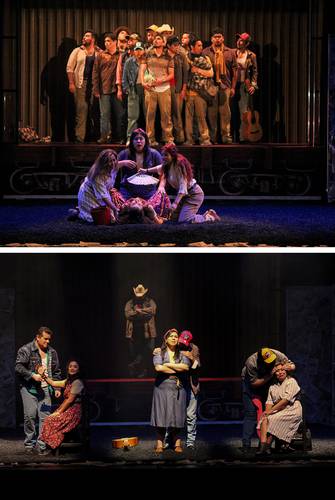
In a context in which the drama of migration has been exacerbated and is often reduced to cold statistics, the Mexico Opera Studio (MOS) presents northern pass, opera that seeks to return its human face to one of the greatest and most current crises in the contemporary world.
The production, which today concludes its three-day stay at the Arts Theater of the National Arts Center (Cenart) with two performances, at 4 and 6 p.m., represents a milestone for this Monterrey musical improvement project: it is the first time they have moved a complete production to the country’s capital, after premiering it in Monterrey in March.
In an interview, Rennier Piñero and Alejandro Miyaki, responsible for the stage directions and coordinator of the production, delved into the details of the production, which seeks to serve a double purpose.
“On the one hand, it is a tribute to Víctor Rasgado (1959-2023) –its author–, an undisputed figure in the opera of Mexico and Latin America,” said Piñero, also artistic director of the MOS.
“But the final impulse was the horror of the change in immigration policies at the beginning of this year (with the return of Donald Trump to the presidency of the United States). We come from a border state (Nuevo León) where we see the caravans (of migrants) passing by; it is necessary to talk about it through art.”
Paso del Norte – based on the play The journey of the singers, by Hugo Salcedo, and real testimonies from a survivor – narrates a tragedy that occurred on July 3, 1987: the death by suffocation of a group of 18 Mexicans inside a train car in their attempt to enter the United States illegally.
According to both artists, the value of this operatic title – premiered in Oaxaca in 2011 and presented that same year in Mexico City – is its ability to humanize an over-mediatized topic.
“We seek to highlight that every day we receive news about migration: in Spain, people crossing the Mediterranean; in the United States, from the Darién. You have to watch the videos on YouTube to understand the cruelty of a step like the Darién Gap (extensive and dangerous jungle on the border between Panama and Colombia),” said Piñero.
“There are 3,900 kilometers that thousands of people walk here every year, but the amount of information is so great that we have begun to put it into perspective and everything is transformed into statistics, numbers and indicators.”
There are stories behind
The purpose of the author and of us with this work, he said, is to “pause the information on that topic” and connect with people by putting on the table that behind each issue there is a story and a need to seek a better tomorrow.
“It is about re-humanizing the concept of migration, and doing so from an unusual language: opera. They are multifaceted and very complex characters, whose fears, expectations, desires and objectives catapult powerful internal conflicts.”
▲ The show by the Mexico Opera Studio company was presented at the Cenart.Photo Eduardo Ruiz
Regarding the characteristics of the staging, the stage director highlighted that, unlike the original approach of the work, based on three singers and a group of actors, his proposal “privileges the choral from the stage: a group of 15 performers and actors emulates the edges of the migratory process.”
Thus, throughout the 65 minutes of its only act, the public sees not only the faces of those who left and are on the train, but also of those women who are left alone in the town, “a true scourge in Latin America.”
The earth is a central element in the staging, which combines a physical scenography – such as a train car and a series of screens covered with newspaper reproductions – with digital projections. “It is the connection to the land: that where you were born and grew up, in which you are rooted and from which you uproot yourself to try to insert yourself into a new culture,” explained Piñero.
Unique score
Alejandro Miyaki, musical director of the MOS, valued Rasgado’s work in this opera – with a libretto in Spanish – not only because he wanted it to have a Mexican theme, but also a social commitment.
He stressed the uniqueness of the score, due to its atonal condition and having the brilliant feature of being written for a symphonic band, the latter giving it a Mexican sound: “Although it is very complex music, it works very well for the staging, by generating that overwhelming, stressful and suffocating atmosphere that the audience can perceive through the characters.”
After clarifying that in this production a reduced version is used for an ensemble of seven breath and percussion musicians, he assumed that the challenge as a director in this case is different from that of the traditional repertoire.
“We are not looking for a neat or academic sound, but rather to convey the emotion and effects that Rasgado was looking for, even if that means being strident. The music is 100 percent dramatic and is designed to be seen on stage; it is not melodic or complacent, its purpose is for the audience to leave moved,” he said.
According to Piñeiro and Miyaki, the arrival of northern pass Cenart is not only an artistic achievement, but the consolidation of a unique model. The MOS, founded in 2019 as a high-performance center for emerging opera singers and accompanying pianists, is supported by a board of almost 40 businessmen from New Leon, which represents a commitment by private capital to culture and young talent.
“It is an important milestone. It is not public money, but a real commitment to helping Mexican artists,” they concluded, thus marking “a watershed” in the national operatic panorama.