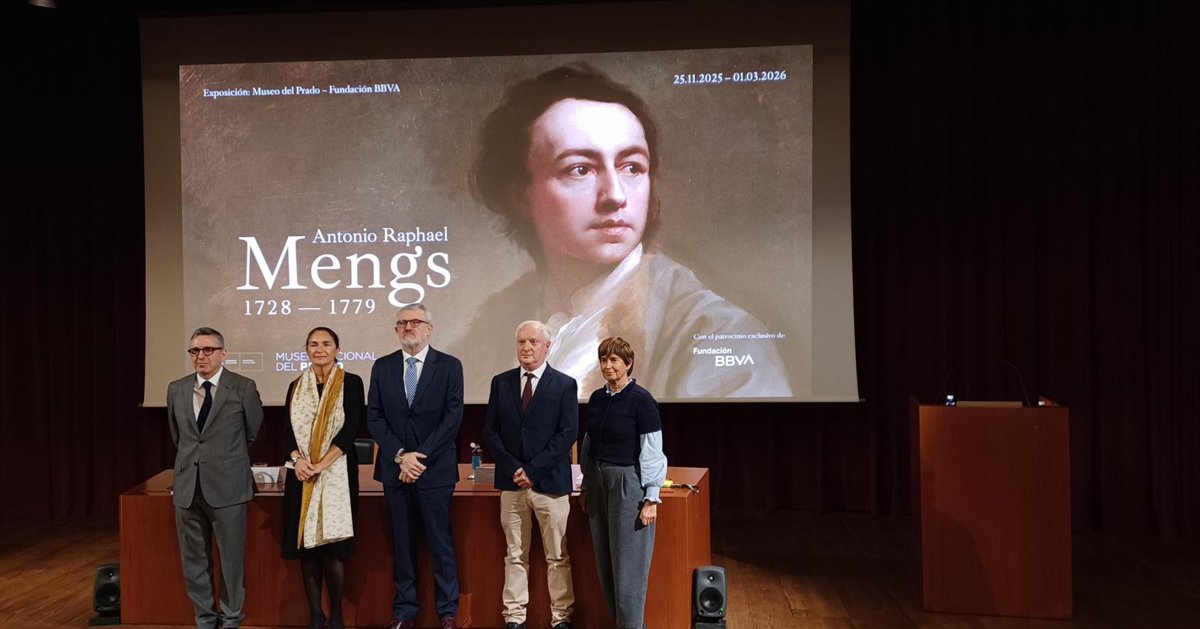
The Prado Museum claims in the exhibition ‘Antonio Raphael Mengs (1728-1779) to an artist”as influential as it is forgotten“, who became a court painter of King Carlos III, as indicated this Monday in the presentation to the media by the curators of the exhibition, Andrés Úbeda and Javier Jordán de Urríes.
At the press conference, Úbeda – who is also head of the Museum’s 18th Century Painting and Goya Collection – pointed out that “Monographic exhibitions usually feature artists who are already well-known, but Mengs has fallen, for many, into oblivion.“despite having been one of the most influential figures of the 18th century and the most celebrated when he was alive.
Mengs was a key figure in the birth of Neoclassicism and one of the most influential artists of the 18th century, so the exhibition offers an in-depth review of his work, thought and legacy, in dialogue with the great masters of the past.
In Úbeda’s opinion, this forgetfulness could be due to the fact that “he had a stormy personality, which did not allow for an easy relationship,” or because “caused very deep wounds among critics” by branding artists they favored, such as Velasquez, as “ignorant” of what the Greeks called the “universal concept of beauty.”“.
The exhibition, carried out in collaboration with the BBVA Foundation, can be visited until March 1, 2026, as pointed out by the director of the Prado Museum, Miguel Falomir. The exhibition brings together 159 works, of which 64 are paintings, 40 books, 14 decorative arts and 81 drawings, engravings and studies on paper, which allows us to explore both his role as a chamber painter and muralist, as well as his intellectual and theoretical dimension. The pieces come from 25 international institutions, 9 Spanish and 10 private collections.
The exhibition has also led to the publication of a catalog book where, together with National Heritage, The artist’s technique has been deciphered, which made the fresco have the opacity of an oil painting, a “revolutionary” painting who recovered a pictorial framework and the paradigm of classical beauty that had not been explored thanks to his trips to Greece.
REVIEW OF HIS CAREER SINCE ITS BEGINNING
Jordán de Urríes y de la Colina – also curator of 18th century painting at the National Heritage – has explained that the route is subdivided into ten blocks, which range from the beginnings of Mengs under the teaching of his strict father, painter of the courts of Dresden, to the legacy of artists such as Andrés Caloba. On this path, works are recovered that, as detailed, despite being together, had not been paired since their creation, such as the drawings and portraits of the infants of Tuscany.
At the same time, the exhibition aims to vindicate Mengs’s drawing skills – whether his sketches, essays in composition, or his studies of light or clothing – as a reflection of his obsession with perfection. “He said that a work is never finished, so he continued and reviewed his works to the point of desperation,” Úbeda noted.
Furthermore, the exhibition exposes the relationship between Mends’ painting and Greco-Roman sculpture, for example, with a portrait of Octavian and Cleopatra, whose body positions refer to other sculptures of these characters and which are also present in the room.
Among the sections is ‘The permanent challenge to Raphael’, where the conscious emulation of the Urbino master is analyzed, visible in works such as ‘The Lamentation over the Dead Christ’, in dialogue with ‘The Pasmo of Sicily by Raphael’. The sections dedicated to Rome (‘Rome, caput mundi’ and ‘Rome, the fascination of the ancient world’) show the impact of the city on his work, both as a spiritual capital and as a repository of classical civilization, with portraits of figures such as Pope Clement XIII and Cardinal Zelada, and copies of ancient sculptures that inspired his ideal of beauty.
The exhibition also addresses his relationship with the archaeologist Johann Joachim Winckelmann, in the section ‘The end of his relationship with Winckelmann’, where the story of a friendship betrayed as a result of the falsification of the Jupiter and Ganymede fresco is told. In ‘Mengs, painter-philosopher’ his theoretical side is explored and the critical reception of his work after his death is analyzed.
The patronage of Charles III occupies a central place in the exhibition, with sections such as ‘Painter of His Catholic Majesty and the Court of Madrid’which brings together portraits of the royal family and figures from enlightened Spain, and ‘The great works: mural painting’, which highlights his mastery in the decoration of large surfaces, such as the frescoes of the Royal Palace of Madrid. The section ‘Mengs, interpreter of the new enlightened devotion’ highlights his contribution to religious painting, influenced by Raphael, Correggio, Guido Reni and Velázquez.
Finally, ‘Mengs’ legacy’ examines how his figure was projected on later generations, influencing artists such as Antonio Canova and Francisco de Goya.