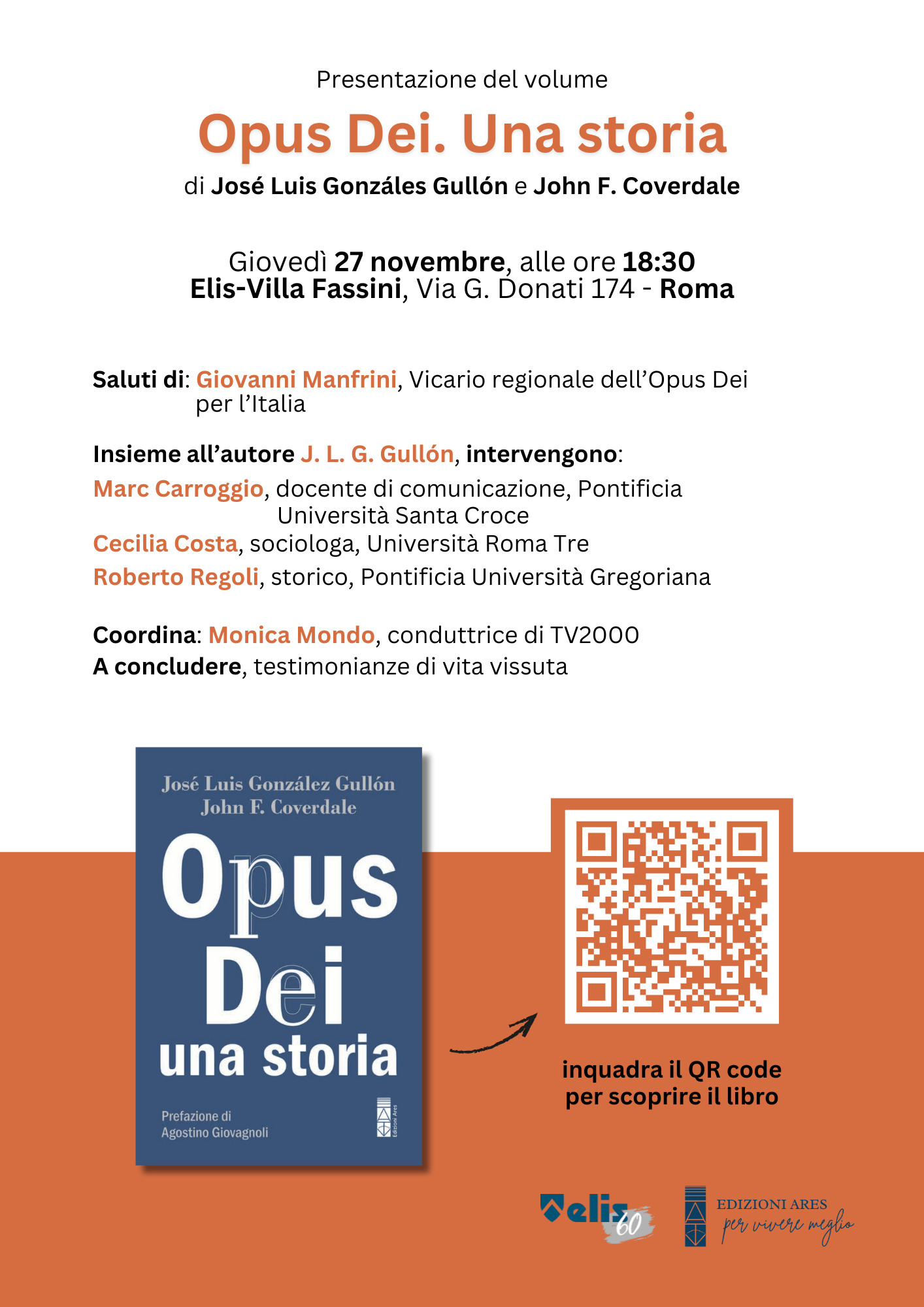
Almost a century after its foundation by Saint Josemaría Escrivá on 2 October 1928, Opus Dei returns to the center of the debate thanks to unprecedented historical research. The book “Opus Dei. A history” (Edizioni Ares, 744 pages, 22 euros) reconstructs with documentary rigor and unpublished testimonies the evolution of one of the most controversial realities of the Catholic Church.
The work written by historians González Gullón and John F. Coverdale promises to change the way we understand Opus Dei. While much has already been written and said about Opus Dei, this volume stands out for its scientific and documentary approach. As the historian Agostino Giovagnoli, member of the Community of Sant’Egidio since its foundation, highlights in the preface, “much has already been written about Opus Dei, but the term history indicates the novelty that the authors have tried to add”. The novelty consists above all in the use of unpublished sources: letters from the founders, notes from popes, confidences from members of the Roman Curia, documents which had never been consulted until now. This allows the authors to tell the story of Opus Dei with rigor and completeness, placing the events of the Work in the broader historical, social and religious context of the 20th century.
One of the most interesting threads of the book concerns the path towards canonical recognition. From the initial form of pious union to the secular institution to the personal prelature, the authors show how Opus Dei had to deal with complex legal, cultural and spiritual challenges. It is not just a matter of formal procedures: as Gullón and Coverdale highlight, the search for the appropriate legal form represented a path of internal maturation and an opportunity to delve deeper into the original charisma of the Work. Monsignor Álvaro del Portillo summarized the experience thus: “the Work is first and foremost the work of God, Opus Dei, and for this reason its history is the history of divine mercies”.
There is no shortage of the most delicate and controversial chapters: the relations with the Franco regime, the accusations of secrecy and authoritarianism, up to the Italian parliamentary question of 1986. Yet, the authors manage to recount these episodes without sensationalism, trying to restore a balanced vision that includes both the criticisms and the strengths of the institution.
In addition to the institutional and political events, the book tells the story of the daily lives of the members of Opus Dei. Women and men from different countries and social conditions who have chosen to live the universal call to holiness in work and daily activities. This “human” dimension of the story gives the text a broader scope and shows how the founder’s spirituality was truly lived in the concrete world, beyond clichés or media interpretations.
José Luis González Gullón is a professor of History at the Pontifical University of the Holy Cross and a member of the Saint Josemaría Escrivá de Balaguer Historical Institute. Specialist in contemporary religious history and Opus Dei, he has published numerous studies in international academic journals. John F. Coverdale, historian and jurist, taught at Princeton and Northwestern and dedicated in-depth studies to the history of Spain and Opus Dei. Their collaboration combines historical rigor and legal expertise, allowing the institution to be analyzed comprehensively, from official documents to personal testimonies.
Almost a century after its foundation, Opus Dei continues to represent a challenge for the Church and for society. The book shows how the diffusion of his message was not linear, but always inserted in changing and often hostile historical contexts. The history of Opus Dei thus becomes a lens for understanding broader issues: the role of the laity in the Church, the relationship between charism and institution, ecclesiastical resistance to spiritual innovations.
“Opus Dei. A story” is a monumental book that manages to combine academic rigor and compelling narrative. This is not just a text for scholars: any reader interested in the religious history of the 20th century, the dynamics of the Catholic Church and the story of a controversial institution will find an in-depth and enlightening guide here. The strength of the volume lies in the ability to tell without filters, offering tools to understand a reality that is often misunderstood and reduced to stereotypes.
The first book presentation event will be held on Thursday 27 November, at 6.30 pm, at Elis-Villa Fassini (Via Giuseppe Donati, 174) in Rome. The greetings of Don Giovanni Manfrini, regional vicar of Opus Dei for Italy, will be followed by speeches by the author José Luis González Gullón, by professor Marc Carroggio, professor of Communication and Government of Institutions at the Pontifical University of the Holy Cross, by professor Cecilia Costa, sociologist of cultural and communicative processes at the University of Roma Tre, by professor Roberto Regoli, contemporary historian at the Pontifical Gregorian University. The meeting was coordinated by TV2000 presenter Monica Mondo. The event will be enriched by some testimonies of real life: men and women, workers from different professional fields, who live every day, in their business and family life, the founding principle of Opus Dei: the sanctification of work. (by Paolo Martini)