Enter the courtyard of Palazzo Strozzi, a Firenze on a clear morning at the end of November, is like crossing a threshold suspended between past and present. The “bronze” stones of the Renaissance palace vibrate with a subtle expectation: here, in one of the most dynamic centers of Italian culture, an unexpected dialogue is about to take shape with one of the fathers of the Renaissance. Beato Angelico is not just an exhibition, it is a close encounter with a perfection that, even today, can transfix.
It is the first major exhibition dedicated to the painter after seventy years, open to visitors until 25 January 2026. The result of four years of research, restoration and reunification of works dispersed over time, it brings together more than 140 masterpieces from the major museums of the world. A constellation of tables, miniatures, drawings and sculptures that convey the voice of an artist capable of moving between heaven and earth with absolute naturalness.
The painting of Beato Angelico – Guido di Piero, then Fra Giovanni da Fiesole – seems to breathe. The surfaces are placid and vibrant, animated by figures that embody a spiritual and human ideal at the same time. It is an art that comes from the late Gothic but embraces the principles of the Renaissance: perspectives that open up new spaces, lights that caress faces, a natural balance between figures and environments. TO Strozzi Palace the route is divided into eight sections, chronological and thematic. Each room introduces a passage into the artist’s universe: his beginnings, his first daring perspectives, his dialogues with Lorenzo Monaco, Masaccio, Ghiberti, Michelozzo, Luca della Robbia. It’s like leafing through a book whose pages are gold, ultramarine blue and silence. I think back to the imposing restoration work: almost thirty works recovered or subjected to diagnostic investigations. I think of the hands of the restorers, of the patience with which they restored breath and legibility to ancient colours. It is a touching gesture of care that the exhibition will document in a dedicated volume.
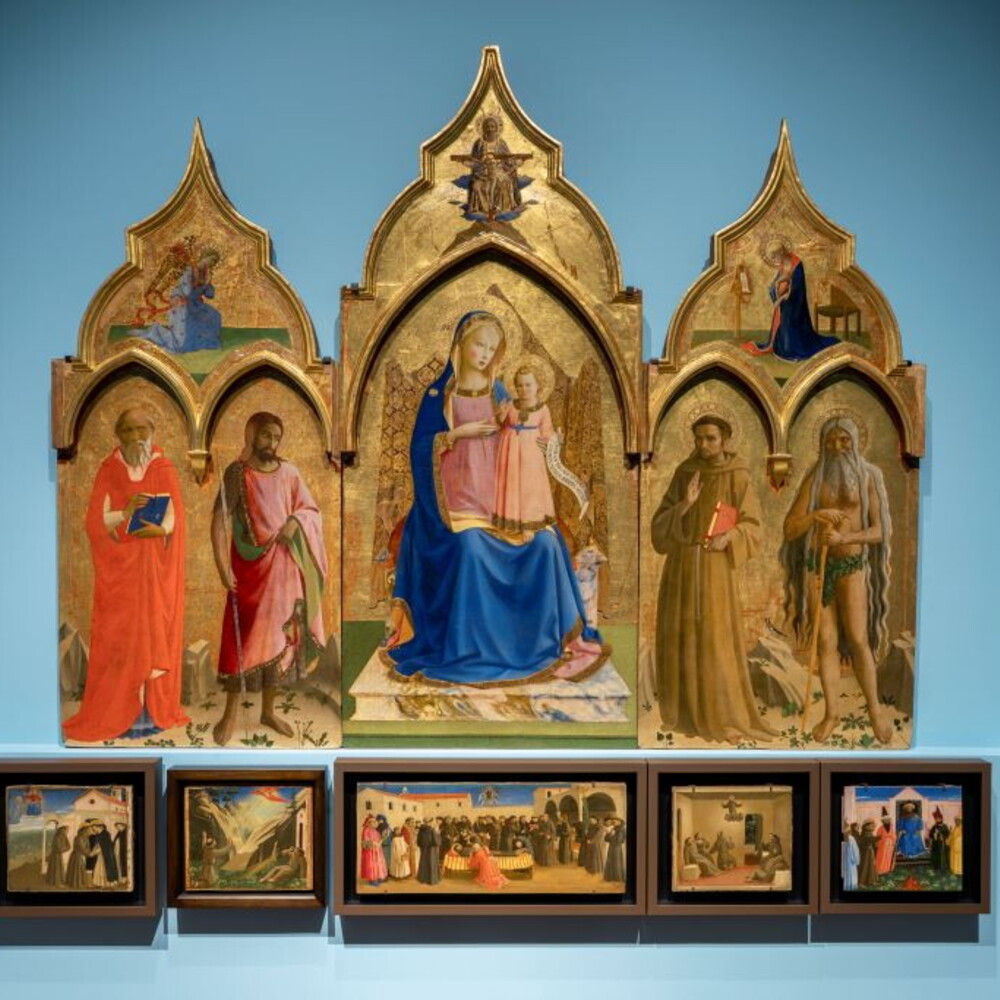
Particularly exciting are the graphic reconstructions of the large shovels dismembered over the centuries. Seeing them finally reunited – even if only virtually – is like witnessing the recomposition of a dispersed body. Two, the Altarpiece of San Pietro Martire and the Altarpiece of Fiesole, are exhibited in San Marco next to the originals; the others, including the Strozzi Altarpiece, the Coronation of the Virgin and the Franciscan Triptych, find space in Palazzo Strozzi, next to the surviving panels. A three-dimensional reconstruction of the Strozzi chapels in Santa Trinità it even restores the original layout of the Strozzi Altarpiece.
Yet, in front of the works, the entire context vanishes. I remain still, struck by the spiritual strength that passes through them. Angelico does not paint to amaze: he paints to make people meditate, to generate peace. The journey continues to San Marco, the convent where the painter friar lived and worked. Leaving Palazzo Strozzi, I carry with me the feeling of a voice that wants to continue speaking. San Marco welcomes with the sober light that Angelico placed on the angels: a light that does not dazzle, but illuminates.
Here the itinerary opens in the large room on the ground floor, dedicated to the artist’s beginnings, and continues in the Library, with sections dedicated to the illuminator and the humanistic codes once kept in the convent. It is a place that vibrates with his memory, in natural dialogue with the frescoes of the cells. The cells frescoed by Angelicothe rooms ordered by Michelozzo at the request of Cosimo de’ Medici, house the largest collection of the artist in the world. Here the experience is transformed: no longer simple observation, but immersion in a space where spirituality, politics and culture of the fifteenth century were intertwined. I think of Saint Antonino Pierozzi, of the monks who meditated here accompanied by those images.
In one room, Ghirlandaio’s Last Supper; a little further on, the works of Paolo Uccello, Fra Bartolomeo, Sogliani, the terracottas of Della Robbia. But it is the cells frescoed by Angelico that strike me most of all: figures that seem to breathe the silence, part of the air itself. I think they were not created for museum glory, but for daily contemplation.
When I leave the convent, the light of Florence seems changed: clearer, more rarefied. Perhaps it is suggestion, or perhaps the effect of that art which – as the director of Palazzo Strozzi Arturo Galansino recalls – knows how to “look at the past and its present, projecting a new language towards the future”. A language that this unrepeatable exhibition forcefully returns.
I think back to the words of the curators: this exhibition is a point of arrival, but also a springboard. For me it is above all an intimate memory: the impression of having touched, for an instant, an idea of perfection that does not only belong to art, but to humanity. A perfection that Beato Angelico still manages to make visible today.