The Colombian sculptor Feliza Bursztyn (1933-1982) had a “libertarian and insolent” temperament and was a “constant rebellion against limitations and straitjackets. Because she was a woman, an artist, bourgeois and left-wing, she aroused the distrust of society.” The above was fascinating to his compatriot, the writer Juan Gabriel Vásquez.
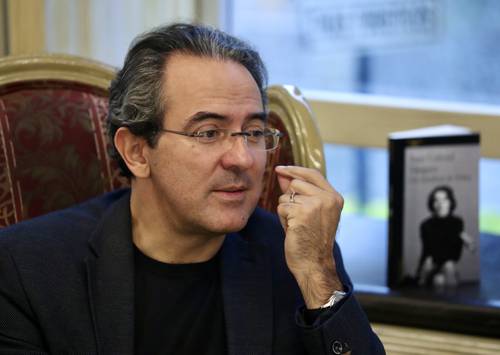
In interview with The Daythe narrator said that he portrayed in his most recent novel, Happy’s names (Alfaguara), to the artist who experienced obvious ostracism. “Many forces in Colombian, conservative and sexist society viewed the figure of this woman with great suspicion and ended up expelling her in different ways. That is what the text tries to explore.”
The creator’s life was one of constant struggle against the restrictions imposed on her: relatives for a husband who did not want her to be an artist; for being a woman and for politics, since she was persecuted by a repressive government and law, the author mentioned.
He has the satisfaction of “having portrayed a moment of extraordinary creative wealth in Colombia”, when in a few years Gabriel García Márquez, Álvaro Mutis, Jorge Gaitán Durán, Eduardo Carranza and León de Greiff coincided in that artistic field, while Fernando Botero began his career.
Feliza Bursztyn participated in that explosion of talent born of the conflict, according to Vásquez: “a violent country, in social crisis produces art, which is a way of explaining things that cannot be explained in any other way. I was very interested in making that portrait through her.”
The narrator considers it a privilege to have the collaboration of Bursztyn’s last partner, Pablo Leyva, a great witness and essential informant for the existence of the novel. “The decision of a person who has gone through difficult times and perhaps wants to forget, and to recover them so that someone can write them down, is fascinating to me. It seems like immense human generosity.”
Vásquez (Bogotá, 1973) turned Leyva into a character, whom he played and whose romantic relationship with Feliza he tried to describe beyond what he told her. When he read the first draft of the story, other hidden memories were awakened in him, the writer said: “it was as if he understood things that he had not understood before about his own relationship with Feliza.”
The title of the book arose from the verses of Jorge Gaitán Durán, in the epigraph: “I want to live the names / That the fire of the world has given / To the body that mortals dispute.” call him Happy’s names It was natural for Vásquez when he discovered that “Feliza’s relationship with the world involved that strange metaphor that the world never understood her name. They wrote it wrong very often. Even on her tombstone it is misspelled.
“In addition, her first name was a succession of very interesting changes. Her parents wanted to name her Faygele, which means little bird in Yiddish, but they saw that it was a bad idea to condemn her to explaining it all her life, so they called her Felicia and she changed it in adolescence to Feliza, because she liked that her name included the word happy. When she was Gaitán’s lover, he gave her the pseudonym Betina.”
The author highlighted that this was “a great metaphor for her journey through life: a woman who never found a solid place in the world, who was always a source of constant misunderstandings. The instability of her name for me reflected that of her life, the impossibility of finding a safe place. That is why the novel is called that.”
Take back Paris
The origin of the narrative is when Vásquez lived in Paris at the age of 23. He was sick and on one of the trips to take exams he read a journalistic text by the writer Gabriel García Márquez that stated: “The Colombian sculptor Feliza Bursztyn, exiled in France, died of sadness at 10:15 pm last Friday, January 8…” There the seed of a novel theme was planted.
The writing of this text, which occurred years later, wants to be a recovery of that Paris of my youth, that of an insecure boy trying to understand what literature is. “I really liked returning to Paris at the age of 50 to write the book in the settings of Feliza’s life.”
The novel tells the outcome from the first page, which challenged the author to build a literary apparatus that impels the reader to continue. This structure is set up “to maintain your interest in the revelation of the character, in the investigation of the secrets and hidden sides of the character; this is how it works in all my novels: the investigation into life, the mystery of the other.”
It is “in a certain sense also a comment on García Márquez. There are phrases in which I try to imitate his resources for the reader who knows how to recognize him and feels that the writer is there not only as a character, but as a verbal environment. I like to play these literary games to explore the narrator, who was a witness and participant in Feliza’s life.”
In this story the author tackled for the first time the writing of a complete novel about a woman. In addition to being an attractive challenge, the author thus responds to the tendency to censor a man telling a woman’s point of view or a white man telling the point of view of a person of African descent.
“We call it cultural appropriation and, according to that, you cannot count lives that are not of your same nationality, etc. I want this novel to be a small gesture of rebellion against that, because the wonder of fiction is the ability it gives me to penetrate another person’s identity and try to see the world from there.”
Juan Gabriel Vásquez concluded that in his novels there is the involuntary connection of his obsessions, where he highlights the use of fiction to “illuminate the space where the forces of the public intersect with private lives. I am obsessed with exploring the moment in which your private life becomes the scene of politics and history.
“That is the life of Sergio Cabrera, in my previous novel, look backand that of Feliza Bursztyn, who by the fact of being Jewish, born in exile because of Hitler, going through moments of revolutions and political violence in Colombia and being persecuted by political factions in a historical moment, becomes the scene of those mechanisms that interest me.