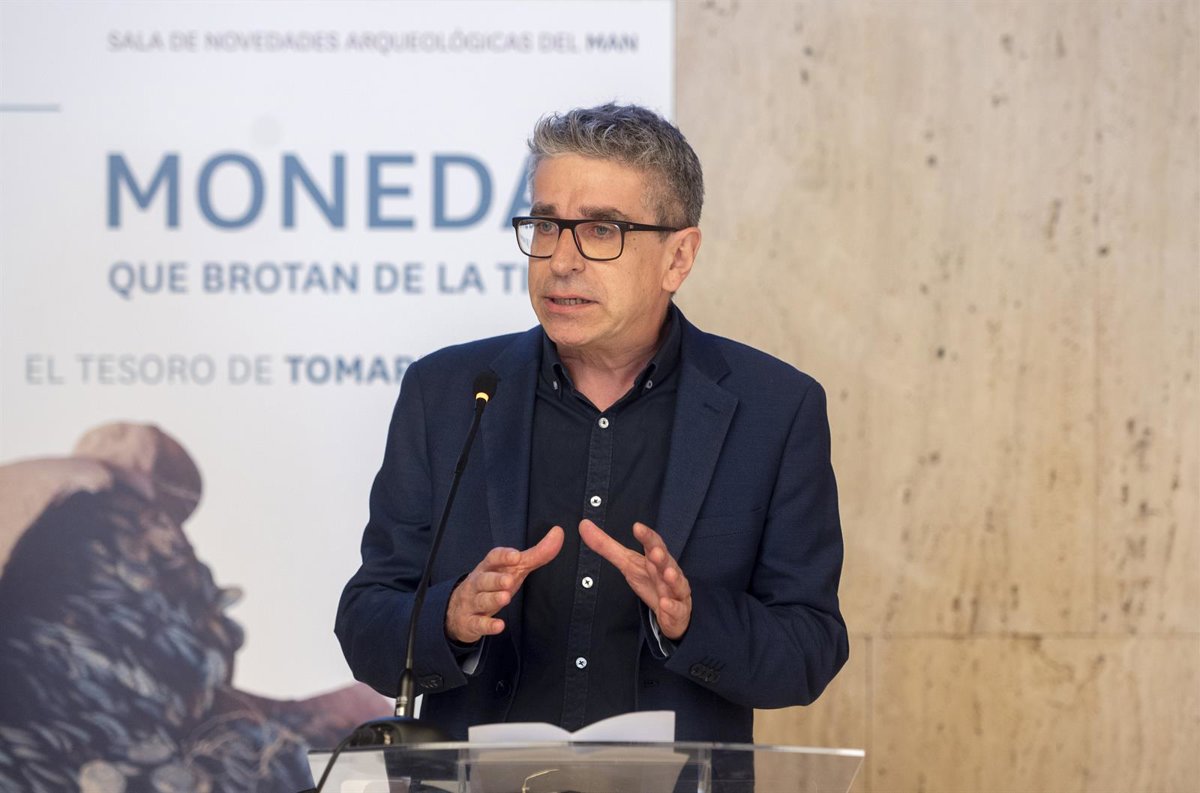
The Secretary of State for Culture, Jordi Martí, considers that the 27,620 archival documents of the Francisco Franco Foundation should be kept in the General Administration Archive.
This was stated by Martí in a meeting on challenges and opportunities of cultural policies, held at the Ortega-Marañón Foundation, where he took stock of the halfway point of the legislature.
The Minister of Culture, Ernest Urtasun, announced on November 20 that The Government will judicially claim the files of the Francisco Franco Foundation (FNFF), shortly after announcing that the process to extinguish this foundation was beginning.
“The General Administration Archive itself has an archive of the presidents, therefore, that is where they must be available to all historians and academics.“, Martí specified this Wednesday when asked where the Foundation’s archives should be.
The Secretary of State has replicated the words that Minister Urtasun spoke this past Monday at the Europa Press Informative Breakfasts, in which he said that “Any file of a head of state, even a dictator, is public by law“, beyond what happens with the Foundation.
“We are going to fight for that to happen and we also have to continue fighting for the closure of the foundation.. We cannot have an entity that praises a dictator who exercised violence against the Spanish population,” Martí assured.
In any case, according to Martí, the process of extinction of the FNFF should have passed “many years ago“. However, he regretted that in Spain “He began to talk about democratic memory many years after being in democracy“.
THE VISIT OF EISENHOWER OR THAT OF EVA PERÓN
The public archive funds in the hands of the FNFF present diverse documentation in different formats, as explained by the Ministry of Culture. Thus, it contains documentation on visits by foreign heads of statesuch as the visit of American President Eisenhower in 1959 or the visit of Eva Perón in 1947.
It also houses documents relating to events of historical relevancesuch as World War II, the strengthening of relations with the United States, Spain’s entry into the United Nations, Spain’s relations with the former colonies and the decolonization processes, on Gibraltar, or on relations with the Holy See.
There are numerous correspondence with foreign presidents and heads of stateas well as with administrative bodies at different levels: Ministries, Provincial Councils, City Councils, Presidency of the Government or Council of Ministers, among others. Also found in this file are petitions and political endorsements sent by citizens or by all types of public and private institutions.
Regarding its age, within the fund there are some 950 documents from the 1930s (3.4% of the total), 8,500 documents from the 1940s (30.8%), 9,500 documents from the 1950s (34.4%), 5,700 documents from the 1960s (20.6%) and 1,040 documents from the 1970s (3.8%); and around 2,000 undated.
“Given the nature of the documents, they must be returned to the State and kept in a public archivein accordance with the Spanish Historical Heritage Law,” says the department headed by Urtasun, which announced that it will transfer the technical reports prepared to the State Attorney’s Office so that it can judicially claim these documents.