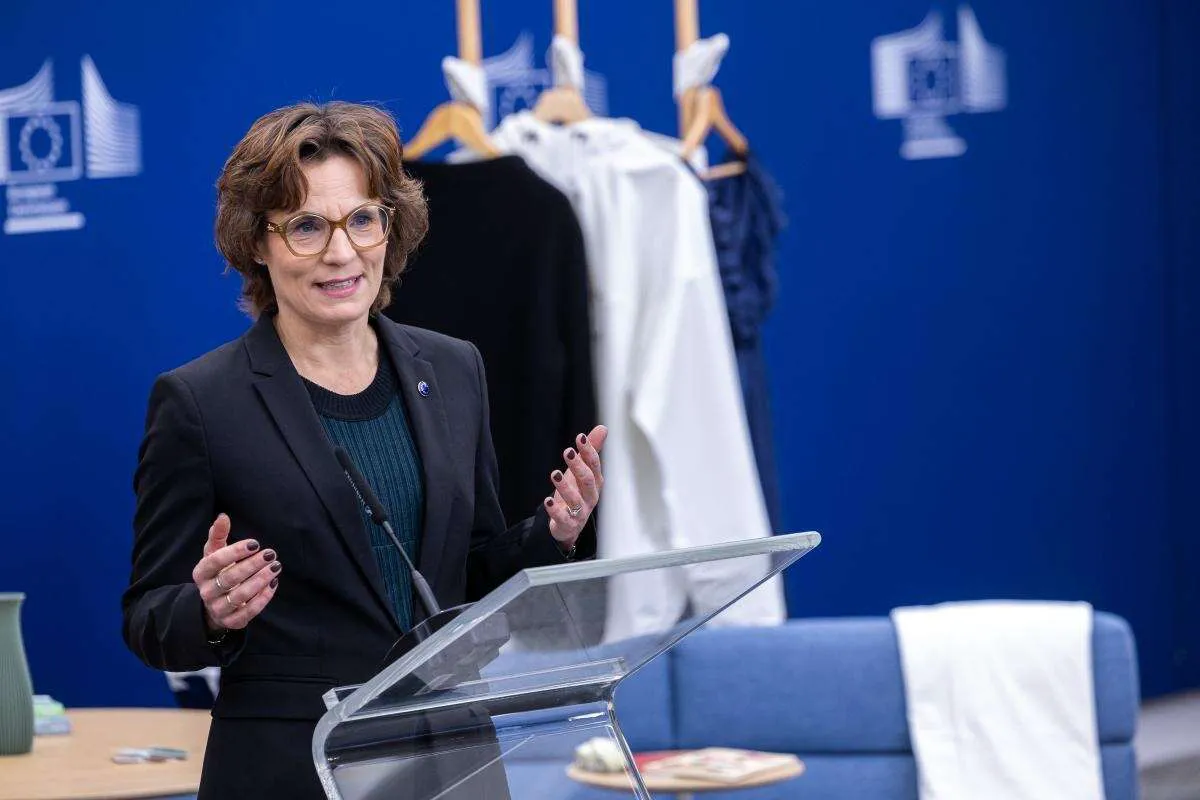
In the EU, the bioeconomy is no longer a possibility, as it was in previous years, but an opportunity. This became clear when the Environment and Circular Economy Commissioner Jessica Roswall presented the Commission’s new bioeconomy strategy on Thursday.
“The bioeconomy is no longer science fiction – in fact, I’m dressed in it,” said Roswall.
At Thursday’s press conference, the Swedish commissioner wore a dress made of wood-based Kuura textile fiber developed by Metsä Group.
Although the bioeconomy has been on the EU’s agenda for years, the Commission admits that the promotion of the matter has so far remained mainly an innovation exercise. In addition, during the period of the previous commission, the focus was on the regulation of the green transition, which reduced the role of forestry and agriculture as enablers of the European bioeconomy.
Now the direction of the commission has changed. The reason for this is that Ursula von der Leyenin the central goal of the current commission is to strengthen European competitiveness. It means that the bioeconomy is also included in the green transition. The central idea is to move from a fossil-based economy to a bio-based economy.
A business of billions
Bioeconomy means the use of renewable resources such as trees, plants, animals and microbes to produce food, materials, chemicals and energy.
The bioeconomy can be seen concretely, for example, in sustainable packaging, bio-based plastics, gas made from manure, wood construction or algae-based cosmetic products.
In the EU, the value of the bioeconomy sector is over 2.4 trillion euros.
The aim of the Commission’s new bioeconomy strategy is to develop pioneering markets and increase bioeconomy innovations and investments.
The Commission also promises to clarify the regulation of bio-based innovations, so that new products can be brought to the market faster than at present.
In order to boost private investment, the Commission proposes the establishment of an investment group that would create a pipeline of financeable projects, share risk and attract private capital.
Legislation support
Finnish organic products.
In Finland, the forest industry makes up more than 50 percent of the national bioeconomy, which is one of the highest shares in the EU member states. Finnish bioeconomy products were also seen at the EU Commission on Thursday.
PHOTO: Xavier Lejeune, European Commission
In the new strategy, the commission lists pioneer industries, in order to scale and create demand, targeted legislative measures will be taken.
CEO of UPM Massimo Reynaudo recently hoped in an interview with Kauppalehti that the commission would start making new regulations for the bioeconomy sector in order to create demand. On Thursday, the commission promised that this would be done.
An extraordinary demand from UPM’s Massimo Reynaudo in an interview with KL
Concretely, the new regulation could mean, for example, that a certain proportion of plastic should be bio-based in the future.
The commission was told that legislation related to this can be expected as early as next year in the Circular Economy Act. Next year, the Biotech Act will also be completed, and in December, an Omnibus set that lightens the regulation of the bioeconomy sector is expected.
From the point of view of companies, it is crucial that the ambition of the new strategy turns into consistent legislation.
The forest industry as a pioneer
A promising direction.
Metsäteollisuus ry’s head of EU affairs, Lydia Dettling, considers the commission’s list of pioneers promising for the Finnish forest industry.
PHOTO: Kreeta Karvala
There are several companies in Finland that are pioneers in the bioeconomy. They are especially in the forest industry, which is responsible for about 50 percent of the national bioeconomy. There are also bioeconomy companies in the chemical industry, the energy sector and the circular economy.
Important Finnish bioeconomy companies include, among others Metsä Group, Stora Enso, UPM, In this and several SMEs in the chemical industry.
New pioneer markets listed by the commission on Thursday include bio-based sectors such as plastics, fibers, textiles, chemicals, fertilizers, plant protection agents, construction materials, biorefineries, fermentation and permanent storage of biogenic carbon.
The Commission believes that these sectors have significant potential for both economic growth and environmental benefits.
From the point of view of the Finnish forest industry, the commission’s list of pioneers looks promising, says Metsäteollisuus ry’s head of EU affairs Lydia Dettling.
“The forest industry is involved in almost all of the pioneering markets listed by the Commission: biochemicals, bio-based textiles, bio-based plastics, fiber-based packaging, bio-based construction and wood construction, as well as bio-refineries and carbon dioxide recovery and storage,” Dettling lists.
He welcomes the fact that the Commission plans to create demand-supporting measures specifically for these sectors in future legislation.
“For example, with regard to wood construction, good initiatives are coming, especially for standardization and public procurement. These are exactly the things that the forest industry has been hoping for,” says Dettling.
Metsäteollisuus ry’s head of EU affairs considers it a risk that the strategy does not mention traditional forest industry sectors, such as wood, pulp and paper, which are the backbone of new markets.
“Without them, biochemicals and bio-based plastics cannot be made, and this must be taken into account in future legislation,” says Dettling.
“Other risks can be, for example, questions related to carbon sinks,” he continues.
The Commission’s strategy states that the utilization of biomass must be in line with nature’s carrying capacity and the EU’s climate goals.
However, Dettling believes that the new strategy gives a strong signal to bio-based industries – especially the forest industry.
“It shows that the commission is directing its industrial and product policy towards sustainable bio-based solutions and transitioning away from carbon, which is exactly what the forest industry is already doing.
“We have the solutions and products ready, and the EU wants to go in the same direction,” says Dettling.
Past failures
Support for farmers.
Miika Johansson, CEO of St1Biokraft, which produces biogas from manure and food industry raw materials, hopes that the Commission will support farmers to produce sustainable biomass. Stock photo.
KUVA: Chasing Marky Aren
In the field of bioeconomy, the EU has previously been criticized especially for the use of bio-oils, as frauds and abuses have been revealed in connection with them. For example, palm oil, which causes significant environmental harm, has been imported into the EU and sold as sustainable bio-oil.
An official source of the commission promised on Thursday that lessons will be learned from old mistakes.
The Commission now emphasizes the importance of responsible biomass. For example, promoting the circular economy emphasizes increasing the value of secondary biomass, such as agricultural residues, by-products and bio-waste.
CEO of St1Biokraft, which produces biogas from manure and food industry raw materials Miika Johansson considers it important that the EU now recognizes the potential of secondary bio-based raw materials.
“We believe they have great value and untapped potential,” says Johansson.
He hopes that the EU would support additional sources of income for farmers in the future common agricultural policy.
“The beauty of biogas production is that it can create jobs and industrial activity in rural areas that are struggling with the energy transition,” says Johansson.
The Commission promised on Thursday that it plans to launch initiatives that reward farmers for supporting the sustainable use of biomass.
The Commission also intends to ensure that the development of the bioeconomy also takes into account the fact that forests, soil, water and ecosystems are managed within their ecological limits.