The president of the United States, Donald Trump, declared this Saturday that the airspace “over” Venezuela “and its surroundings” has been completely “closed” in one more step towards a possible land invasion of the country in the same week that the North American president spoke clearly about his intention to enter Venezuelan territory to begin arresting drug traffickers, especially taking into account the accumulation of his military personnel around the area.
“To all airlines, pilots, drug traffickers and human traffickers: we ask you to consider that the airspace over Venezuela and its surroundings will remain completely closed,” the US president announced on his Truth Social platform.
Pending new events, this announcement has for now broken the narrative of a possible rapprochement with the Venezuelan president, Nicolás Maduro, according to the information published this week by the ‘New York Times’, which spoke of a recent telephone conversation that occurred between the two. The conversation took place at the end of last week, according to two sources close to the dialogue, and in it both leaders even talked about a possible bilateral agreement in the United States.
The same US media reported in October that Maduro had offered the United States a significant stake in the country’s oil fields, in addition to numerous other opportunities for US companies, in an effort to reduce tension. However, the United States ended up making a practically unaffordable offer: Maduro had to abandon the power he assumed in 2013 directly after the death of Hugo Chávez.
However, the events of the last few hours have deviated from this line. In fact, Trump’s announcement this Saturday occurs practically at the end of a week in which the North American president has clearly warned that his military strategy in the fight against drugs would in the near future go from being limited to the waters of the Caribbean to becoming a fight on land.
This same Thursday, Trump already warned that “very soon” operations by North American forces will begin to “detain by land” the supposedly “numerous” Venezuelan drug traffickers, further fueling speculation about a possible US military intervention in the Latin American country.
“You have probably realized that people do not want to make deliveries by sea, and we are going to start stopping them by land as well. By land it is easier, but that is going to start very soon,” said the tenant of the White House in a remote conversation with military personnel on the occasion of Thanksgiving Day.
As soon as he learned of the North American president’s statements, Maduro declared a state of “alert” for the country’s Air Force and assured that “there is no threat or aggression that frightens” Venezuela in the face of the actions of the “imperialist foreign forces,” which “continually threaten to disturb the peace” in the Caribbean region “under false and extravagant arguments.”
The Donald Trump Administration, which has authorized the CIA to operate in Venezuela, has used the alleged role of the Cartel of the Suns in drug trafficking as one of its main assets to justify attacks against alleged drug boats in Caribbean waters, although it has also extended them to the eastern Pacific, adding at least 83 deaths in 21 operations in total.
MILITARY DEPLOYMENT
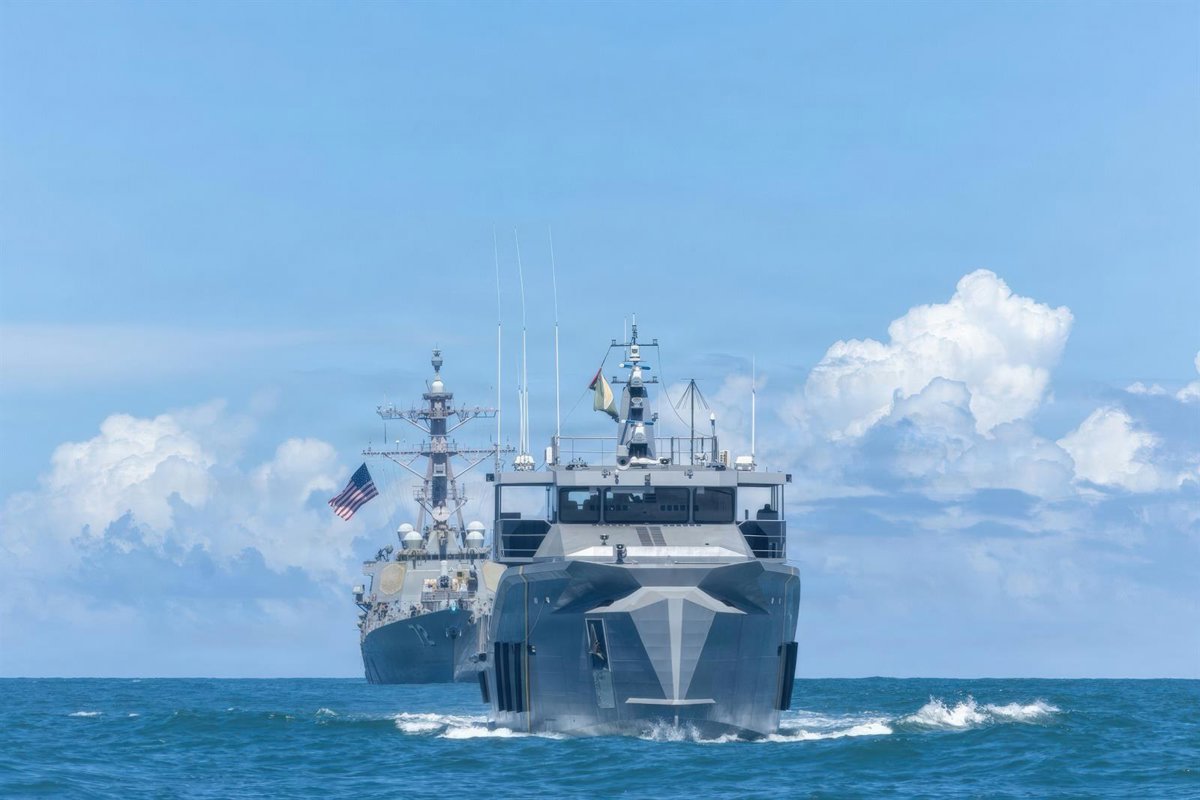
These attacks, within the framework of the so-called ‘Southern Lance’ operation, add to the increase in the US military presence in the area, which has included the deployment of the ‘USS Gerald Ford’ aircraft carrier, the largest in the US Navy.
The deployment was confirmed a few hours after the aircraft carrier entered the Southern Command (SouthCom) area of responsibility on November 11, after Secretary of Defense Pete Hegseth ordered to “support Trump’s directive” to “dismantle transnational criminal organizations and combat narcoterrorism.”
“The increased presence of US forces in the SouthCom area of responsibility will strengthen the ability of the United States to detect, monitor and disrupt illicit activities and actors that compromise the security and prosperity of the United States and our security in the Western Hemisphere,” said Pentagon spokesman Sean Parnell.
For Washington, this deployment of forces – which includes 4,000 uniformed personnel and dozens of aircraft on board – “will improve and reinforce existing capabilities to dismantle drug trafficking and weaken and dismantle transnational criminal organizations,” adding that it “provides” a “greater capacity to project power through sustained operations at sea.”
In this sense, the spokesperson explained that the ‘USS Gerald R. Ford’ “can simultaneously catapult and recover fixed-wing aircraft on its flight deck, day or night, in support of assigned operations.” Thus, it will “reinforce” the joint forces already deployed in the region “to defeat and dismantle criminal networks that exploit our borders and shared maritime domains.”