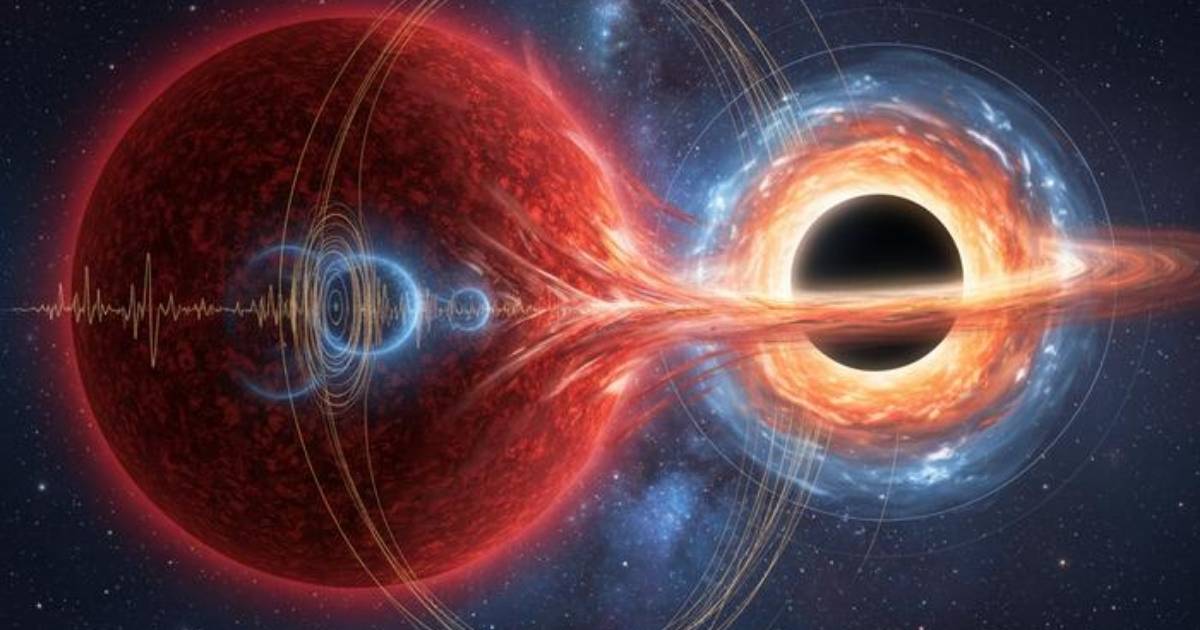
By studying the light coming from stars, astronomers usually reveal their temperature, composition, age and evolutionary stage. These are the foundations of astrophysics that we have relied on for decades. But what happens when a star tells two completely different stories at the same time? That’s exactly what happened to a red giant orbiting a dormant black hole in a system called Gaia BH2. This star, according to all previous rules, should not exist in the form in which we observe it, and its discovery forces scientists to rewrite the textbook on the evolution of the universe, writes Science Alert.
This celestial object behaves like a cosmic liar. Its chemical composition suggests that the wordč about an ancient star, almost as old as the universe itself, while its internal vibrations scream that it is only in the “flower of youth”.
A star who lied about his age
The main actor of this cosmic drama is a red giant, a dying star similar to the Sun in mass, but which in its death agony swelled to enormous dimensions. It orbits Gaia BH2, a so-called “sleeping” black hole that is not actively absorbing material and therefore does not emit X-rays, making it extremely difficult to detect. These systems are relatively close to Earth – Gaia BH2 is 3,800 light-years away in the star Centaur. The problem arose when scientists analyzed the star’s composition. It is full of heavy elements, known as alpha elements (such as oxygen, magnesium, silicon and calcium). Such a chemical signature is typical of ancient stars that formed in the early stages of the universe, about 10 billion years ago.
However, a team of astronomers from the University of Hawaii used NASA’s TESS (Transiting Exoplanet Survey Satellite) to “listen” to the star. Using a technique called asteroseismology, they measured the vibrations that travel through the star’s interior. The results were shocking – the star is only 5 billion years old.
– Young stars rich in alpha elements are quite rare and confusing. The combination of youth and ancient chemistry suggests that this star did not evolve in isolation – said Daniel Hey, lead author of the study published in The Astrophysical Journal.
Song of the red giant
Asteroseismology works similarly to seismology on Earth. Just as seismic waves reveal the internal structure of our planet, “stellar quakes”—oscillations that cause a star’s brightness to flicker subtly—reveal what’s going on beneath its surface. Hey explains that a star’s “song” can reveal its deepest secrets.
– I like to describe the pulsations of the stars as bell-like. It is easy to see that the small, regular star on the main sequence rings with a high pitch and low amplitude, like a small bell, while the big inflated red giant makes a deep, loud sound – explained Hey.
It was these deep vibrations that revealed that the star was too young to naturally have such a chemical composition. This led to the conclusion that the star probably “stole” the material.
The service of stellar cannibalism
Another clue that doesn’t fit the puzzle is the rotation speed. Most red giants rotate slowly, needing about 2000 days for one revolution. However, observations from Earth have shown that this star rotates every 398 days – too fast for an isolated red giant of that age. Stars slow down as they age because they lose angular momentum, so something had to “spin” this star.
The most likely explanation is a violent past worthy of Greek tragedies. Scientists believe that this star either swallowed another star or absorbed huge amounts of gas and dust when its former companion collapsed to form a black hole. Either of these scenarios – merger or massive absorption – would inject additional mass and energy, explaining both the unusual chemistry and rapid rotation.
– The star had to rotate through tidal interactions with its companion, which further supports the idea that this system has a complex history – explained Joel Ong, a member of the research team.
These discoveries suggest that silent black hole systems, lurking throughout our galaxy, may hold evidence of stellar collisions that more active black holes would have erased long ago.
A new class of ‘bare’ stars
This is not the only case in which the universe defies our models. Recently, scientists have confirmed the existence of a new subclass of exploding stars, or supernovae, that are literally stripped to the bone. The discovery of a supernova called SN 2021yfj, made using data from the WM Keck Observatory, provided direct evidence that massive stars have a layered arc-like structure. When massive stars explode, astrophysicists usually find strong signatures of light elements like hydrogen and helium.
But this supernova showed a surprisingly different chemical signature with lots of silicon, sulfur and argon. This suggests that the star somehow lost its outer layers just before the explosion, exposing the inner layers.
– This event literally looks like nothing anyone has ever seen before. “This star tells us that our ideas and theories about how stars evolve are too narrow,” said Adam Miller, assistant professor of physics and astronomy at Northwestern.
Scientists believe that the star has experienced such violent instability that it has shed its outer layers, or perhaps been “cleansed” by a companion, similar to the case of Gaia BH2.
A mysterious object that ‘knocks’ every 44 minutes
That the universe is becoming an increasingly strange place is confirmed by the discovery of the object ASKAP J1832−0911. Using NASA’s Chandra X-ray Observatory, a team of astronomers found a star that behaves like no other. This object regularly changes intensity in radio waves and X-rays every 44 minutes. This is thousands of times slower than pulsars, which are rapidly rotating neutron stars. Scientists are baffled because current models cannot fully explain this behavior.
The object is located within the remnants of the supernova, but does not appear to be connected to it. Some theorize that it could be a magnetar – a neutron star with an extremely strong magnetic field – but over half a million years old, which again does not match the intensity of the emissions. Another option is a white dwarf with the strongest magnetic field ever recorded in our galaxy.
All of these discoveries—from a cannibalistic red giant to a stripped-down supernova and a mysterious “clock” in space—suggest that our understanding of the life cycle of stars is only just beginning. Although the textbooks are not necessarily wrong, nature clearly shows us that they are incomplete and that there are exotic paths of evolution that we have yet to understand. Future observations by the TESS satellite and data from the Gaia mission will surely reveal more such anomalies hiding in our cosmic backyard.