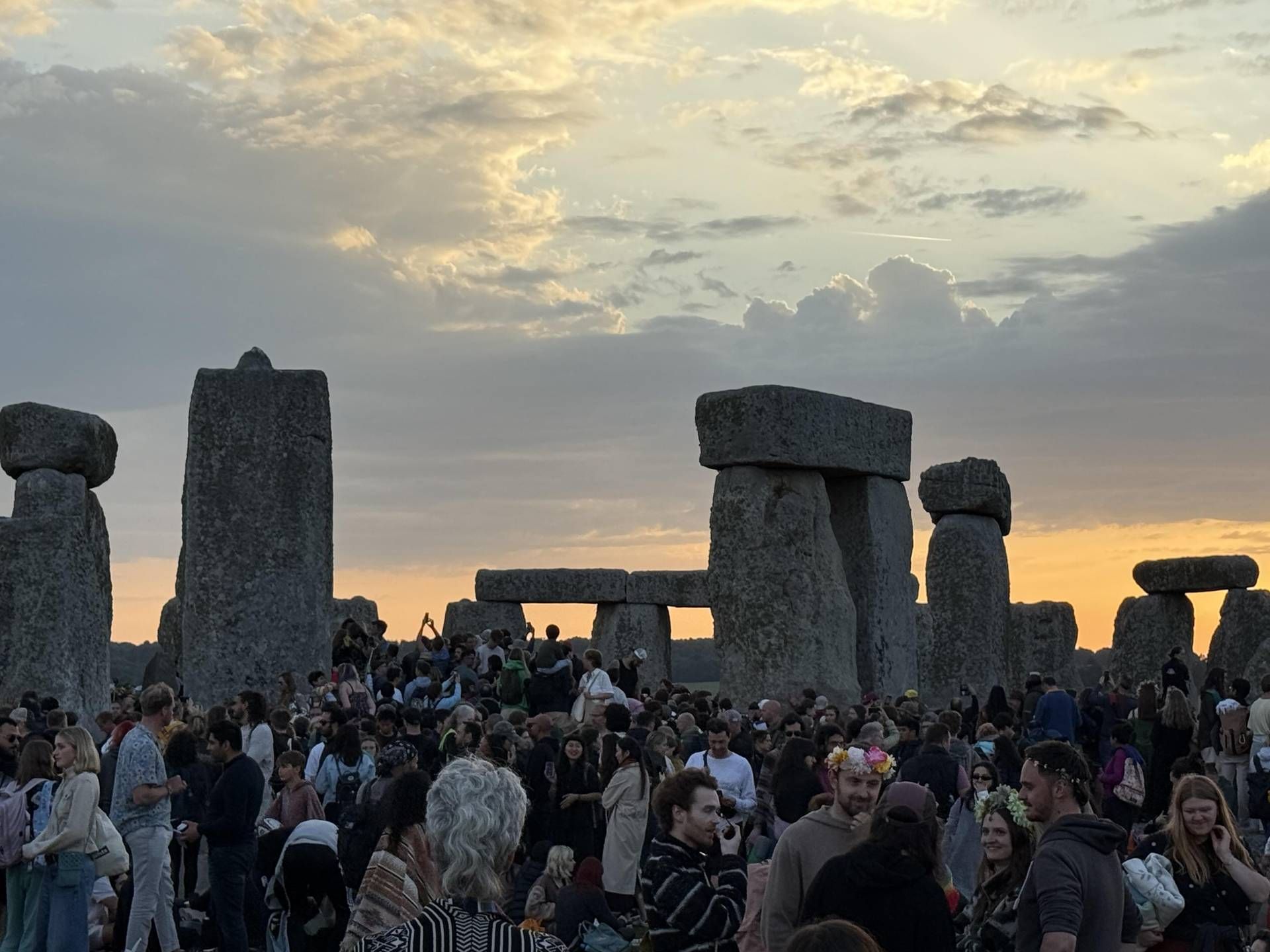
A monumental circle of deep, perfectly aligned pits around the Stonehenge complex it could really be a work of Neolithic man, between 6,000 BC – 4,500 BC and 2,000 BC. This is supported by a new study led by British archaeologist Vince Gaffney, which puts what could prove to be the largest prehistoric artefact known in the United Kingdom back at the center of the debate.
The mystery
The story began in 2020, when a team of 18 researchers announced the discovery of two arches of circular pits distributed over 3 square kilometers around the Durrington Walls, the vast ceremonial enclosure linked to Stonehenge. The cavities – about 10 meters wide and 5 meters deep – were immediately contested by the scientific community, according to which they could be simple natural sinkholes formed in the chalky soil of the area.
The reply now arrives on the pages of the magazine “Internet Archaeology”: a new group of scholars, again led by Gaffney, presents data that would confirm the intentional origin of the pits. “They may represent a sacred boundary linked to the ritual activities of Durrington Walls,” explained the University of Bradford, involved in the project.
Although none of the graves have been completely excavated – a costly and complex operation – researchers used a number of advanced techniques in 2021: magnetic and georadar prospecting, geochemical analyses, luminescence dating and even DNA studies of sediments taken from cores.
The results, the team reports, are “consistent with the original interpretation”: the ten structures analyzed show surprisingly uniform shapes, sizes and arrangements, incompatible with random natural phenomena. The regularity of the route suggests a more developed than expected numerical knowledge on the part of the Neolithic communities.
Luminescence dating places the excavation of the pits around 2480 BC, in the middle of the Neolithic and contemporary with the use of Durrington Walls. A fact that definitively weakens the sinkhole hypothesis: to form naturally, the authors explain, a thick layer of sediment would have been necessary, which is currently absent and whose large-scale removal finds no evidence in the landscape.
The new study therefore invites continued investigations: in recent years similar structures have also emerged in other areas of Great Britain, such as Milltimber (Aberdeenshire) and Linmere (Bedfordshire)suggesting that the construction of large pit circles was far from uncommon for the communities that erected Stonehenge.
“The existence of extensive pit complexes should not surprise us, but be expected during field work,” the researchers conclude. A message aimed at the scientific community: those voids in the ground, often dismissed as natural anomalies, could instead tell one of the most fascinating chapters of British prehistory. (by Paolo Martini)