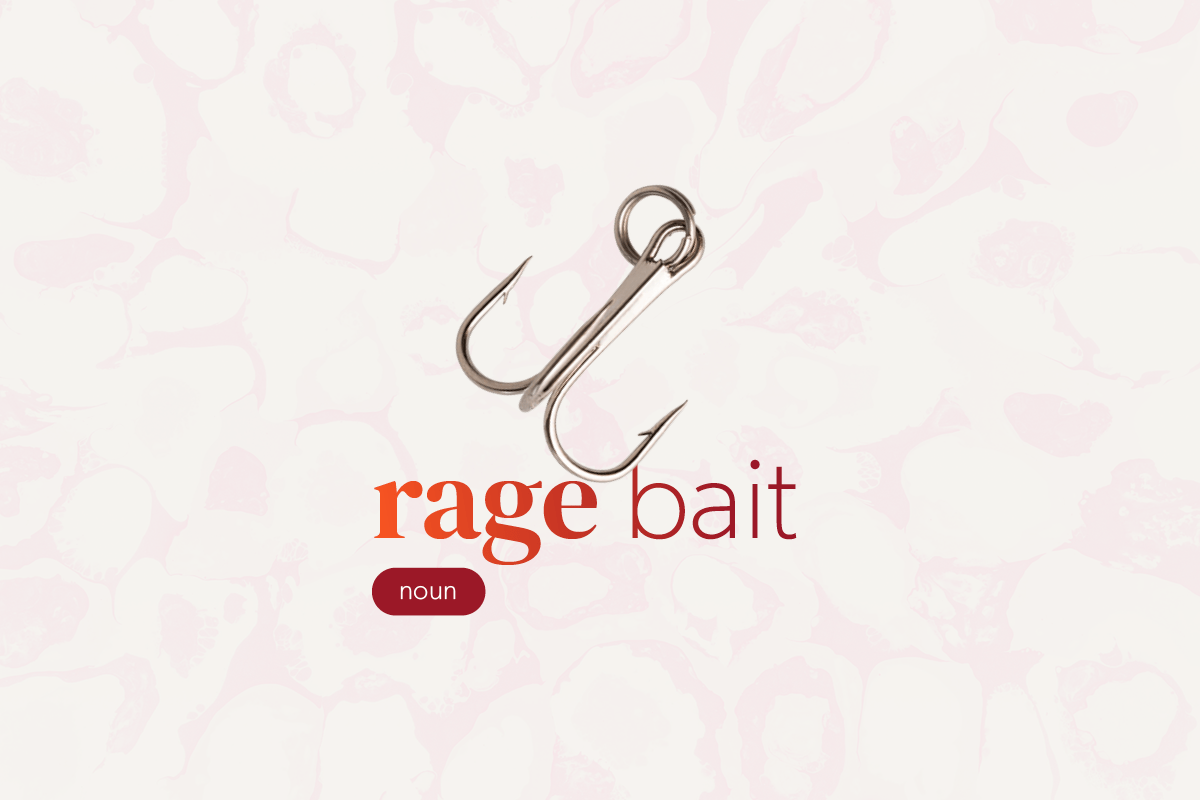
Scrolling through social media, do you suddenly feel irritated, provoked, pushed to react? You are not alone: according to Oxford University Press, more and more users are falling into the trap of “rage bait”, a term elected word of the year 2025 by the publisher of the authoritative dictionary of the English language.
The Oxford Dictionary defines “rage bait” as online content created specifically to arouse anger, frustration or indignation, with the aim of generating traffic and interactions. A more aggressive form of “clickbait”: no longer curiosity, but negative emotions used as fuel to make comments, shares and visibility skyrocket. According to Oxford University Press, use of the term has tripled in the last twelve months.
Also competing for the title were “aura farming” and “biohack”, but the weight that digital outrage has taken on in the conversations of 2025 convinced linguists and the public to choose “rage bait” as the words of the year.
“The boom in the term shows how aware we have become of the manipulative tactics that engage us online,” explained Casper Grathwohl, president of Oxford Languages. “The Internet used to capture attention; now it aims to influence our emotions.”
It happens to anyone who frequents social media and information platforms: a deliberately provocative video, an extreme opinion, an image designed to irritate. The aim is not to inform or open a debate, but to trigger instinctive reactions. And the more users get angry, the greater the return in terms of visibility for those who publish. The phenomenon is part of a cycle which, according to the linguist Grathwohl, unites the words of 2024 and 2025: from “brain rot” – the mental wear and tear of infinite scrolling – to anger as the engine of algorithms. “Outrage breeds engagement, algorithms amplify it, and constant exposure leaves us exhausted,” Grathwohl summarized.
In contention were other terms such as “aura farming” (the construction of a magnetic and fascinating personal image, capable of conveying security or mystery) and “biohack” (practices – from diet to technological tools – to optimize physical, mental performance or general well-being). The three terms were subjected to a public vote, which contributed to the final choice of the Oxford experts.
Not just Oxford. The Cambridge Dictionary has chosen “parasocial” as the word of 2025, thus defining the emotional relationship an individual feels towards a celebrity he or she does not know. A recent example: the wave of reactions to the engagement announcement between Taylor Swift and football player Travis Kelce. Collins instead opted for “vibe coding,” or developing apps or sites by describing them to an artificial intelligence instead of writing code manually.
With “rage bait”, the linguistic photography of 2025 brings to the foreground a crucial theme: the evolution of emotions in the digital ecosystem, increasingly fertile ground for strategies designed to capture – and manipulate – our attention. (by Paolo Martini)