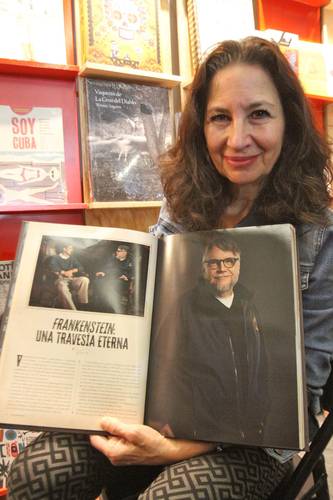
the book Frankenstein collects “the literary and visual sensitivity” of Guillermo del Toro
Guadalajara, Jal., Trilce Ediciones owns the Spanish rights to the book that Sheila O’Malley prepared based on the filming process of the film Frankenstein, directed by Guillermo del Toro.
The volume, launched at the Guadalajara International Book Fair (FIL), due to its quality of design, size and paper, vindicates the health of the publishing industry in a time of digital vertigo; It details every stitch and seam to turn film craftsmanship into pure art.
In hall C, pavilion 28, Déborah Holtz, editor of Trilce, treasures copies of this work, inspired in turn by the original by Mary Shelley. Holtz shows the book like someone opening a chest. “See what a beautiful thing,” he says as he gently takes it.
Photographs, sketches, graphics, descriptions that go beyond promotional stills or posters designed for visual impact, as well as Sheila O’Malley’s synthesis translated into Spanish, coexist with storyboards which capture images of the ship trapped in the ice of the northern seas and with interviews with the film crew, from the art design area to makeup artists and actors.
“What Guillermo del Toro has achieved with Pinocchio, and now with Frankenstein, They are works of art, a sample of the amalgamation that must exist with a group of people, because the film itself prefigures the monster, but what Del Toro does is unusual: there already being 100 or more films of Frankenstein, From a very young age he realized that the true story had not been told,” he says.
He states that the above shows “a literary and not just visual sensitivity” of the Guadalajara-born director.
The preface of the book is by Oscar Isaac, actor who gave life to the doctor Frankenstein in the film; “Each part is narrated in an incredible way; there is a chapter dedicated to Mary Shelley and what represents the story and the creation of the novel she wrote at the age of 18.”
▲ Déborah Holtz, editor of Trilce, shows a copy of Frankenstein printed by that seal.Photo Arturo Campos Cedillo
Orphanhood in both creators
Holtz puts Shelley and Del Toro on the same level regarding orphanhood; her, because when she was born her mother died, and because of her father, often absorbed in his philosophical vocation.
“Guillermo del Toro has narrated that he grew up like an ear in the wind, that there were days when he did not even see an adult in his house,” he equates.
“One of my great emotions is that we are a small, independent publisher; so, that this possibility has crossed my path is a miracle; I feel that there is a lot of Del Toro in that; there is a vibe that I think would be happier seeing itself here than there, in a publisher that has bet its life on what we have believed.”
Trilce also published in Spanish Pinocchio: A timeless story told by Guillermo del Toro, with which she won two years ago the award for best youth book awarded by the National Chamber of the Publishing Industry, for which she claims to be proud to be a “kind of spokesperson” for the director.
“Trilce was born without intending it: I partnered with Juan Carlos Mena, who is the brilliant designer of the books; we partnered to do business design work, but one day he told me that he had the idea of making a book, and when I saw his images I realized that they are a praise to the current popular culture of Mexico: sound bars, wrestling typography, vulcanizers. Street graphics with a unique personality,” he remembers.
Then, Holtz shows other gems from his publishing chest: books like Avocado, “who has done very well”; They are from Cuba, published before the rise of the Buena Vista Social Club, or Tacopedia, taco encyclopedia that took several years to complete and has been “priceless, but at the same time invaluable, for the satisfaction it has given us to elevate the taco.”