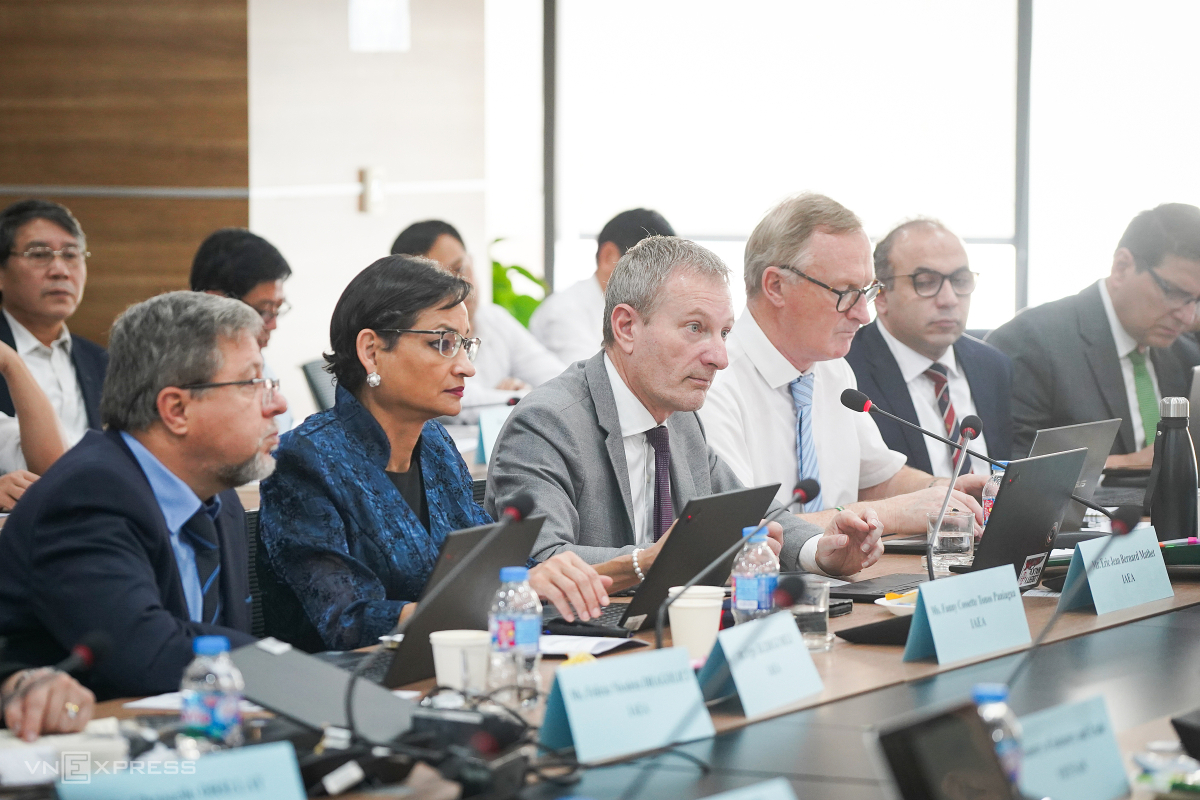
The International Atomic Energy Agency IAEA began an 11-day infrastructure assessment (INIR) working session, preparing for the deployment of nuclear power in Vietnam.
The IAEA’s Integrated Nuclear Infrastructure Review (INIR) is a program in which international experts will visit a country to comprehensively review its level of readiness if it wants to develop nuclear power.
The IAEA delegation’s working session in Vietnam started from December 1 to 11, organized by the Ministry of Science and Technology. This is an important activity in the preparation roadmap for implementing the Ninh Thuan Nuclear Power Project and similar projects in the future. The INIR working group includes seven IAEA experts, three international experts invited by the IAEA from the UK, Brazil, Bulgaria and one observer from Egypt.
IAEA International Atomic Energy Agency delegation, with delegation leader Mr. Eric Mathet (gray shirt) in the first working session, December 1, 2025. Image: Luu Quy
Speaking at the opening of the working session, on the morning of December 1, Deputy Minister of Science and Technology Le Xuan Dinh emphasized the importance of nuclear power in the context of a sharp increase in electricity demand to meet economic and social development and high-tech industries, while also meeting the requirements of reducing greenhouse gas emissions.
He said that from the end of 2024, the Vietnamese National Assembly has approved the policy of restarting the Ninh Thuan Nuclear Power Project. The Government then gave direction on strengthening the management apparatus, completing the legal framework and fully preparing the necessary conditions to deploy the national nuclear power program.
In addition, the Atomic Energy Law was passed in 2025 and guiding decrees are being completed according to international standards. “This is an important foundation for Vietnam to ensure the development of a safe, secure, effective and sustainable nuclear power program,” the Deputy Minister said.
For a country that has just started its first nuclear power program like Vietnam, the infrastructure development process must go through three stages marked by three corresponding milestones. In particular, phase 1 is preparing to make a decision to launch the nuclear power program; Phase 2 is to prepare for the construction of the plant, phase 3 is to build and put into operation the first nuclear power plant.
The completion of the INIR assessment is equivalent to milestone number 2, the start of phase 2, allowing Vietnam to prepare bidding documents for the first nuclear power plant, according to the Deputy Minister.
Deputy Minister of Science and Technology Le Xuan Dinh during the working session. Image: Luu Quy
The INIR program evaluates 19 infrastructure items, ranging from legal framework, nuclear safety and security, nuclear inspection, capital strategy, power grid, site selection, environmental protection, human resource development, international cooperation, fuel cycle, radioactive waste management, and stakeholder engagement. To prepare for the program, previously, the working group to evaluate Vietnam’s nuclear power infrastructure established by the Ministry of Science and Technology completed the development of a Self-Assessment Report and sent it to the IAEA in October 2025.
Mr. Eric Mathet, Head of the IAEA delegation, expressed his joy when Vietnam restarted the nuclear power project after stopping in 2016. During their time working in Vietnam, the group will conduct interviews with relevant agencies, observe and evaluate issues to serve the report.
Emphasizing that developing nuclear power infrastructure is a complex undertaking, he said it requires intensive preparation and a long construction period, possibly up to a decade, long-term commitment and significant financial investment, while nurturing highly skilled human resources.
According to Mr. Eric Mathet, the group’s goal is to help, provide an outside perspective on the work that has been done, “give directions for the project to move forward in a more sustainable and organized way”.
The IAEA delegation representative also committed to the timelines and results obtained, such as the INIR report, recommendations, proposals, and how Vietnam can use these results for its milestone No. 2. The official report is expected to be completed by the end of the first quarter or the second quarter of 2026.
At the meeting, Deputy Minister Le Xuan Dinh highly appreciated the participation of the IAEA delegation and requested relevant units to absorb and coordinate to implement the program. “The Ministry of Science and Technology will continue to support and support cooperative activities between Vietnam and the IAEA in developing and applying atomic energy for peaceful purposes in Vietnam,” he said.