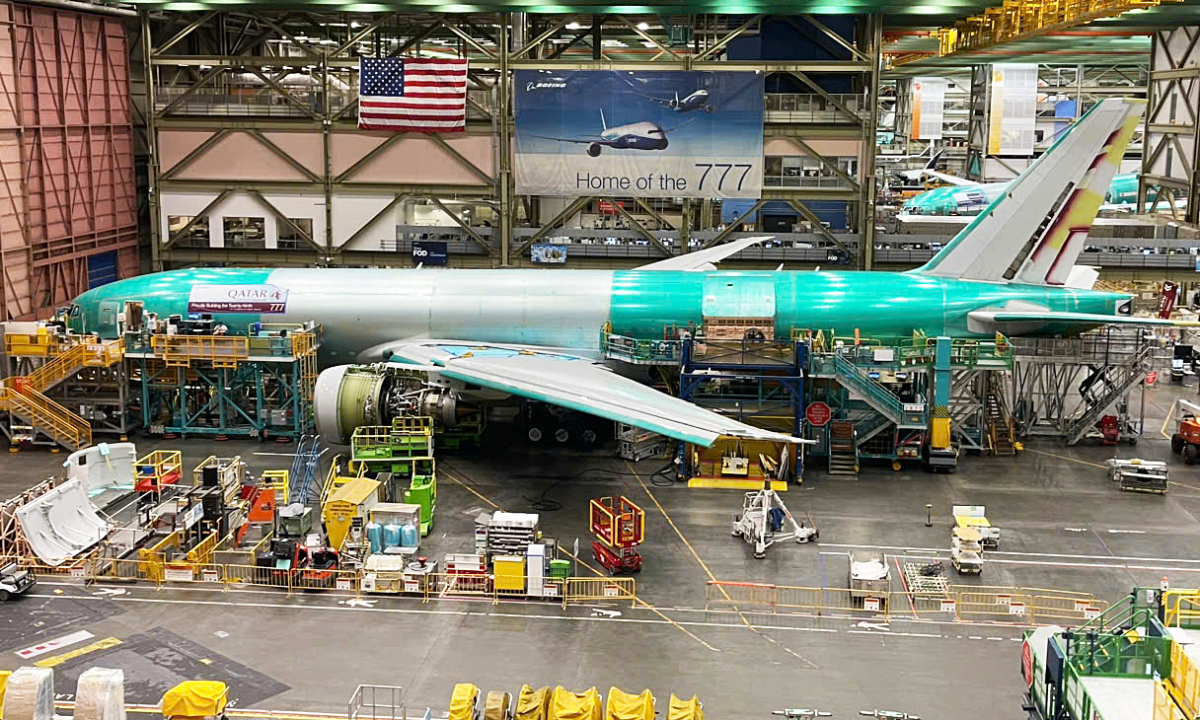
The Everett factory in Washington state is Boeing’s largest aircraft manufacturing facility, the birthplace of iconic machines of the American aviation industry.
Boeing owns a network of factories across the United States, specializing in the production of commercial, cargo and military aircraft. Among them, the Everett factory was established for the 747 family of aircraft in 1967 and is producing the 767 and 777. Recently, the factory began producing the 777X series – the company’s latest and most advanced generation of large wide-body aircraft.
Aircraft assembly process
The Everett factory stretches nearly a kilometer long, is about 500 m wide, with a floor area of 399,000 m2 and an internal volume of 13.3 million m3, making it the largest building in the world. The Everett area is often described as a “mini city,” with fire stations, medical clinics, sports facilities, restaurants and cafes serving tens of thousands of employees.
The plant’s design supports natural ventilation and air control. During the summer, teams of employees open and close the factory to optimize air flow. Above are 26 cranes moving through a 72 km long rail system, with a total lifting capacity of nearly 860 tons. Four hangar doors are 91 x 25 m in size and two hangar doors are 107 x 25 m in size, approximately an American football field.
From outside parking lots, staff including engineers and technicians are brought into the production area by shuttle and can travel by foot, electric vehicle or tricycle.
When visiting, guests must wear reflective vests, goggles and closed-toed shoes. Sandals are not allowed to avoid equipment-related risks.
A 777-9 under construction. Image: Mr. Duy
The Boeing 777X aircraft family currently has two passenger variants: 777-8 and 777-9. With a conventional design, the 777-8 can accommodate 395 passengers with a range of 16,190 km, while the 777-9 has 426 and 13,510 km respectively. Boeing also offers the world’s newest and largest twin-engine 777-8 cargo aircraft.
Share with VnExpressMr. Nicholas Batkoski, Director of the 777/777X Program Fuselage Assembly Center, said the Everett facility currently produces about four 777s and 777Xs per month, with 35,000 employees, engineers and technicians working in shifts. Each employee undertakes from 3 to 8 tasks on his or her line.
Large components of the 777/777X family, including the mid and rear fuselage, nose section, vertical and horizontal wings, as well as the GE9X engine, are manufactured at multiple Boeing facilities and suppliers across the United States and globally, then transported to Everett by truck, train and ocean.
The aircraft is partially assembled at the Everett factory. Image: Mr. Duy
Overhead cranes lift the front, middle and rear body sections into the production area and place them on molds to begin the final assembly process. The robot moves these sections through each location, where technicians install wiring and equipment, including seating, stoves and toilets, and perform inspections. The wings are attached to the middle fuselage, which technicians then connect to the front and rear fuselages, creating a 70-meter-long fuselage.
When the fuselage and interior were completed, two engines were mounted under the wings. The aircraft was then transferred to a nearby facility for painting, refueling and inspection and then taxied to the Paine Field airport runway for test flying.
Advanced technology on the 777X line
Inside the Everett factory, the 777-9 is easily recognizable thanks to its folding wings. As a large aircraft, each 3.6 meter long wing tip is designed to fold up after landing to reduce the wingspan from nearly 71.8 to 64.8 meters, allowing the aircraft to taxi and park at existing airports. This is the first commercial aircraft in the world to have this mechanism.
According to Boeing, the 777-8 and 777-9 were born after long-term research, combining the strengths of the 777 and 787 lines and adding many innovations to create the flying experience of the future.
Unlike many large commercial aircraft that have more than 400 seats, use four engines and consume a lot of fuel, the 777X is a two-engine aircraft, providing the lowest operating costs per seat among commercial aircraft.
The 777X folding-wing aircraft is waiting for test flights. Image: Mr. Duy
The 777X series also has strong technical and technological upgrades, including wings made from carbon fiber composite material to increase durability but reduce weight. Together with the new GE9X engine and natural laminar flow nacelles, the 777-9 will reduce fuel consumption and emissions by 20% and noise by 40% compared to the aircraft it will replace. Boeing says this is the most advanced and fuel-efficient commercial engine available today.
The cabin has higher humidity, is equipped with an optimal pressurization system for passenger comfort, and has more natural light and LED lighting systems than other aircraft models. The upper luggage compartment has double the capacity, keeping the cabin neat and providing clear visibility.
Although it is in the test flight phase and not yet in commercial operation, Boeing said it has received more than 565 orders for the 777X from the world’s leading airlines.
Boeing is also producing narrow-body 737 aircraft and wide-body models such as the 767 and 787 Dreamliner. In 2024, Boeing’s commercial aircraft division generates $22.8 billion in revenue and employs more than 50,000 people. Boeing aircraft currently account for nearly half of the global commercial fleet, with more than 14,000 aircraft in operation.