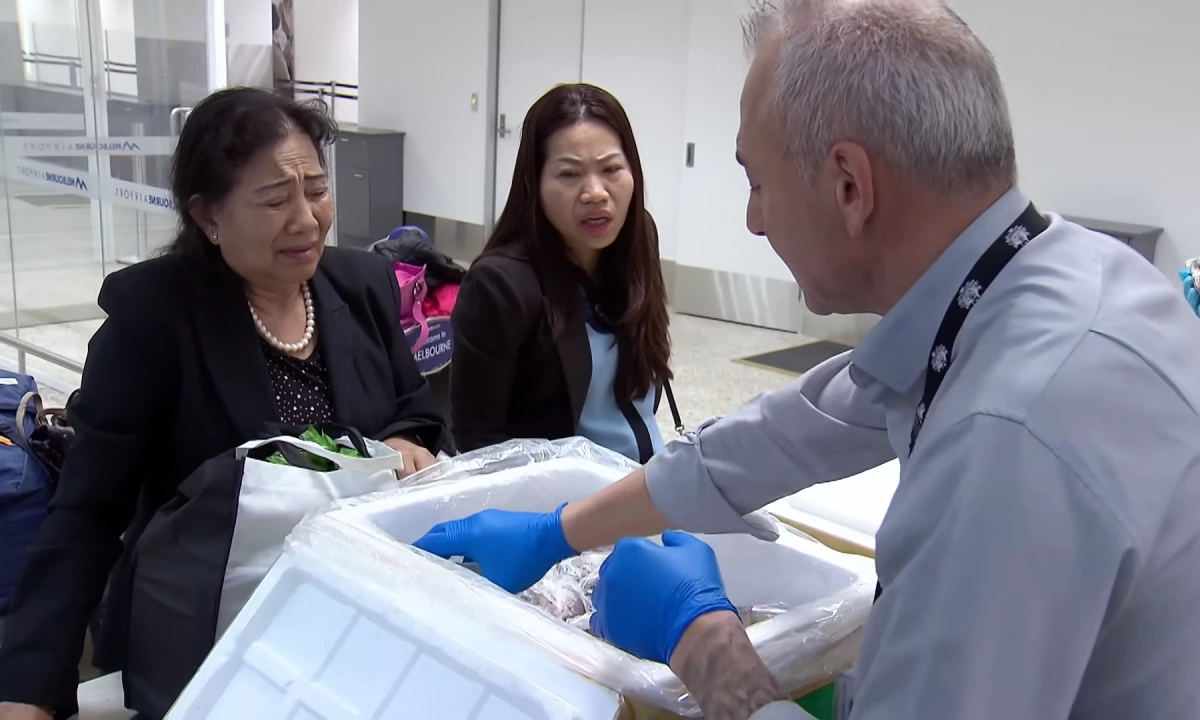
Many tourists carrying illegal goods when entering Australia were fined and featured on television in the program “Border Security Australia’s Front Line”.
Hoang Minh, living in Hanoi, plans to travel to Australia next year so he regularly watches the show Border Security Australia’s Front Line (Border Security: Australia’s Front Line) to learn more about regulations on goods entering the country. However, what attracted him most was the dramatic feeling when watching tourists entering the country have their luggage checked, their panicked faces when they were about to be discovered with illegal items.
“The way they cut, edited, and mixed the music made me too caught up in checking,” he said, saying he was quite surprised because he saw Asians – especially Vietnamese guests – appear on the show many times.
Border Security: Australia’s Front Line is an observational documentary reality television program that ran for 17 seasons, starting in 2004, focusing on the day-to-day work of Australian Border Force officers and biosecurity officers. The show is filmed primarily at major international airports such as Sydney, Melbourne and Brisbane along with seaports and international mail centres.
Banned substances are disguised in mouthwash bottles. Image: Border Security
Content of Border Security revolves around three main areas including Customs and Drugs, Biosecurity (Quarantine) and Immigration (Immigration/Visa). The recorded episodes range from minor violations such as tourists intentionally bringing banned food to serious incidents such as large-scale drug smuggling, arrests of people with serious criminal records, visa cancellations and deportation of visitors. The show’s YouTube channel has more than 550,000 subscribers and its most popular video has nearly 7 million views.
Hoang Minh said he was still impressed with episode 13 of season 14 when two women from Vietnam were discovered carrying live crabs in their luggage. They had entered Australia from Vietnam about 18 times and knew the process but still intentionally did it wrong so they were fined 420 AUD. In addition, many food items from Vietnam were also ordered to be destroyed by security officers because of “potential risks”.
“It’s not good,” the security officer reminded before the two tourists left. In addition to this episode, Minh was also impressed with an episode about a guest from Thailand being arrested at the airport for transporting a banned substance worth 2.4 million USD, disguised as a mouthwash bottle.
Two Vietnamese tourists brought live crabs when entering Australia. Image: Border Security
According to Minh, besides happy moments like two Vietnamese tourists bringing live crabs, the show also has many dramatic episodes like action movies. With experience watching the show over many seasons, Minh said he is quite confident when entering Australia next year.
Dao Minh Hien, a Vietnamese living in Australia, said he is also a fan of the show and was tested several times when returning from Vietnam. His experience is to always be honest when filling out the immigration declaration to make the procedure smoother. For example, if you bring food such as green rice cake, dried star fruit, dried bamboo shoots but have been carefully packaged and vacuum-sealed, you will proactively mark “Yes” on the declaration.
The longest time Hien was detained in the inspection room was about 10 minutes, mainly because the Australian border force (ABF) wanted to ask clearly about his purpose of returning to Vietnam, his current school and field of study in Australia, and why he stayed in Melbourne for two days.
“I know there’s a camera, but just stay calm and concentrate on answering. Usually they’ll let you go and won’t force you to scan your luggage,” he said. Based on many observations, Hien said Asian guests are mainly tested for food, but many Western and African guests are also tested for banned substances and diseases.
He assessed that Australia has many strict security and safety regulations to protect biodiversity, helping to minimize the risk of pests and strange insects entering vulnerable ecosystems.
The Australian immigration declaration form in Vietnamese is distributed on the plane to passengers by flight attendants. Image: Minh Hien Dao
Grant Wilson, an Australian, often goes back and forth to Vietnam to visit relatives and work, sharing that people like him are often targeted by the program. According to Grant, security officers in Australia always pay attention to Australian men who frequently travel back and forth to Asian countries, especially Thailand, Cambodia and Vietnam. They suspect these people went to Asia to transport banned substances or commit other wrongdoings.
“I never did anything wrong, but if you are a man, traveling alone and going to those countries many times, the possibility of being checked is very high,” Grant shared.
In early November, Hien shared a post about the program on a Vietnamese group and received more than 1,500 likes. In the comments section, many people said this is an indispensable “spiritual meal” for them every night, some even taught themselves English by watching the show.
According to Hien, to avoid becoming the above reluctant actor Border Securityall Vietnamese tourists about to enter Australia should remember the slogan at the airport “Don’t apologize, just declare”.
Two Vietnamese tourists had to pay a fine for bringing crabs upon entry. Video: Border Security Australia’s Front Line