Accommodation establishments import thousands of liters of oil every day to run generators, causing losses of tens of millions of dong, not to mention guests leaving due to power outages in Phu Quoc.
Since November 29, a 110 kV submarine cable incident in Ha Tien – Phu Quoc has caused widespread power outages in the areas of Duong Dong, Cua Can, Cua Duong, Ham Ninh and the entire northern region of the island. An Giang Electricity Company has isolated underground cables for inspection. It is expected that the repair time may be longer, depending on the level of damage and treatment plan.
Tourist service businesses in Phu Quoc are experiencing a series of days “opening their eyes to lose tens of millions of dong” while it is the peak season for foreign tourists.
On the morning of December 2, Mr. Le Hong Son, owner of the Gold Coast resort in Ganh Dau, just bought an additional 1,000 liters of oil to operate the generator. Every day, the fuel cost alone to operate the large capacity generator system “costs” this business about 20 million VND. This number is expected to increase gradually if the problem is not resolved soon.
According to Mr. Son, this is the “golden” time for Phu Quoc tourism when the number of international visitors, especially European and American tourists, flock to avoid the winter. Room occupancy rate at the resort is reaching its highest level. However, the power outage caused about 40% of guests who booked during the week to request to cancel their rooms to move to the South Island area or fly to another locality. Currently, the facility is maintaining electricity for about 10 hours a day and notifying visitors about power cut times so that guests can proactively adjust their schedules to return to the resort to rest.
“We can bear the cost of fuel, but tour cancellations and bad reviews about the service experience are long-term damage to the local tourism brand,” Mr. Son said.
A resort with more than 1,000 rooms in the north of the island. Image: Agoda
Mr. Son’s situation is not unique. At large-scale resorts with 300 rooms or more, damages are calculated in billions. Ms. Le Thi Hai Chau, manager of a 5-star resort chain in the North Island, said that on average, a 300-room facility costs about 1.5 billion VND in grid electricity each month. When switching to running a diesel generator, this cost doubles or even triples, ranging from 2.8 to 3 billion VND. In just the first three days of the incident, a resort in her system had to spend 200 million VND just to buy oil.
Unlike previous local power outages that were often announced in advance and only lasted a few hours, this incident occurred suddenly and lasted for many days, leaving businesses unable to react in time. To maintain operations, most accommodation facilities are forced to run generators almost 24/7. However, generator capacity usually only meets about 70-80% of actual load demand.
To adapt, resorts must activate emergency energy saving procedures. The public lighting system was reduced to a minimum, central air conditioning was fixed at 24-25 degrees Celsius, and large power consuming devices in staff areas were completely turned off.
Some places even have to apply extreme measures such as rotating power cuts in areas where there are no guests staying.
“We are having to manage every hour to minimize the impact on tourists’ vacations. If this situation lasts past Christmas and New Year, the consequences will be very unpredictable,” Ms. Chau said.
Not only the “big guys”, small and medium enterprises are also struggling. Ms. Hoang Linh, owner of a resort in Duong Dong ward, said that after two days of continuous operation, the facility’s generator broke down due to overload. She was forced to rent an external generator at a high cost, but it was only enough to maintain power for the reception desk and wifi system. At night, customers must use rechargeable lamps or candles in the break room. Faced with this inconvenience, Ms. Linh proactively refunded 100% to guests who wanted to leave and waived all services for guests who stayed.
“Losing peak season revenue is very painful, but maintaining reputation and safety for tourists is the top priority right now,” Ms. Linh said.
Mr. Ha Tuan Minh, Director of Winner Phu Quoc International Tourism Company, said that current operating costs are 5 times higher than normal. What is more worrying is that the unstable voltage problem when switching between grid power and generator has caused many expensive electronic equipment in the hotel to be damaged.
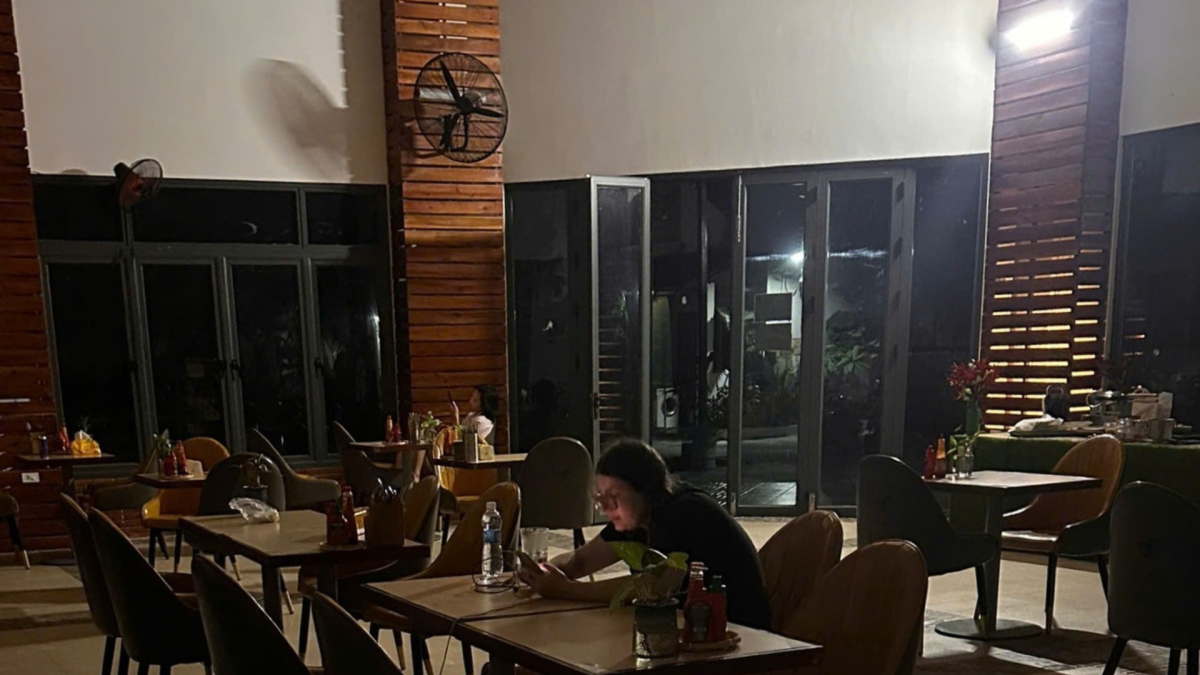
The resort in Duong Dong ward lost power while the generator was only enough to supply power to the reception area and restaurant. Image: Hoang Linh
According to the Southern Power Corporation (EVNSPC), the 110 kV Ha Tien – Phu Quoc underground cable line is one of two important cable lines supplying electricity to the pearl island, besides the 220 kV Kien Binh – Phu Quoc line. This incident was determined to be quite complicated, making access and repair difficult.
A representative of An Giang Electricity Company said that it has mobilized maximum human resources and specialized equipment to overcome the problem, and at the same time implemented a load regulation plan, prioritizing power supply to central areas and important infrastructure, however, full recovery needs more time.
The resort lost power while the generator was only enough to supply power to the reception area and restaurant. Image: Hoang Linh
Many businesses recommended that, in addition to troubleshooting, Phu Quoc and the electricity industry need to have a mechanism to compensate or adequately support damaged units, instead of just stopping at notification and apologizing.
In the long term, investors like Ms. Hoang Linh are considering the option of installing a rooftop solar power system to have partial power source autonomy. Although the initial investment cost is large, this is considered a solution to reduce risks in the future, while also aiming at the green tourism criteria that Phu Quoc is pursuing.
Mr. Tuan Minh, representative of Winner Phu Quoc, owner of a residence with more than 50 rooms, said that the power outage most severely affected small hotels and tourist homestays because they could hardly afford the cost of running generators. Moreover, this is the peak tourist season and also the main source of income for the year. If there is a loss of income, the whole year will be lost.
“The damage is certain, but who should I call to get compensation?” Mr. Minh wondered.
According to data from the An Giang Department of Tourism, in 11 months, the province welcomed more than 22.7 million visitors, an increase of 24% over the same period and exceeding the yearly plan by 8%. Of which, Phu Quoc special zone welcomed about 7.6 million visitors, an increase of 35% over the same period, exceeding the year’s target by nearly 5%.