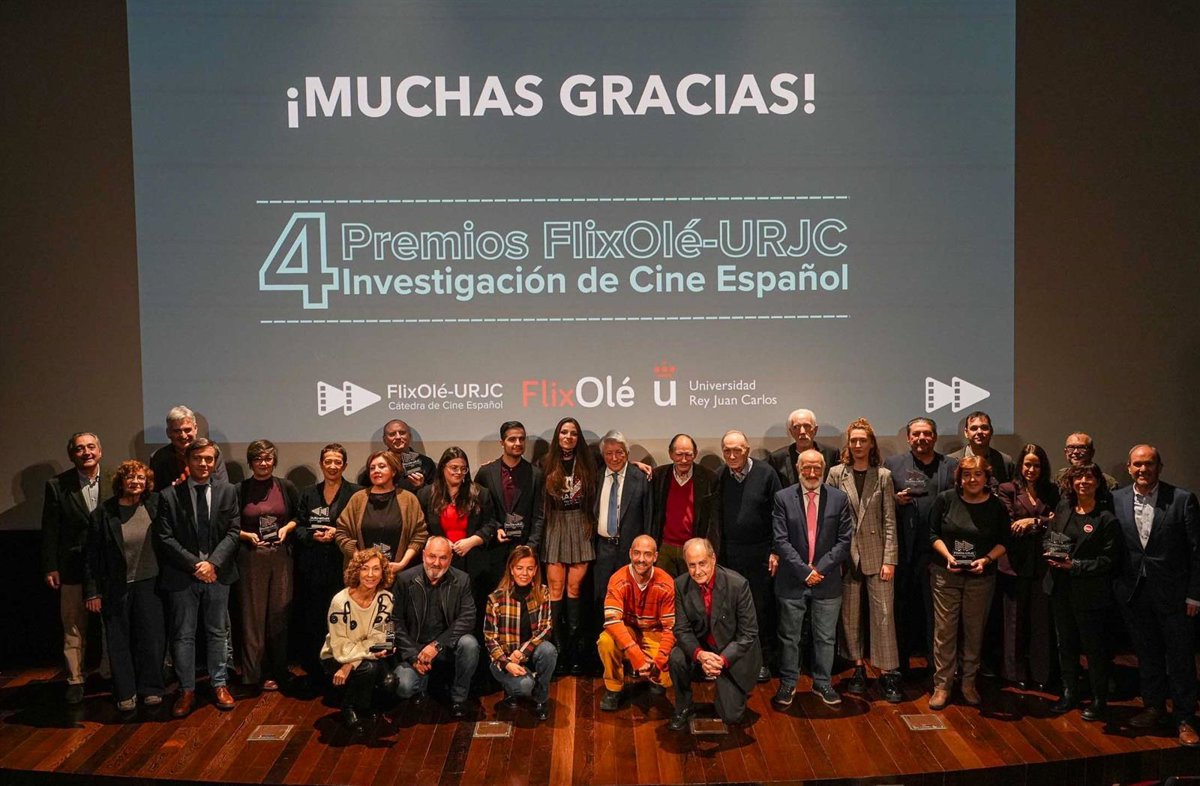
The headquarters of the Film Academy has hosted the IV edition of the Spanish Cinema Research Awardsthe awards that recognize the audiovisual research and dissemination work developed by students, teachers and communication professionals, and are awarded annually by the FlixOlé-URJC Chair. The journalists Begoña Piña, Yolanda Flores, Conxita Casanovas and María Guerra; the SGAE exhibition ‘Comedy, which is no small thing’ or the RTVE documentary series, ‘The secret files of the NODE’ have been some of the winners.
Some awards that, as the founder of the FlixOlé platform, Enrique Cerezo, has pointed out, were born “to build bridges between academic research and industry” and that they have become “a consolidated, necessary and increasingly diverse space.” “These awards are the seats where theory and practice dialogue,” Cerezo highlighted in his speech in which he stated that “investigating Spanish cinema is also making Spanish cinema.”
“Each study, book, article and project expands the life of our films, contributes to reviewing them from other levels. and, above all, it allows new generations to find in them an identity and a shared memory. And this year, the plurality of perspective tells us about a cinema that continues to inspire,” he noted and then concluded by pointing out that “Spanish audiovisual is not only written with cameras: also with study, reflection, analysis and memory“.
The event was inaugurated by the director of the FlixOlé-URJC Chair, researcher and teacher, Mario Rajas, who emphasized the role of higher education: “These awards reflect a crucial moment in the revolution that universities are experiencing, which have become content producers“. He was followed by the rector of the Rey Juan Carlos University (URJC), Abraham Duarte, who presented the first award, Best Final Degree Project (TFG): “A TFG is a sensational means to make society aware of the quantity and quality of projects that are generated in university classrooms, a way of connecting culture, science, art and the future.
Thus, Esther Muñoz has opened the contest with her TFG ‘The evolution of female representation through art direction in Spanish cinematography’. Already in the best TFM category, Eduard Grañana has won the statuette through ‘De l’hegemonia a la marginalitat’. A vision of masculinities in the cinema of the transition of ‘Eloy de la Iglesia’, a project that shows how the director in question “He did not film crime, but humanity and a Spain that many preferred not to see.”“, in the words of the artist ‘La Pucci’, who awarded the prize.
Fernando Sánchez has collected the trophy for best doctoral thesis for ‘Spanish neo-noir in the culture of indignation (2009-2020): a film genre, a transnational intermediate between industry and society’; while Minerva Campos has been the winner in the best scientific article category for ‘To be a ‘class A’: the negotiations of the San Sebastián Film Festival and the FIAPF (1953-1985)’, It was presented to him by the person in charge of Artxiboa at the San Sebastián Festival, Irati Crespo.
SPECIAL PRIZES
Once the academic awards have ended, the gala has been given recognition for its journalistic and editorial proposals. The journalist Begoña Pineapple She was the first to take the stage for her publication ‘The Ogre of the Forest’, which won a specialized article award. “I want to thank the Furtivos team for their audacity: it is such a radical, politically incorrect and brave proposal. that, nowadays, no one would have thought of it,” said Piña, who was “very happy” because in this edition the awards recognize the work “of four veteran journalists who have fought a lot.” “And this is not a coincidence, it is a great victory“, he declared.
Cascajosa Conception has received the award for his study ‘The screenwriter’s profession in Spain’. “I hope these types of studies help to overcome precariousness in the screenwriting profession“, he said. Likewise, the critic and economist, Miguel Marías, has received the award for best Spanish film book for ‘Another Luis Buñuel’, “a book that is the merit of Luis Buñuel”, in the words of its author.
The president of the Academy, Fernando Méndez-Leitepresented him with the statuette and dedicated some emotional words to him: “Miguel has always written about cinema in a special way, combining rigorous analysis with great personal intuition and artistic sense. Working on Buñuel is audacious, because a lot has been written about him, and it is great to achieve what Marías has done, giving a personal vision of Buñuel“.
In the best activity or initiative category, the president of the SGAE, Antonio Onetti, together with the person responsible for Complementary Activities of the entity, Maribel Sausor, and the comedian, Arturo Gonzalez Campos, have received recognition for the exhibition ‘Comedy, which is not little’. “This exhibition would not have been possible without the work of our authors, since a part of what is raised allows this type of projects,” declared Onetti, while González Campos stressed that “A country is a long-distance race in which, when the battles are over, what remains is what makes us laugh. “That is the spirit of this exhibition.”
The director of Film and Fiction at RTVE, José Pastor, accompanied by the director of the production company Minoría Absoluta, Francesc Escribano, have detailed the work behind the documentary ‘The secret files of the NODE’award for best audiovisual research. “It has been proven that when the audience is given a quality project, they respond. And so it has been with this documentary, which has come to lead La 1“Pastor explained before Escribano focused on all the work “of a year, to recover the stories that they did not want to tell.”
Cadena SER journalist, Pepa Blanes, and her colleague at Kinótico, Iñaki Mayora, took the microphone to present the winning emerging medium, ‘La Script’ by Maria Guerra. The director of the program has stressed that “‘The Script’ is not mine, it is a collective project“. “We are 14 years old, we are teenagers and that is why we have so much bad luck,” he said with a laugh before thanking the awards for recognizing “a generation of veteran journalists.” “In this world of journalism, women have been swept away in a cruel and shameful way,” has concluded.
The journalist and writer, Fernando Lara, also awarded the outreach program award to Yolanda Flores, for her space ‘De Movie’. “I asked myself what the ‘Dissemination’ award was for, but I thought about the 27 years we have been doing the program and all the young people who have learned with us. That is also about spreading the word about cinema and we feel satisfied with it,” said the winner.
The gala concluded with tributes to professional career. On the one hand, the brothers Javier and Ignacio Muñoz received recognition for half a century of dedication to research, thought and cinematographic and communicative dissemination through FRAGUA: “Receiving the award for an entire career is an honor, and even more so when it comes from a publishing house. Thank you to all those who continue to think that Culture is essential for living.”
The journalist and film critic, Conxita Casanovas, closed the event by receiving from Fernando Trueba the award for a lifetime dedicated to the dissemination of the seventh national art: “It is my turn to give an award to a person who I have always liked for his kindness, the purity with which he practices his craft and his great love of cinema.” “Spanish cinema is ‘The apple of my eyes’ and we have to defend it from whatever fronts we open to continue contributing.”Casanovas thanked.