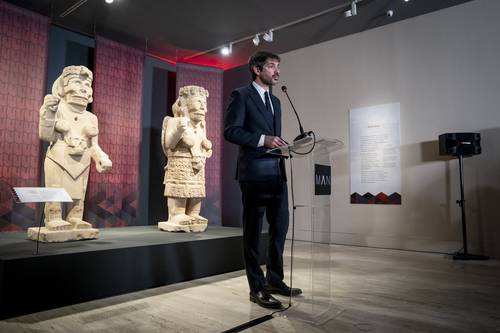
Madrid. The Minister of Culture of the Spanish government, Ernest Urtasun, insisted that “we should not be afraid” of asking “forgiveness” to the native peoples of Mexico for the excesses perpetrated during the Conquest and the Colony, as the government of our country has been demanding for at least three years. Within the framework of the reopening, in this case already complete, of the exhibition at the National Archaeological Museum, in coordination with the National Institute of Anthropology and History (INAH) and the Ministry of Culture of the Mexican government, the Spanish politician sent a “loving greeting” to President Claudia Sheinbaum.
On October 31, at the official opening of the four exhibitions in Madrid Half the world: Women in indigenous Mexicothe Minister of Foreign Affairs of the Spanish government, the socialist José Manuel Albares, spoke some words that meant a step forward in the gesture of forgiveness, stating: “like all human history, it has chiaroscuros. There has been pain and injustice towards the native peoples. There was injustice, it is fair to recognize it and regret it.” That same day, the samples of pre-Columbian art were opened to the public in four different venues: the Casa de México in Spain, the Thyssen-Bornemisza Museum, the Cervantes Institute and the National Archaeological Museum.
So a month later the complete exhibition was inaugurated and it was within the framework of its opening when Minister Urtasun, who belongs to the left-wing coalition Sumar, insisted on his words of rapprochement with the Sheinbaum government: “we should not be afraid of the words that unite us and bring us closer in so many countries and in so many people. I have already said it many times: words like dialogue, forgiveness, encounter, fraternity. Because all those words bring us closer and improve our lives and all of them constitute the field semantics of culture, which is that fertile ground where changes and transformations are always announced.”
The minister also highlighted the importance of the exhibitions in Madrid to promote the “necessary political rapprochement between both countries”, at which time he took the opportunity to send a “affectionate greeting to the president of Mexico, Claudia Sheinbaum”, and later insisted that “it is an exhibition that has, therefore, a very important substrate, reinforcing the links between our countries and making it possible for us to hug each other through culture.”
The director of the Arequeological Museum, Isabel Izquierdo, explained during the presentation of the exhibition that the pieces on display come from 31 places in Mexico and that they all have a common denominator: “they show women as guardians of memory and ancestral knowledge.” The exhibition will end its itinerary in Madrid on March 22, 2026.
https://www.ranktracker.com/blog/casino-seo/
https://solsea.io/a/67c572e8d3d1c2e984b0d9e7/about/
https://devpost.com/lmkhackgems
https://tawk.to/lmkfreegems
https://issuu.com/lmkfreegems
https://myspace.com/lmkfreegems
https://www.facebook.com/events/618810717595850
https://www.bandlab.com/post/c9b0f6f7-3bf8-ef11-90c9-00224848fea7
https://www.start.gg/user/80816310
https://flipbooklets.com/pdfflipbooklets/lmkfreegemshack
https://solsea.io/a/67c6b7e1ab93b071cf306bba/about/
https://devpost.com/befriendhack
https://tawk.to/befriendfreediamonds
https://issuu.com/befriendfreegems
https://myspace.com/befriendfreegems
https://www.facebook.com/events/2050940518750739
https://www.bandlab.com/post/4bc0f02e-d8f8-ef11-90c9-00224848fea7
https://www.start.gg/user/8fdda5db
https://flipbooklets.com/pdfflipbooklets/befriendfreegemshack
https://solsea.io/a/67c80ad17cc6ded3b5919cbb/about/
https://devpost.com/funmeethackgems
https://tawk.to/funmeetfreegems
https://issuu.com/funmeetfreegems
https://myspace.com/funmeetfreegems
https://www.facebook.com/events/861727649384336