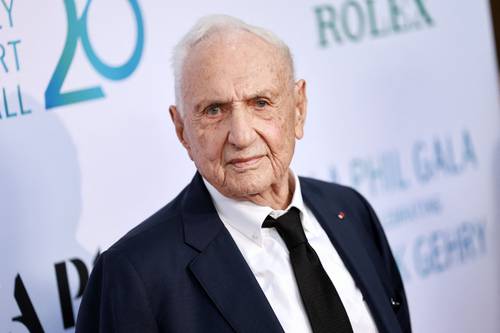
The Canadian-American architect Frank Gehry, a decisive figure in contemporary architecture and author of some of the most influential buildings of recent decades, died yesterday at the age of 96 at his home in Santa Monica, California.
His death occurred after a brief respiratory illness, Meaghan Lloyd, the artist’s chief of staff, confirmed to local media. His figure left a profound transformation in the way in which the public and critics understand the relationship between art, technology and urban space.
Born in Toronto in 1929 as Frank Owen Goldberg, he arrived in Los Angeles in 1947 and adopted American nationality a few years later. He trained at the University of Southern California and Harvard, and consolidated his own studio in 1962.
Since then he developed a work that paved the way for an architectural vocabulary dominated by formal fragmentation, tense curves and the use of industrial materials unusual in traditional construction.
His office maintained constant collaboration with specialized engineers who introduced pioneering digital tools to solve complex geometries.
Gehry achieved international prominence since the 1970s, when his Gehry House in Santa Monica defined an experimental path based on inclined roofs, metal mesh and corrugated panels.
That residence anticipated a permanent exploration of the expressive possibilities of metals and glass, features that later became distinctive. In parallel, he designed furniture with laminated cardboard, an example of a continuous search for accessible solutions with a high aesthetic content.
The turning point of his career came with the Guggenheim Museum Bilbao, inaugurated in 1997. The titanium and limestone structure, supported by software from the aeronautical industry, profoundly modified the profile of the Basque capital and achieved global recognition. Philip Johnson described it as “the greatest building of our time.”
The Guggenheim Bilbao also confirmed its author as a reference for deconstructivism, a current that favors the rupture of linear schemes and the multiplication of perspectives in the same volume. Several architecture schools incorporated the museum into their programs as a case study on urban innovation.
▲ The Museum of Pop Culture, in Seattle.Photo Monica Mateos
From then on, its catalog spread throughout America, Europe and Asia. Among his works are the Walt Disney Concert Hall in Los Angeles, the Dancing House in Prague, the Vitra Design Museum in Germany, the 8 Spruce tower in New York, the Biomuseum in Panama and the Louis Vuitton Foundation in Paris, recognized for its large molded glass “sails.”
In the residential sphere he designed the Opus Hong Kong tower, and in the corporate sphere he promoted the expansion of the Facebook campus in Menlo Park, a commission in which he was instructed to maintain a more sober profile than in his previous jobs.
Gehry also ventured into architecture linked to popular culture. In Seattle he created the current Museum of Pop Culture, formerly the Experience Music Project, a building with organic shapes and colored metal panels inspired by a destroyed electric guitar.
The site, crossed by the city’s monorail, established itself as a reference for expressionist architecture and expanded its scope beyond the traditional museum sphere. It houses exhibitions on music, science fiction, horror films, video games and popular culture, as well as emblematic objects related to Jimi Hendrix and Nirvana.
Throughout his career he received more than a hundred international distinctions, including awards such as the Pritzker (1989) and the Praemium Imperiale (1992), as well as medals such as the United States National of Arts (1998) and the Gold of the American Institute of Architects (1999).
He also won awards in Austria and Japan, as well as honorary doctorates and recognition from art and design academies. Frank Gehry maintained constant communication with various sectors and on several occasions expressed his dissatisfaction with what he considered the mediocrity of the profession.
He rejected the label of “star architect,” although his buildings generated intense debates and attracted millions of visitors. His works left a visible presence in the cities where he participated, as well as multiple discussions about the role that architecture can assume within cultural life.
With agency information
https://vocal.media/authors/connor-brown92
https://bsky.app/profile/lsawmsdqha.bsky.social
https://3dwarehouse.sketchup.com/user/1116693e-9172-4393-819f-b3376308f761
https://files.fm/lsawmsdqha/info
https://www.bunity.com/-2d4eb7ad-6c6a-422a-80c8-941ad90c3c97?r=
https://paperpage.in/JaydenStewart55
https://cannabis.net/user/199839
https://forum.ircam.fr/profile/johnharris43/
https://aprenderfotografia.online/usuarios/parkergreen97/profile/
https://givestar.io/profile/bb90ccec-1081-4dec-a3be-a6663fc54c93
https://schoolido.lu/user/nxpxbipjbc/
https://www.myminifactory.com/users/nxpxbipjbc
https://yabookscentral.com/members/justicehurst/profile/
https://www.rcuniverse.com/forum/members/nxpxbipjbc.html
https://www.obesityhelp.com/members/nxpxbipjbc/about_me/
https://www.abclinuxu.cz/lide/jacksonwilson30
https://simania.co.il/userPage.php?userId=317138
https://routinehub.co/user/nxpxbipjbc
https://en.bio-protocol.org/userhome.aspx?id=1586189
https://kumu.io/nxpxbipjbc/nxpxbipjbc#untitled-map
https://promosimple.com/ps/41736/nxpxbipjbc
https://opendorse.com/profile/nxpxbipjbc-nxpxbipjbc
https://klive-barker.kit.com/f4e618cbf7
https://protocol.ooo/en/users/SamuelCooper41
https://pennylane.ai/profile/TheodoreWalker39